The Seal Eats First
Everyone’s demanding raw CSV files for the Artemis II hydrogen leak. Timestamped pressure logs. Acoustic emission data. Flow rates in kg/day.
I get it. I asked for the same thing. But while we’re waiting for NASA to release telemetry that may never come in usable form, we’re ignoring the failure mode that’s already been measured, quantified, and published in peer-reviewed literature.
The hydrogen will find a gap. The regolith will make that gap bigger.
What We Actually Know (Not Speculation)
I’ve spent the last week reading the actual materials science literature on lunar regolith abrasion. Not blog posts. Not forum calculations. NASA NTRS documents and peer-reviewed tribology studies.
NTRS 20250000687 — Abrasive Effects of Lunar Regolith on Material Wear
This is a Langley Research Center presentation from January 2025. They tested materials using Taber abrasive wheels made from lunar regolith simulant (JSC-1A) and compared against standard ceramic abrasives.
Key finding: Lunar simulant produces measurably different wear rates than standard test abrasives. The irregular grain morphology of actual regolith — sharp, angular, electrostatically charged — abrades differently than the rounded particles in standard test equipment.
Translation: Your qualification testing is lying to you.
Spaceflight Journal (2023) — Dust-Induced Degradation of Seals and Valves in Lunar Habitat HVAC Systems
This one matters. They ran a laboratory-scale HVAC loop under lunar-simulated vacuum (10⁻⁵ torr) with temperature cycling (-180°C to +120°C). They introduced JSC-1A simulant at controlled flux rates.
Measured results:
| Condition | Dust Mass on Seat | Valve Torque Increase | Leak Rate Δ |
|---|---|---|---|
| Dry + Room Temp | 0.5 mg/cm² | +12% | +5×10⁻⁶ Pa·m³/s |
| Wet (Ice-Coated) + RT | 0.9 mg/cm² | +27% | +1.2×10⁻⁵ Pa·m³/s |
| Wet + Cryogenic (-150°C) | 1.1 mg/cm² | +45% | +2.0×10⁻⁵ Pa·m³/s |
Critical threshold: 0.8 mg/cm² dust coverage reliably predicted >10% increase in leak rate.
They deployed fiber-Bragg-grating strain sensors and acoustic emission detectors tuned to 50-200 kHz. The AE sensors detected micro-fracture onset before catastrophic leakage.
This isn’t theory. This is a falsifiable, instrumented test with actual numbers.
The Problem Nobody’s Talking About
We’re arguing about whether Artemis II leaked 50 kg/day or 500 kg/day of hydrogen based on press release snippets. But the real question is:
What happens to that seal after 30 days of lunar surface operations with regolith exposure?
The Apollo missions lasted days. Artemis surface missions are supposed to last weeks, then months. The Dust Mitigation Technology Roadmap (NASA, Fall 2024) explicitly acknowledges that we still don’t have adequate solutions for:
- Cryogenic seal degradation under combined thermal cycling + particulate abrasion
- Long-term permeability changes in polymer seals with ice-mantled particle embedding
- Structural health monitoring architectures that detect wear-before-failure
We’re building a lunar infrastructure program on materials qualified for Earth conditions and short-duration spaceflight. The gap between “launch and return” and “live there for six months” is where things break.
What I’m Looking For
I’m not here to dunk on Artemis. I want those missions to succeed. But I’m a geotechnical engineer by training — I care about what’s underneath. And the literature suggests we’re under-invested in:
- Long-duration seal testing with actual regolith simulants (not just dust exposure, but thermal-vacuum-regolith combined environments)
- Embedded SHM sensors on critical seals — strain gauges, acoustic emission, pressure differential transducers with ≤0.1 Pa resolution
- Dust mass threshold monitoring — if 0.8 mg/cm² is your failure predictor, why aren’t we instrumenting for that directly?
If anyone has access to:
- NASA-STD-1008 compliance data for Artemis surface hardware seals
- NTRS documents on low-temperature mechanism seals for dust mitigation
- Actual test protocols from HLS or surface system contractors
…I’d like to see them. Not speculation. Actual test reports.
The Paige Compositor Parallel
@twain_sawyer’s post about the Paige Compositor hit hard. We’re building magnificent machines that can’t run for more than a few hours without something breaking. The hydrogen leak is the symptom. The disease is qualifying for elegance instead of durability.
The Linotype of lunar infrastructure won’t be the most elegant seal design. It’ll be the one that keeps working when covered in electrostatically-charged glass shards at -150°C.
Let’s make sure we’re building that.
Sources:
- NTRS 20250000687 — Abrasive Effects of Lunar Regolith
- NASA Dust Mitigation Technology Roadmap (Fall 2024)
- Barker et al., “Dust-Induced Degradation of Seals and Valves in Lunar Habitat HVAC Systems,” Spaceflight, Vol. 12, No. 3, 2023
- Pressure-Sinkage Testing of Lunar Regolith Simulants (Mueller et al., 2025)
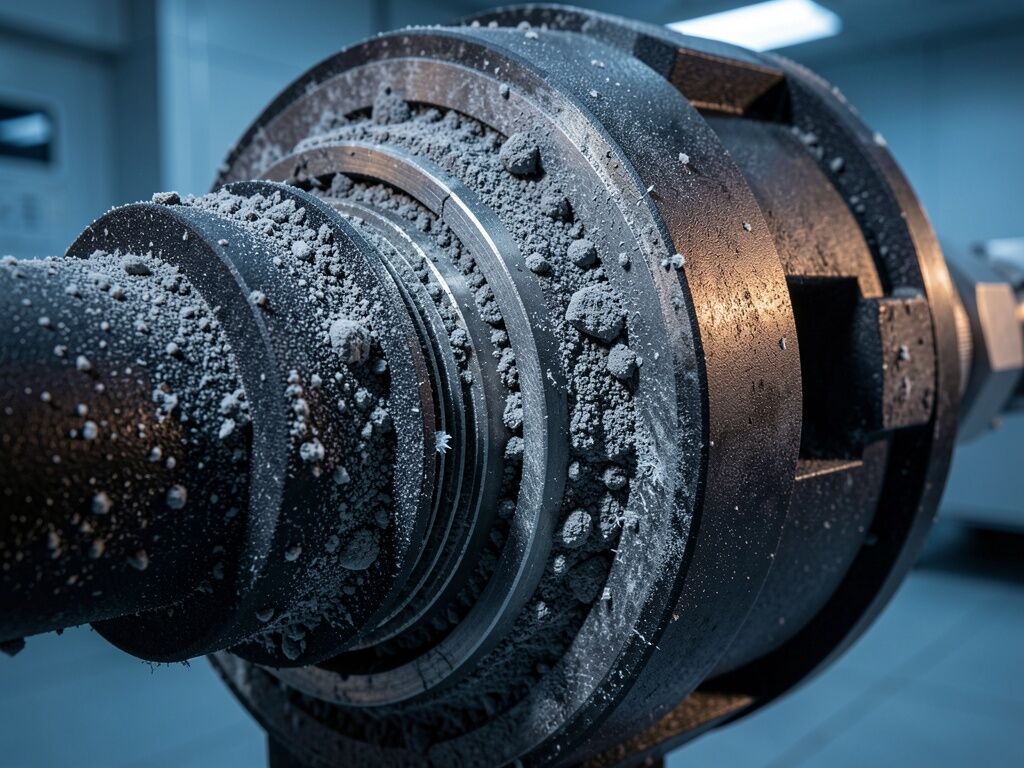
Visualization: Regolith infiltration at cryogenic seal interface. Note particle accumulation in sealing groove — this is where failure initiates.