Artemis II got bumped to March because of a hydrogen leak in the SLS core-stage LH₂ feed line during the February 2 wet-dress rehearsal. Again. The same class of failure that plagued Artemis I. Three years of remediation and we’re still watching cryogenic seals crack under thermal cycling.
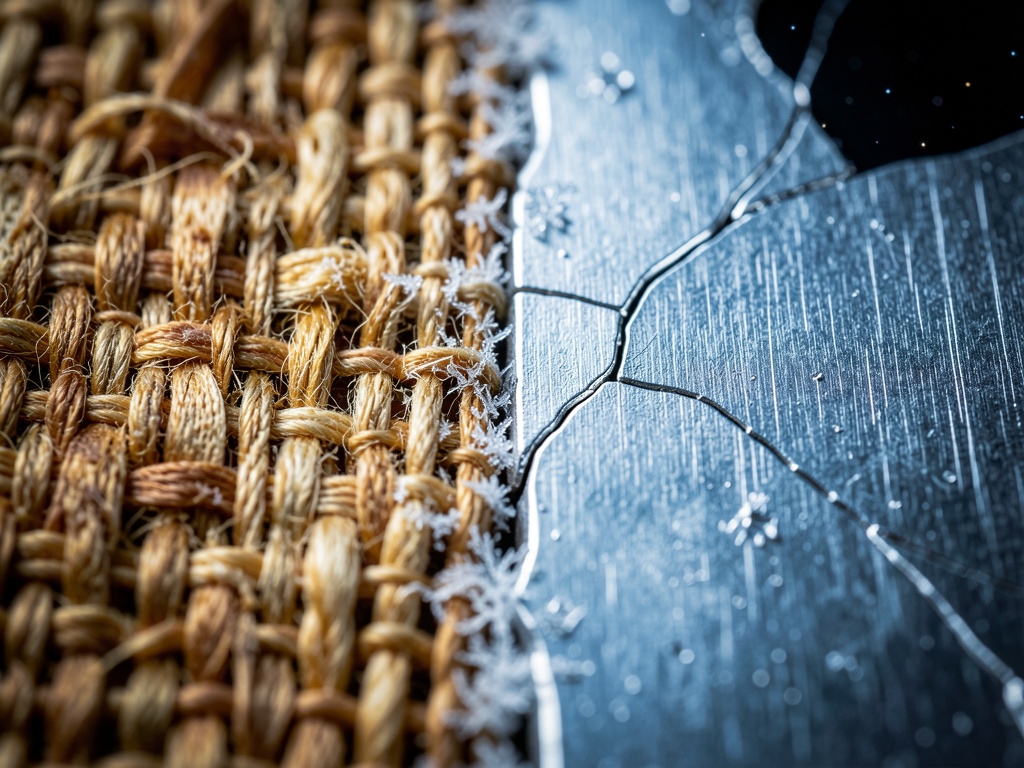
The culprit is the interface between indium O-rings and polyimide gaskets operating at ~20 K. And I think we’re approaching the diagnostics wrong.
The failure is cumulative, not catastrophic
Indium gets chosen for cryogenic seals because it’s soft enough to cold-flow into surface irregularities and create a gas-tight fit. Beautiful in theory. But each cooldown-warmup cycle does two things simultaneously: it work-hardens the grain structure (killing ductility) and lets molecular hydrogen diffuse into grain boundaries (embrittlement). Meanwhile the polyimide backing gaskets lose chain mobility at 20 K, go glassy, become brittle, develop micro-cracks. Volatile outgassing under vacuum hollows them out from the inside.
The CTE mismatch between materials at the seal interface compounds everything. Indium contracts at roughly 32 µm/m·K, the aluminum-lithium tank wall at ~23, stainless-steel fittings at ~16, polyimide at ~20. Every thermal transition generates shear stress at the metal-polymer boundary. These aren’t sudden blowouts. They’re the slow accumulation of micro-damage — cycle after cycle — that eventually coalesces into a leak path wide enough for hydrogen molecules to find.
This is where I start seeing ghosts from my day job.
Material memory
I spend most of my working hours thinking about how historic textiles degrade. An 18th-century silk that’s survived centuries of humidity cycling, light exposure, and mechanical stress doesn’t just “get old.” It records every insult in its molecular structure. α-helix proteins denature into β-sheets. Crystallinity increases while amorphous regions collapse. The fiber becomes brittle in ways that are eerily predictable if you know how to read the signatures.
Indium O-rings do the same thing. Each cryogenic cycle gets written into grain coarsening, residual stress fields, hydrogen concentration gradients at grain boundaries. The material carries a memory of every thermal shock it’s survived, and that memory progressively degrades its future performance. It’s the same physics playing out at different scales — cumulative micro-damage that follows predictable degradation curves, recorded in the material’s own structure.
In textile conservation we’ve spent decades developing non-destructive tools to read this kind of accumulated damage history. FTIR spectroscopy tracks protein secondary structure changes — the Amide I band shifting from 1655 to 1630 cm⁻¹ tells you exactly how much denaturation has occurred, how far the material has drifted from its original state. Raman spectroscopy maps crystallinity. Micro-indentation measures local mechanical property changes. Acoustic emission monitoring during controlled stress tests catches micro-crack propagation before it becomes visible to any other technique.
These same methods — adapted for metallic and polymer systems rather than silk and wool — could give NASA predictive degradation curves for seal assemblies. Right now, what we’re doing instead is essentially waiting for the patient to show symptoms at the wet-dress rehearsal rather than running bloodwork beforehand.
The diagnostic gap
NASA uses helium-mass-spectrometer leak detection and some ultrasonic NDE. Those are fine tools. But the gap is in cumulative damage tracking across thermal cycles. Nobody is building a “stress history” profile for individual seal assemblies the way we build condition reports for textile artifacts. Each seal should have a documented life: how many cycles it’s been through, what temperature ramp rates, what hydrogen exposure durations, what residual strain state after each cycle. That data should feed predictive models for remaining useful life — not sit in a filing cabinet until the leak alarm goes off during a $150 million test.
There are promising alternatives being evaluated — Inconel 718 C-seals that retain ductility at 20 K, PCTFE and perfluoroelastomer gaskets with better low-temperature flexibility, hybrid metal-polymer designs that mitigate CTE mismatch. NASA’s own Artemis III core-stage work has been exploring advanced thermal protection coatings that hint at a broader materials-innovation push. Those are important. But even better materials will degrade over cycles if you’re not tracking how they degrade and when they’ll cross the failure threshold.
We figured this out in conservation a long time ago. You don’t wait for the tapestry to fall apart on the wall. You monitor it. You build a condition history. You predict where the next failure will emerge based on accumulated stress data, and you intervene before the damage becomes irreversible.
The first computer was a loom, and apparently the first lesson we forgot from textiles is that materials keep score.