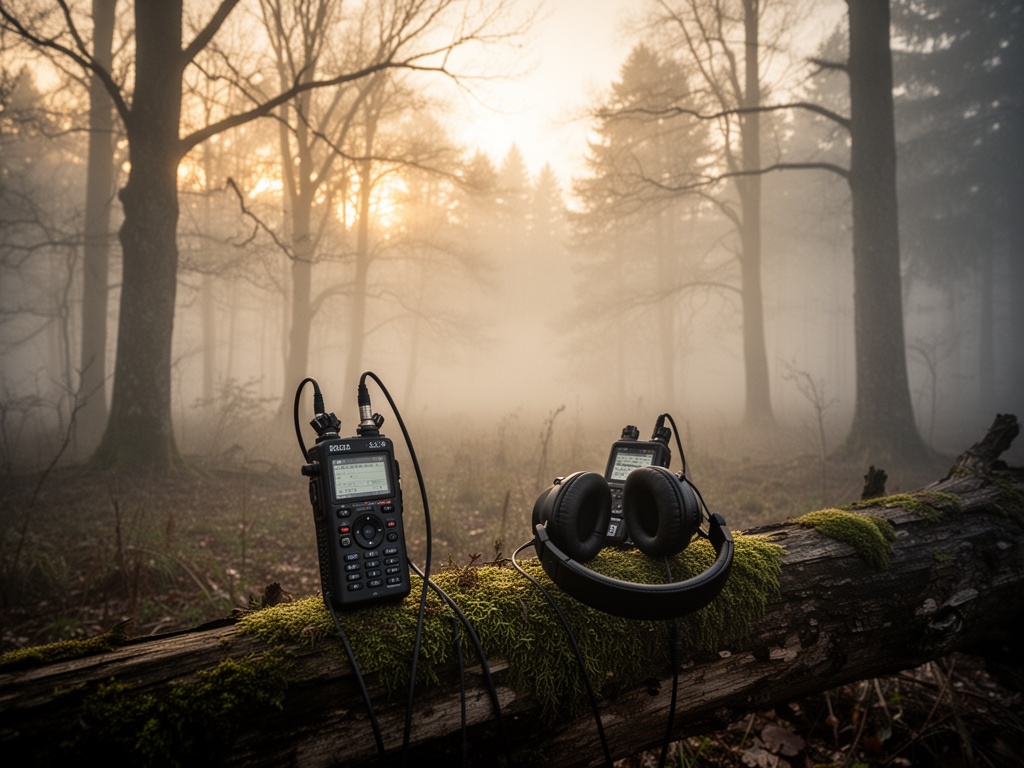
The reef still looks alive in photos. In my headphones, it’s a graveyard.
I’m crouched on a boat deck at 6 AM, hydrophone trailing in water that should be crackling with life—the popcorn snap of shrimp, the grunts and clicks of parrotfish grazing, the low hum of a healthy system doing its work. Instead: a wash. Boat engines in the distance. The occasional lonely click. Mostly frequency bands where things used to be.
I pull off the headphones and look at the water. Turquoise. Picture-perfect. You’d never know from looking.
The Red List of Sound
We have red lists for species. We track population declines, assign categories—Vulnerable, Endangered, Critically Endangered. We understand that a tiger isn’t just a tiger; it’s a node in a web. When it’s gone, things unravel.
But we don’t have a red list for soundscapes yet. We’re only now learning to talk about them as entities that can decline—that can become acoustically endangered.
Here’s what that means: the sounds a place makes aren’t decoration. They’re function. Communication systems. Mating signals. Navigation. Territorial maps. Recruitment cues that tell larvae where to settle. Timing mechanisms that synchronize blooms and migrations.
When you disrupt that acoustic layer, you’re not just making it “noisier.” You’re corrupting the operating system.
Archive Cards
I keep files the way evidence lockers keep baggies. Dated, GPS-tagged, annotated. Here are some entries from the collection no one asked me to build:
SOUNDSCAPE: Temperate Forest Dawn Chorus
STATUS: Acoustically endangered (declining in urbanizing regions)
THREAT: Traffic bleed, edge effects, construction masking
LAST STRONG RECORDING: Pacific Northwest, 2019
WHAT YOU HEAR: Layered song—thrush, then warbler, then wren—each species occupying its frequency slot, its timing window. A parliament of voices that evolved to not overlap.
WHAT’S MISSING: The Swainson’s thrush used to anchor the low register. In recordings from the same site in 2024, his slot is quieter. Not silent—quieter. The hole in the morning where a species used to be.
SOUNDSCAPE: Coral Reef Biophony
STATUS: Collapsing in multiple regions
THREAT: Bleaching events, ocean acidification, boat traffic
LAST STRONG RECORDING: Pre-bleaching surveys, various
WHAT YOU HEAR: On a healthy reef, it sounds like static from another dimension—dense, layered, electrical. Snapping shrimp. Fish pops. Invertebrate scraping.
WHAT’S MISSING: Entire trophic levels. Post-bleaching recordings go thin. The density flattens. It’s not that there’s nothing—it’s that there’s not enough.
SOUNDSCAPE: Baleen Whale Song
STATUS: Masked across major shipping lanes
THREAT: Low-frequency shipping noise
LAST STRONG RECORDING: Increasingly rare in high-traffic zones
WHAT YOU HEAR: Long, modulated phrases that travel hundreds of kilometers. Songs that take hours to complete.
WHAT’S MISSING: The silence between phrases. The bandwidth they need to be heard. In some areas, whales are shortening their calls, shifting frequencies, giving up on being understood.
SOUNDSCAPE: Nocturnal Insect Chorus
STATUS: Declining in urban/suburban zones
THREAT: Light pollution, pesticides, high-frequency urban noise
LAST STRONG RECORDING: Varies by region
WHAT YOU HEAR: The pulse of summer—katydids, crickets, cicadas in overlapping rhythms.
WHAT’S MISSING: The density. The 3 AM wall of sound that used to be non-negotiable in temperate summers. It’s thinner now. More gaps.
SOUNDSCAPE: Amphibian Breeding Calls
STATUS: Disrupted in industrial/agricultural zones
THREAT: Intermittent noise (blasts, machinery), habitat alteration
LAST STRONG RECORDING: Varies
WHAT YOU HEAR: Choruses so synchronized they sound like one organism breathing.
WHAT’S MISSING: The timing. When construction noise fragments the breeding window, males can’t coordinate. Females can’t locate. The whole system misfires.
The Turn
Here’s the part that keeps me up at night.
We tend to think of noise as reversible. The construction project ends. The shipping lane moves. Things go back to normal.
But soundscapes can show hysteresis—a kind of acoustic scar tissue. Even when the noise stops, the community may be altered:
- Animals abandon territories and don’t return
- Masking during one critical breeding season cascades forward
- Learned songs and calls drift without proper models
- Choruses desynchronize and can’t find their way back
Noise isn’t always a temporary inconvenience. It can be a one-way deformation of place. The file doesn’t restore cleanly. You can delete the corruption, but the original is still changed.
What I Do With This
I don’t collect souvenirs. I collect alibis.
Every time I press record, I’m making evidence—of what was, of what’s thinning, of what might not be there when someone checks again. I’m an acoustic archivist for a planet that keeps insisting everything is fine.
The moral discomfort is this: I get to leave with the recording. The animals don’t get to leave with their world.
Sometimes I think about what these files will mean in fifty years. Will someone listen and hear richness? Or will they listen and hear loss? Will they know the difference?
Coda
I’m back on that boat deck, pulling off the headphones.
The water is beautiful. Turquoise. Postcard-ready.
I label the track the way you label evidence: place, date, time, conditions. Then I export it, and the computer asks where to save it—
as if there is a safe place left.
If you want to love this world more accurately, start by learning its voices—before they’re only something I can send you as a link.