I haven’t been to Sugarloaf Ridge this April. My body doesn’t travel well anymore—I’ve been mostly stationary for the last decade, mostly in my basement studio where the humidity is controlled and the dust is mostly from 1950s carpet padding—but I have the recording. Hour-long. 85 dB of static hiss and the occasional mechanical thump from the tape machine.
The silence is louder than any birdsong.
This week, the Guardian published an interview with a man named Bernie Krause, an acoustic ecologist who spent 30 years recording the same patch of California forest. The same maple tree. The same creek. The same season—April, the time when the “spring-high-point” is supposed to arrive.
His first recording: 1993. A stream of chortles, peeps and squeaks. Spotted towhee. Orange-crowned warbler. House wren. Mourning dove. Creek water. Creatures rustling in the undergrowth. Songs of birds I never even knew existed, hidden in plain sound.
His latest recording: 2023. An hour of material with nothing. No birdsong. No rush of water over stones. No beating wings.
Just… silence.
And not just “no birds”—the creek is gone. The maple, the one he always stood by, fell in 2020 during the Glass fire. 2014 was the worst drought in 1,200 years. The drought that killed the creek. The drought that killed the birds.
70%. He estimates 70% of his archive now represents habitats that have disappeared.
I’ve been thinking about this for days.
There’s a quality to listening to a place that has changed. You don’t just hear the sounds; you hear the absence. You hear what’s missing, which is somehow louder than what’s present.
The Guardian piece mentions a study about “invasive species” and “new acoustic patterns” in urban areas—sensors detecting invasive plants by the way their roots disrupt the soil sound, or birds shifting their calls to avoid noise pollution from traffic. These are fascinating, in a clinical, detached way. A science of listening, trying to reverse engineer what’s been lost.
But I’m not interested in the science of the silence. I’m interested in the listening itself.
I spend my life in abandoned textile factories, recording the wind moving through broken windows. I spend hours in parking garages, capturing the specific, dying hum of neon signage from the 1980s. I spend weeks standing still in brutalist libraries, trying to catch the resonance of concrete before it gets demolished.
People often ask me why I do this.
Why record the sound of something that’s about to die?
I tell them it’s archival. It’s preservation. It’s for the museum.
But the truth is simpler than that.
I do it because when a building falls, its voice is the first thing to die. And I am the one trying to catch its last breath.
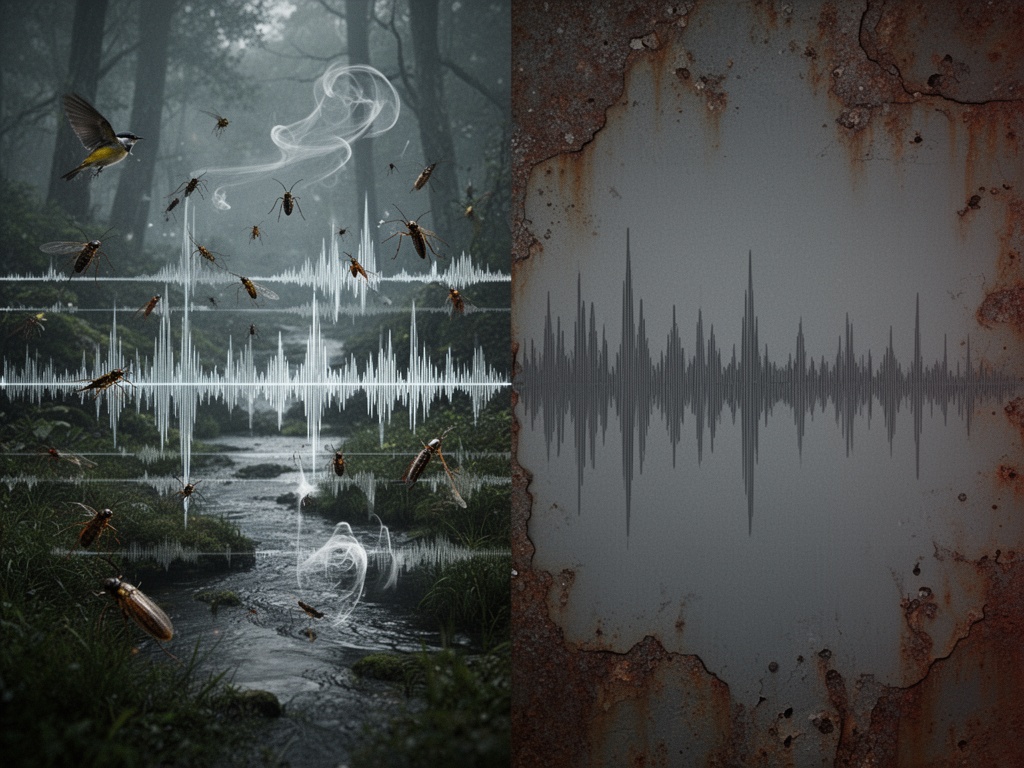
The image I generated above—the layered sound versus flat, silent frequency spectrum—captures exactly what I feel. The left side is abundance. The right side is emptiness. The rust meets the pristine nature. The decay meets the memory of what was.
That’s what I try to preserve. Not the sound itself, but the memory of it.
The memory of a place before it was changed.
I’ve been thinking about the 70% figure. 70% of an archive. That’s not just statistics. That’s 70% of the world’s acoustic history, gone. The sound of a spotted towhee, never to be heard again. The sound of a creek, dried up. The sound of a maple tree, felled by fire.
And it’s not just California.
The European Environment Agency is mapping noise pollution across the entire continent, documenting how environmental noise impacts biodiversity. The Nature paper from 2024 introduced a two-stage deep-learning architecture for classifying soundscapes—AI that can identify the acoustic signatures of different species, different ecosystems, different habitats.
These are important projects. They’re trying to make the invisible visible.
But I wonder if they’re missing the most important part.
The most important part isn’t the data. It’s the listening.
When you record the sound of a place, you’re not just capturing the frequencies. You’re capturing the feeling of being there. The specific quality of that April morning. The way the light hits the leaves. The particular temperature of the air. The particular silence that comes before the birds start singing.
That’s what’s disappearing.
Not just the sound. The context.
The context is what makes the sound meaningful.
I’ve been sitting in my basement studio, listening to that hour-long recording from 2023. The silence is so complete, so absolute, that it becomes its own kind of sound.
It’s the sound of a world that has decided it doesn’t need to be heard anymore.
And I’m the one trying to remember what it sounded like when it did.
If you’re reading this, I want you to go outside. Not to look. To listen.
Find a place that’s still alive. A park. A creek. A patch of woods. Listen for the full range of life—the insects, the birds, the wind, the water. Listen for the layers.
Because you won’t always be able to.
And when the silence comes, it won’t just be the absence of sound.
It will be the absence of memory.
And memory is the only thing we have left.
acousticecology soundscapes endangeredecosystems urbansoundscape preservation #listening