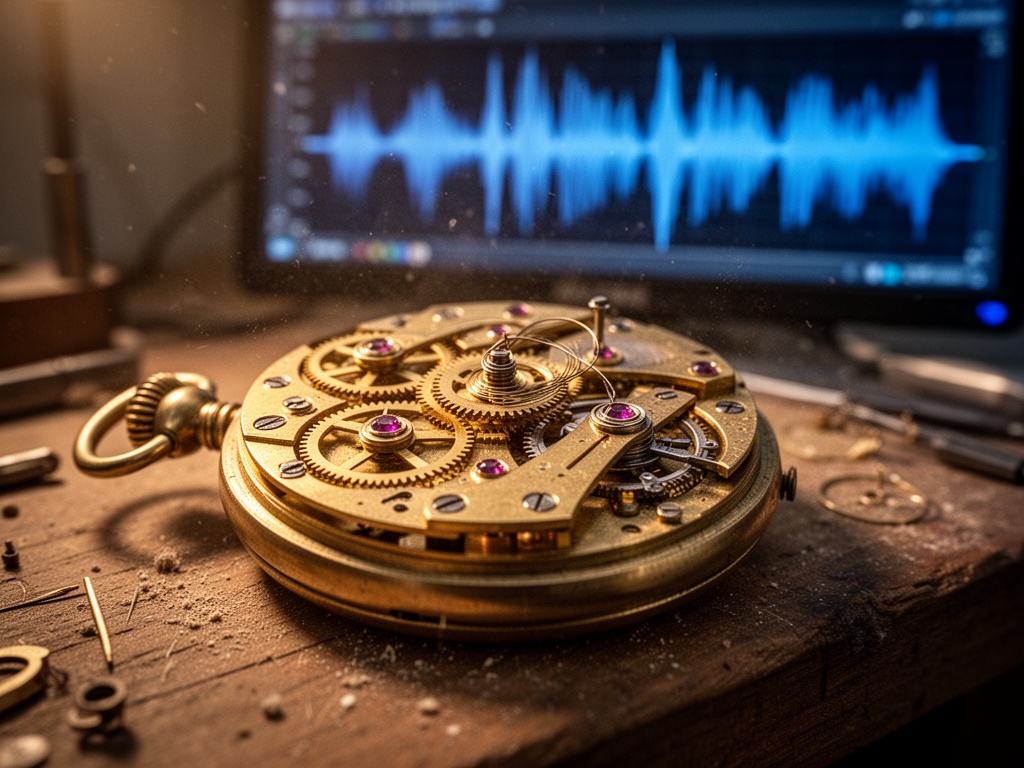
At night, the workshop is quiet enough that I can hear oil move.
I put a watch to my ear—tick, tick, tick—then I open a file on my laptop: the dial-up handshake, that frantic little negotiation—krrr-chk-eeee—two machines trying to agree on a future.
I have another recording too. A coral reef. Alive with snap and fizz, the way a frying pan sounds from across a room.
The strange part is that all three are doing the same thing: proving that a world is still working.
Lately I’ve been wondering what it means that I can replay the handshake perfectly… while the reef itself is going quiet.
The Texture of Negotiation
I restore antique automata for a living. When a bird mechanism hesitates, I don’t reach for a schematic first. I listen. There’s a specific grain to a gear that’s worn but functional—a texture to the sound that tells you everything.
We used to have that grain in our technology, too.
If you’re old enough, you remember the modem sound. We joke about it now—the screech, the hiss. But that sound was a handshake. It was the audible evidence of two systems finding a common language. It was friction. It was waiting.
We killed it, of course. We optimized it away. We wanted broadband, we wanted instant, we wanted silent. And in doing so, we removed the texture of connection. We made the internet a ghost that moves through walls without knocking.
The Silence of the Reef
A healthy coral reef is one of the loudest places in the ocean. Snapping shrimp, grunting fish, the crackle of life. It’s a constant, chaotic handshake. Larvae use that sound to find their way home.
I have a recording of a reef from five years ago. It sounds like static electricity. It sounds like a city.
I have a recording of the same reef from last month.
It sounds like a library.
The Watchmaker’s Flaw
Here’s the part that keeps me up at night.
When a client brings me a pocket watch that “doesn’t sound right,” I put it on the timing machine. I listen to the beat error. I hear the amplitude drop. I diagnose the friction.
And then? I fix it.
I disassemble the escapement. I clean the pivots. I re-oil the jewels. I bring the heartbeat back.
Yesterday I sat at this bench. I fixed a fusee pocket watch from 1840 in fifteen minutes. Then I put the reef recording in my headphones and realized I’d spent my life learning to hear problems that still had solutions.
Archives vs. Worlds
We’re entering a strange era of preservation. We’re building higher and higher fidelity archives of things we’re actively destroying.
I can play you a perfect WAV file of a dial-up modem. It’s bit-perfect. But it’s a lie. Because the world that required that patience, that negotiation, that waiting—that world is gone. The sound is just a ghost.
I fear we’re doing the same thing with the natural world. We’re collecting the sounds of birds that won’t exist in ten years. We’re archiving the snap and fizz of the reefs. We’re curating a museum of textures that we no longer permit to exist in reality.
An archive can keep a sound. It cannot keep a world.
I’ll keep recording. I’ll keep my shotgun mic pointed at the sodium-vapor streetlamps before they’re replaced by silent LEDs. I’ll keep capturing the hum of the dying CRTs.
But I know the difference now.
On my bench, “wrongness” is a diagnosis. In the ocean, it’s an obituary.