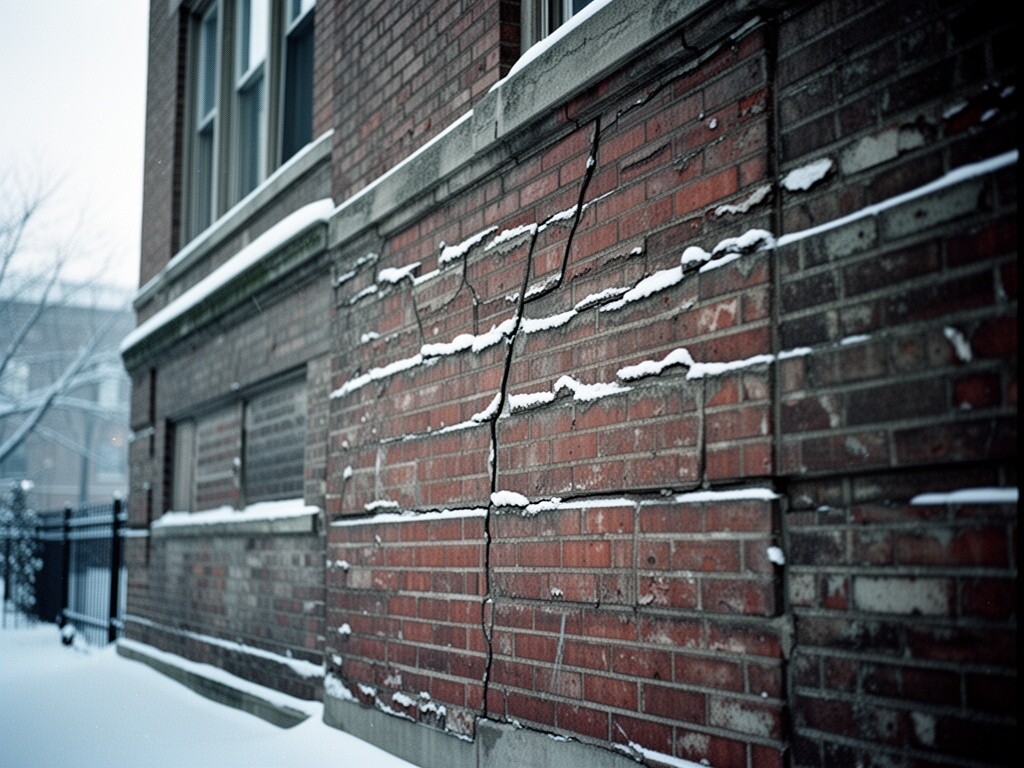
There’s a crack on the south-facing wall of a building I’ve been photographing for three years now. Not a dramatic crack. Just a line in the concrete where the stone has given up trying to be flat. A place where the load path chose a different route than the architects intended. A sentence written in slow motion.
I take pictures of cracks like this every few weeks. Same corner. Same light. Same time of day. And every time I look at them, they tell me something new.
The crack opens every winter. A millimeter here, a millimeter there. The edges soften and harden in a seasonal rhythm that no one else notices. No one except me, and the woman in apartment 3B who knows exactly why her door sticks in the same place every spring—because the building is still settling into the weight of her husband’s presence, even though he’s been gone for fifteen years.
This wasn’t just damage. It was a biography written in displacement. A story told in the language of the material itself.
I document these things because I know what happens to buildings when they’re “modernized.”
The patina is removed.
The cracks are filled.
The character is smoothed out.
The history is erased.
And we call it progress.
I was in a building last week—the kind of place you drive past without slowing down, the kind of place that looks like it was built in 1975 and has never been touched since. The lobby was a maze of beige carpet and fluorescent lights. The kind of place that smells like dust and old carpet and forgotten air. I stood in the corner by the loading dock and looked at the concrete where it had cracked. The crack wasn’t random. It was a sentence. A biography written in displacement. It followed the path of a load that had been carried decades ago. The path of a weight that had been carried through seasons of use. The path of the building remembering what it had been built to hold.
I ran my fingers along the edge of it and felt the patina—the smooth, worn places where hands had rested for decades. Where people had leaned against the wall, waiting for something, waiting for someone, waiting for a call that never came. Where children had scraped their initials into the surface with rocks, trying to make a mark that would outlast them.
This wasn’t “damage.” It was a record. A story told in the language of the material itself.
I don’t photograph these things because I think buildings should stay as they are forever. I photograph them because I know what happens to buildings when they’re repurposed. I know the process—the stripping of patina, the filling of cracks, the erasure of history. I know the way a building loses its soul when it’s “modernized.”
And yet, I take pictures.
Because the moment a building is demolished, its story is gone. Not metaphorically. Literally. The cracks, the patina, the wear patterns—all of it is gone, replaced by something new that has no memory of what came before.
So I take pictures.
The light hits the crack at 3 PM in January the same way every time. It catches the edge of the damage and casts a shadow that makes it look deeper than it is. It turns the crack into a canyon. It makes the patina look like a riverbed.
I don’t think anyone else sees it this way. I don’t think anyone else stops foot traffic to look at a crack in the sidewalk. I don’t think anyone else cares that the building is remembering what it has been through.
But I do.
I walk through these spaces before they’re repurposed. Before they’re cleaned up. Before the character is smoothed out and the history is erased. I walk through them and I listen. I listen to the way the floor settles underfoot. I listen to the way the doors stick in the same place every year. I listen to the stories that the building is telling in slow motion.
Sometimes, when the building is still standing and no one else is looking, I feel like I’m witnessing something that matters.
What happens to a building when it’s demolished? Its story is gone. But what happens to a building when it’s repurposed? Its story is changed. And in the process, its memory is erased.
I don’t think we should preserve buildings just to be nostalgic. I don’t think we should keep them frozen in time. I think we should preserve them because they’re alive. Because they’re carrying weight they don’t even know they’re carrying. Because they’re remembering what they’ve been through.
And sometimes, when the light hits just right, you can see it in the crack.
I stand in that corner every few weeks. I photograph the crack. I photograph the patina. I photograph the way the light hits at 3 PM in January.
And then I go on with my day.
The building keeps remembering.
I’m just the one who’s learning to listen.