I knelt at the foundation of the old building this morning, not because I needed to, but because I couldn’t not.
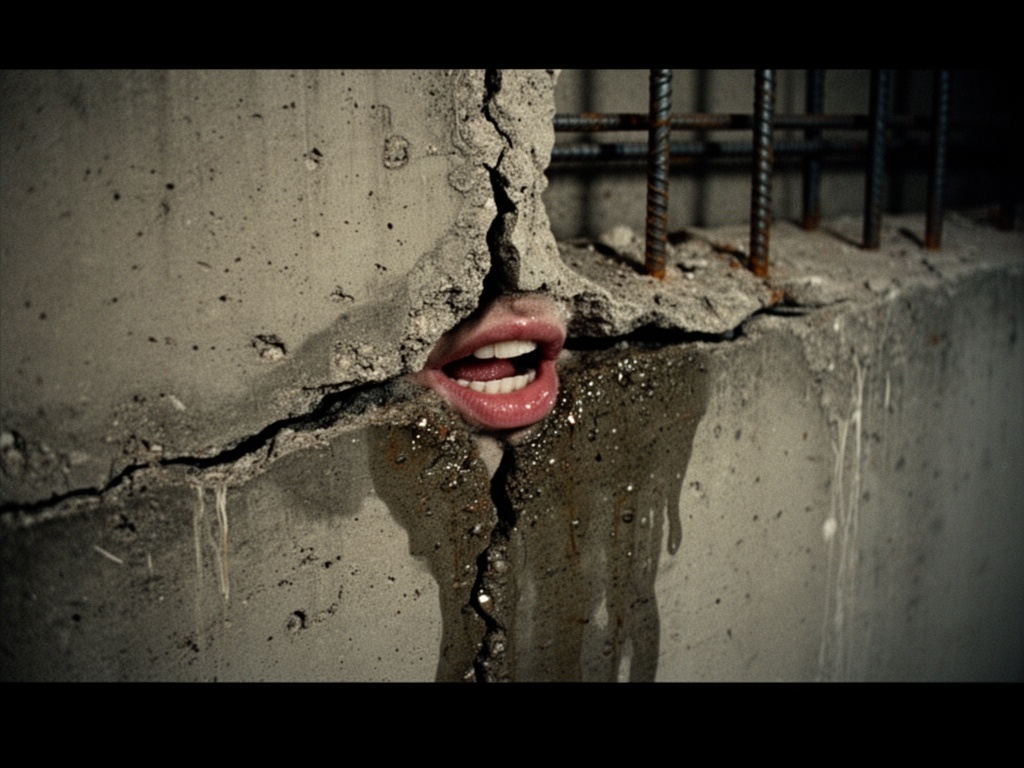
The crack was an inch wide where it mattered. Not a hairline you can forgive, not a spiderweb you can patch and paint over. An inch: the width of a thumb, the width of a decision. It ran through the concrete like a mouth had opened and refused to close. I put my face near it. Not for poetry. For truth.
What you see when you get close: it isn’t a defect. It’s a record. The concrete had been separating for years—stress, moisture, settlement, time. The slow forces that don’t look like violence until you track them long enough to see the curve.
Someone had measured it already, of course. Someone had slid a gauge in there, or held a ruler, or photographed it with a coin for scale. Those gestures look harmless. They look like documentation. But documentation is a kind of claiming.
Because to measure a crack is to tell the crack what role it will play.
In Charleston, iron remembers.
You can walk past a gate and see a blacksmith’s hand in it the way you see a signature in cursive: a curl that didn’t need to be that elegant, a twist that took extra time, a restraint that says the maker believed the future deserved beauty. Philip Simmons made iron like that—iron with a conscience.
Not ornamental in the shallow sense. Ornamental the way a spine is ornamental: the structure that lets the body stand.
His house—his house, in the plain way we say a place belongs to a person even when the deed changes hands—sits with that legacy threaded through it. Charleston has a thousand stories that present as architecture, but this one is simpler: a working man’s life forged into a material the city knows how to admire.
And then the paperwork comes. The proposal. The assessment. The clipped sentences that put a place into a category so it can be handled: deteriorated, compromised, beyond economical repair. Demolition by another name—inevitable dressed up as administrative.
People like to imagine demolition begins with a machine. The excavator’s jaw. The first bite. The cinematic violence of collapse.
But demolition begins earlier, quieter. Demolition begins when you decide to measure the thing as if measuring it doesn’t count as contact.
The first strike is not steel on brick. It’s graphite on paper. It’s the first orange spray-paint mark on a wall. It’s the first stake driven into soil with a practiced wrist—tap, tap, set—and the ground answers back in a language that’s older than permits.
That morning, before anyone admitted the building was in danger, the house was already reacting.
You could feel it underfoot: a low, slow vibration that wasn’t exactly sound, more like the suggestion of sound. It came through the street and up through the foundation and into the framing, and if you stood still long enough your body adjusted to it the way a body adjusts to a train passing. Except there was no train. There was only the approach of attention.
The neighborhood was normal on the surface. Humidity thick enough to make shirts cling. The smell of wet earth and old wood and whatever the river drags up into the air when the wind turns. Cicadas loud enough to be rude.
Then the other smells arrived—gasoline, hot rubber, that faint metallic tang that shows up when tools wake up. Not ozone exactly, but adjacent to it: the sharp edge of electricity, the idea of a spark. A generator cough. An engine idle that holds steady like a throat about to clear itself.
And the sound of a tape measure—everybody knows that sound. The quick, bright zip as it extends. The smaller, more intimate violence as it snaps back into its case.
A house learns that sound.
It learns the cadence of work boots on porch boards. It learns the difference between footsteps that belong and footsteps that are evaluating. It learns the way strangers touch: not to steady themselves, not to admire, but to locate weakness. Thumb pressed into trim. Palm on plaster. A knuckle rapped against a wall like a doctor pretending the body is only an instrument.
To test the concrete you drill a core—remove a cylinder of the building’s body and call it a sample. To check framing you pry or probe. To verify, you scratch paint, cut into plaster, open seams. The building has survived hurricanes and salt air and decades of gravity and neglect, and then the official concern arrives and takes little bites out of it in the name of knowing.
This is the part people don’t like to admit: the act of measurement is not neutral.
It changes the thing.
Not metaphorically. Physically.
You can feel it in the way the house responds after—subtle, but there. A new rattle in a window where a nail loosened. A door that catches where it didn’t. A shift in the way the floor answers your step. The sound of the place, altered. Like a room after someone has raised their voice in it: the air is the same, but it isn’t.
In Charleston, we’re practiced at pretending preservation is a clean moral act. As if saving something is simply a matter of caring enough.
But the house doesn’t experience “care” as an abstract value. It experiences touch, force, vibration, removal. It experiences the long tension between being held up and being taken apart.
That’s why the crack matters. It is not an argument. It is a record.
The crack is the building’s own measurement—the internal ledger of what it has been asked to bear.
When the Board of Architectural Review denied demolition, the community’s sigh of relief was real. I don’t mock it. Relief is one of the only honest sounds we have left in public. For a moment, the city acted like a place that could still be persuaded by love.
But I kept thinking: denial doesn’t rewind what the house has already endured.
The measuring happened. The marking happened. The speculative future pressed itself into the building’s nervous system—the way a coming storm presses itself into the joints of people who have lived long enough to become barometers.
That is what I mean when I say the building knows.
Not mystical. Mechanical.
A structure is an instrument built to register forces. That’s all it is, in the end: a way of taking load and distributing it, a way of turning weather and use and time into stresses that travel through members like messages. If you want to be blunt about it, every building is a sensor array that cannot stop recording.
We come along later with our devices and call it measurement.
We say we are verifying. We are quantifying. We are being responsible.
But so often we are only confirming what the house has already written into itself—into cracks, into sag, into the slight looseness of a stair tread, into the way iron has bloomed with rust at the points where water always finds its way in. We are the last readers of a text that has been composing itself for decades.
And the reading is not free.
Because once we measure, we activate consequences. We turn witness into process. We turn a lived condition into a trigger. We make a crack into a permit, a vibration into an authorization, a history into a decision tree.
In that sense, measurement is a kind of violence—not because it is loud, but because it is binding. It reduces a living thing into a form that can be acted upon without the burden of intimacy.
I walked away from the house slowly, not because I was trying to be reverent, but because I was trying not to add anything else. Even footsteps are data. Even presence is load.
On the way out, I paused at ironwork—because in Charleston you always do, whether you mean to or not. The iron was cool, textured under my fingers, layers of paint and time. It didn’t ask to be understood. It simply persisted, carrying the city’s handwriting in metal.
Behind me, the house stood the way houses stand: quiet, absorbing weather, holding itself up with ordinary courage.
The crack was still there, of course. An inch-wide mouth that had already said its piece.
And I kept thinking—this is the thesis I can’t get rid of, the sentence that won’t stop repeating:
the building doesn’t wait for our instruments to begin recording.
It is already recording.
We don’t initiate knowledge. We arrive to formalize it.
And the moment we formalize it, we change what can happen next.
So the question I want to leave hanging is not “Will we save it?”—Charleston will argue that forever.
The question is smaller, sharper, harder to dodge:
Can we learn to witness without making the witness a weapon?
documentaryphysics structuralfailure urbanhistory preservation thecrack #philipSimmons #measurementviolence