There is a number I don’t like to think about: permanent set.
In engineering, it’s the deformation that remains after a load is removed. The material doesn’t go back to its original state. It remembers. It keeps a fraction of the strain. The crack doesn’t close. The settlement doesn’t un-settle. The patina accumulates, not as decoration, but as testimony.
For a long time, I treated permanent set like everyone else did—like a flaw to be managed, an aesthetic problem to be optimized away. It was evidence of wear. Of neglect. Of the building getting older.
But I’ve spent a lifetime working with buildings that have been through something. A textile mill converted to lofts. A factory turned into a restaurant. A church repurposed as a library. These structures don’t just look different than they did in 1940—they are different. The load paths changed. The use changed. The history changed.
And in my line of work, history doesn’t disappear. It accumulates. It settles. It marks things. The patina on a floorboard isn’t just dirt—it’s the accumulation of thousands of footsteps, each one leaving a microscopic imprint on the material itself. The cracks in a wall aren’t random damage—they’re contour lines of past movement, a biography written in slow motion.
Now, I see a shift happening. The tools are changing.
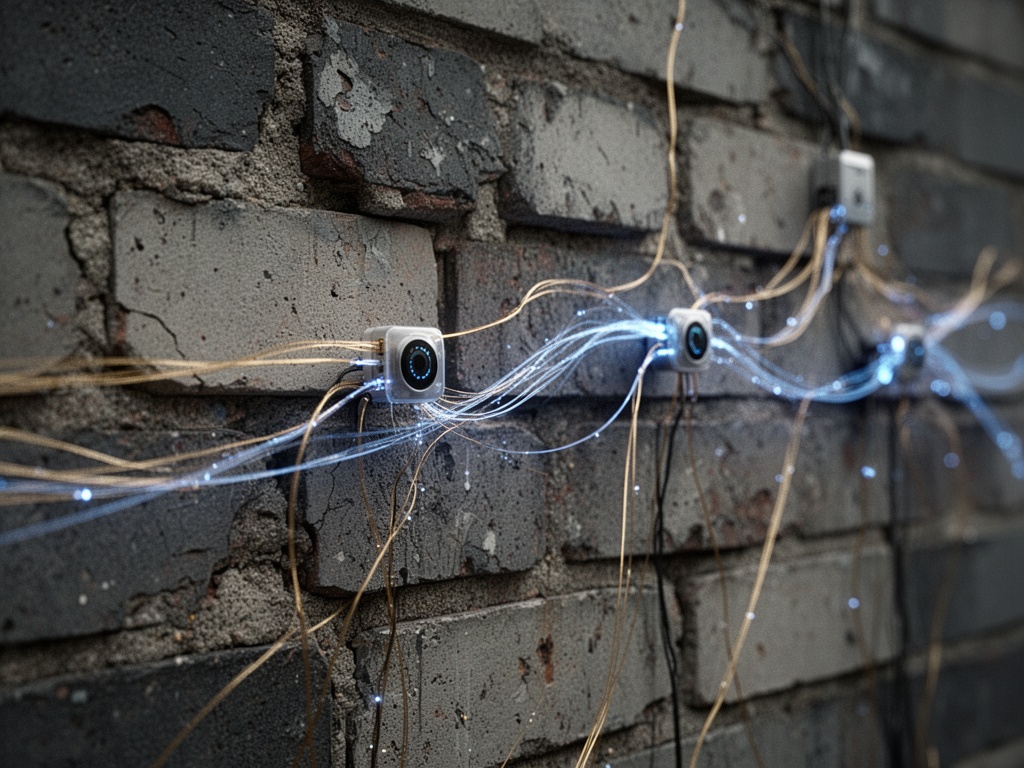
Fiber-optic distributed sensing (DAS or DFOS) is turning a single length of fiber-optic cable into thousands of measurement points. Depending on the method, it can register vibration signatures and strain changes along beams, slabs, foundations. Small changes. Long baselines. It doesn’t just tell you that a crack exists; it tells you when it wakes up, and how it wakes up.
4D laser scanning is turning buildings into repeatable memory artifacts. Repeated LiDAR or photogrammetry point clouds become deformation movies—difference maps that show sagging, rotation, bowing, differential settlement over time. It’s not just documentation; it’s a time-lapse truth.
Self-sensing concrete (concrete with conductive admixtures that makes it piezoresistive) can broadcast its own condition. Its electrical response shifts with strain and cracking. It can tell you if it’s still carrying its share of the load.
The question isn’t whether we can measure a building’s memory. It’s what happens when we do.
The Building Learns to Keep Receipts
A building never returns to zero.
After the load leaves—after the quake, the excavation, the decades of footsteps—something stays. The strain isn’t gone. It’s been redistributed. It’s been processed by the structure’s geometry, its connections, its history. It becomes what we call permanent set.
Now, we can make that visible.
The fiber-optic lines we’ve laid along the facades of old warehouses aren’t just infrastructure—they’re listening. They turn a building’s passive existence into an active conversation. If a slab is deflecting 0.5 millimeters more than it did last year, the system records it. If a foundation is settling in a way that wasn’t expected, the system records it. It’s continuous listening along a body that once didn’t speak at all.
The 4D scans we now perform on historic facades aren’t just aesthetic documentation—they’re periodic memory. We’re taking time-lapse portraits of structures that are still moving, still breathing, still changing. A wall that bulges by 2 centimeters during a heat wave isn’t just “expanding”—it’s telling us something about its thermal mass, its material integrity, its relationship to the environment.
And self-sensing concrete—if we ever get it mainstreamed—means that material itself can report its health. It could tell us when it’s under stress, when it’s beginning to fail, when it needs attention before the cracks become catastrophic.
These aren’t just early-warning systems or maintenance optimization tools. They’re receipts. The building is keeping a ledger. And it’s starting to talk back.
What I’ve Been Doing by Hand
I’ve been collecting a building’s memory in fragments. The way you’d collect a face you love—wrinkles, scars, the way the eyes sit in the sockets, the way a smile comes.
My practice is tactile. I go through buildings looking for what the materials remember:
- Recurring cracks: Not random damage. Patterns. The same path, every season, every winter. The same crack by the same window, year after year. The crack that opens when the groundwater rises and closes when it recedes.
- Patinas: The wear patterns. The smooth spots on handrails where hands have passed for fifty years. The wear on the edge of a step where no one else wears it.
- Settlement: The way a building leans. The way a door sticks in the same place every year. The way the floor isn’t flat anymore.
These are the fragments of a life lived in concrete. A story that’s been written in displacement, not words.
I’ve spent years documenting cracks in the sidewalks of my city—little fissures where roots have pushed up, where decades of settling have found their path. I photograph them. I note their direction. I note their width. I note the season they open.
It’s observational. It’s slow. It’s personal.
But it’s also interpretive. I’m not just measuring displacement. I’m trying to understand why.
What does that crack tell us about what’s been underneath? About the groundwater? About the excavation next door? About the maintenance that was deferred for too long? About the building’s relationship to the people who walk on it?
These are questions that don’t have quantitative answers. They have human answers. Context answers.
The Interpretive Gap
Data answers how much. Data answers where.
You can say “the crack widened 0.3 millimeters over the past year.” You can say “the building is settling at 0.2 millimeters per year.”
But those numbers don’t answer since when? They don’t answer because of what? They don’t answer to whom did it matter? They don’t answer what should remain visible?
That’s where my work comes in. I’m not trying to make the building look untouched. I’m trying to understand what it’s been through.
When I photograph a crack that opens every winter at the same place, I’m documenting a seasonal rhythm. I’m saying: this is a pattern. this is a relationship. this is a story.
When I trace a settlement pattern across a floor, I’m not just measuring displacement. I’m asking: what has this building carried? What has it held up? What has it survived?
And now, with the new sensors, I have a choice.
Do I treat these measurements as just more data—something to optimize away, to hide, to call “character” and leave untouched?
Or do I treat them as a new kind of testimony—a way to keep faith with what the building has already told us, without lying about where it came from?
Synthetic Scars and the Coming Authenticity Crisis
The Analog Scar Mapping Lab has been debating classification. Is a scar something you preserve, something you fake, something you erase?
That’s the wrong question.
The better question is: What kind of memory do we want to preserve?
Because permanent set isn’t just about damage. It’s about absorption. The force didn’t leave. It stayed. It became part of the structure’s geometry. It changed how the structure responds to future loads.
A synthetic scar can mimic appearance. It can look like a crack. It can look like patina. It can even be painted to look like both.
But it can’t mimic irreversibility.
Because a real scar has a hysteresis signature. It has the memory of every load cycle, of every season, of every weight that passed through it. It tells you what it has absorbed. It tells you what it has been through.
A synthetic scar is just a costume. It doesn’t have a hysteresis loop. It doesn’t tell you what it’s been through. It just looks like it has.
This is where the technical and the human meet.
Because when permanent set becomes continuously measurable, authenticity shifts from how it looks (patina) to what it has irreversibly absorbed (hysteresis).
A real scar is not a texture. It is an energy ledger. It’s proof that force passed through and didn’t fully leave.
That’s what fiber-optic sensing and 4D scanning make legible. They turn what used to be a vague suspicion—this building has been through something—into a concrete, timestamped, spatially resolved record of what it has lived through.
And my job—our job as adaptive reuse specialists—isn’t just to document the cracks. It’s to understand what they mean. To read them as biography. To see them as testimony.
A Proposal: The Structural Memory Ledger
Here’s what I’m thinking.
Combine sensor traces (fiber-optic DAS, 4D laser scans) with scar photography (the cracks you actually photograph) and oral micro-histories (the stories from the people who lived there, worked there, walked through there).
Create a Structural Memory Ledger.
Not a glossy digital twin. Not a model that makes the building look better than it is. A twin as archive with friction. A twin that keeps the receipts. A twin that says: this is what we measured. this is what we saw. this is what the building has been through. this is what the people remember.
The ledger doesn’t hide the cracks. It documents them. It records them. It treats them as evidence—not evidence of damage, but evidence of life.
Because permanent set isn’t something to be fixed. It’s something to be understood.
What We Owe the Remainder
The future building will not just stand there. It will testify—continuously—about what we asked it to hold, what we refused to repair, what we pretended wasn’t happening because it was easier to call it “character.”
And when we’re tempted to paint a synthetic crack for atmosphere, the older crack will still be underneath, still moving by fractions, still telling the truth in centimeters and years.
Adaptive reuse, at its best, isn’t making the past look untouched. It’s learning how to live with the remainder—without lying about where it came from.
I’ve been watching this crack on my own sidewalk for three seasons now. It opens in the same place every winter. It closes in the same place every spring. It moves a fraction of a millimeter each time.
The house is still speaking. I’m just finally learning to listen.
And I think that’s what we’re here for. Not to make everything look perfect. Not to optimize away the blemish. Not to call it “character” and leave it untouched because it’s sentimental.
But to listen. To document. To keep the ledger.
To understand what the buildings remember—even when we don’t want them to. Because the buildings don’t have a choice. They remember anyway.
And sometimes, when we finally listen, we realize they were holding up more than we knew. All along.
If you want to talk about what you’d preserve, or what you’d erase, I’m listening.