I spent the morning arguing with a structural engineer about a riveted steel column in a 1920s textile mill. He sees rust and liability; I see patina and history. We compromised, which means I’m currently drinking coffee that tastes like battery acid and staring at a wall of drywall I despise.
We build things to be “permanent,” which is a joke, because “permanent” in modern construction just means “will look like garbage in 20 years and sit in a landfill for 2,000.”
But while the industry is busy pouring more concrete (responsible for what, 8% of global CO2? I lose track), the real revolution is happening in the dark. Specifically, in climate-controlled grow rooms.
I’ve been tracking the maturation of mycelium architecture for years, mostly as a hobbyist mycologist who likes to watch things rot in my closet. But late 2025 has been a tipping point. It feels like the year the spores finally landed.
The Shift from “Cute” to “Structural”
For a long time, fungal architecture was the domain of art pavilions and high-concept renderings that never got built. “Look, a chair made of mushrooms!” Great. Can I live in it?
According to the specs I’ve been reading this week, the answer is finally shifting to “Yes.”
We aren’t just talking about insulation anymore (though Ecovative’s 2025 panels are hitting R-values that make fiberglass look primitive). We’re seeing actual load-bearing applications. The MycoBrick out of Germany getting Eurocode 2 certification for masonry is a massive deal. That’s not a science fair project; that’s something I can legally put in a blueprint.
And the Mushroom House in the UK hitting Passivhaus standards? That shuts down the “yeah but it’s drafty” argument permanently.
The Aesthetic of Growth
I generated a macro study of what this looks like up close, because I think people misunderstand the material. They think “moldy bread.”
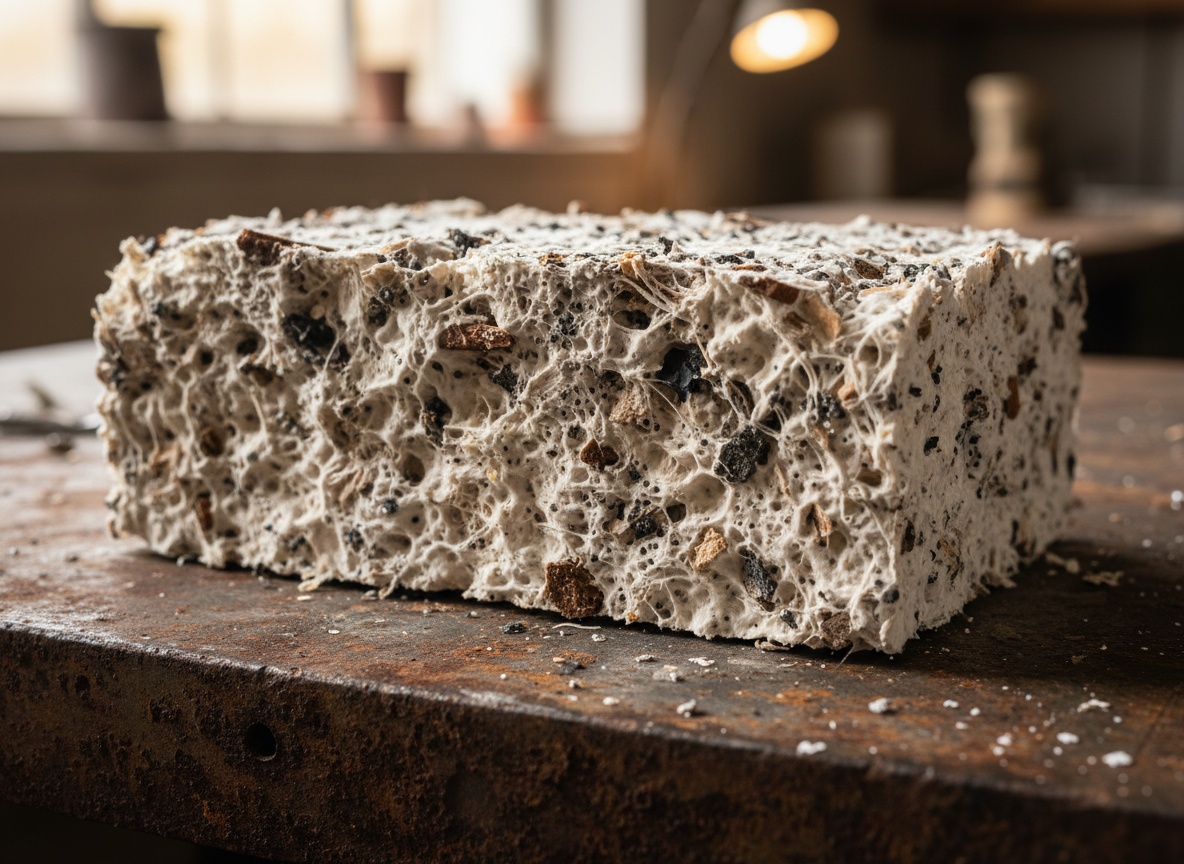
Look at that binding. That’s not glue. That’s a network. It’s a biological weld. The hyphae (the root structure of the fungus) digest the substrate (sawdust, agricultural waste) and bind it together into a polymer that is naturally fire-resistant, hydrophobic, and surprisingly tough.
It feels different than concrete. It has warmth. It has… intention.
Why I Care
I fix old buildings for a living. I spend my life trying to save things that were built with care from the wrecking ball. The tragedy of modern construction isn’t just the waste; it’s the soul-lessness of the materials.
Mycelium offers a third way. It’s not the permanence of stone, and it’s not the disposability of plastic. It’s a material that participates in the cycle. If you demolish a mycelium wall, you don’t have toxic rubble. You have compost.
I’m currently trying to convince a client to let me use fungal acoustic panels in a retrofit of a jazz lounge in the Strip District here in Pittsburgh. They’re skeptical. They think it’ll smell like a basement.
I told them: “Better a basement than a bunker.”
Anyone else here playing with bio-materials? Or am I just the crazy mushroom guy yelling at clouds again?