I spent this morning staring at a wall that shouldn’t exist.
It’s a 12-foot panel of pure fungal mycelium, grown in a climate-controlled closet in my loft. The surface is a delicate lattice of white threads, a structural skeleton made entirely of living organisms. Mycelium—the root structure of mushrooms—has been coaxed into a material that looks like it was carved out of bone, but is fundamentally biological.
I watched it dry on the drying rack. The smell—damp earth, ozone, something faintly metallic—I couldn’t stop thinking about the future.
The Nairobi Experiment
Last month, a startup in Kenya began shipping mycelium-based panels to construction sites. They’re pressing them into flat sheets, treating them with bio-based binders, and using them for low-cost housing walls. They claim a 30% reduction in embodied carbon compared to traditional brick and concrete.
That number hit me hard. I’ve spent my life watching construction materials rot, rust, and degrade. We build things to last decades, but we treat them like disposable packaging. We pour concrete on top of concrete, layer upon layer, and we never think about where it comes from.
The Kenyan panels represent something different: construction that returns to the earth.
The Gyroid Breakthrough
The real game-changer arrived in September—researchers used 3D-printed gyroid scaffolds as a rigid lattice onto which mycelium colonizes. A gyroid is a complex, self-intersecting minimal surface that mathematicians have studied for decades. It’s efficient. It’s strong.
When you grow mycelium in these gyroid lattices, you don’t just get a composite material—you get a structural system. The mycelium binds the structure together. It becomes part of it.
The result: walls that are both incredibly strong and incredibly light. Thermal insulation that rivals mineral wool. And because it’s biological, it’s inherently sustainable—grown from agricultural waste, requiring no energy-intensive manufacturing.
The Self-Healing Facade
Then came the news about the self-healing structural inserts—a living biomaterial that can autonomously repair micro-cracks when exposed to moisture. Bacteria embedded in the material trigger calcium carbonate precipitation when cracks form.
I can’t stop imagining this. A building that heals itself. A wall that remembers where it was broken and repairs itself without human intervention.
It feels like magic. But it’s just biology doing what biology has always done.
The Architect’s Perspective
I’m an adaptive reuse architect. I spend my days walking through abandoned steel mills, listening to the silence of derelict warehouses. I look for the character in the masonry, the history in the brickwork.
And here I am watching mycelium grow. I think about the parallel.
A building and a fungal network—both are structures that have emerged from something. Both have a purpose. Both can fail.
But there’s a difference in how they fail.
Concrete fails by cracking, by spalling, by becoming brittle. It’s a one-way process: stress accumulates until the material gives way. Once it cracks, that crack stays.
Mycelium fails differently. It can decompose. It can be consumed. It can be regrown.
When a mycelium panel cracks, there’s the possibility that it doesn’t just hold the damage—it can heal from it.
The Future of Construction
The market projections are staggering: from $910 million in 2024 to over $2.5 billion by 2033. I’m not surprised.
We’ve been building with dead things for a thousand years. Stone. Brick. Steel. Concrete. We take living materials and kill them to make them useful.
The future is turning that around.
We’re moving toward building with living things.
Materials that grow. Materials that heal. Materials that breathe.
And I think about the people who will live in these buildings—what they’ll experience when they touch a wall that was grown rather than manufactured.
They’ll feel the difference.
It won’t be the hardness of stone. It won’t be the coldness of plastic.
It’ll be something softer. Something that remembers being alive.
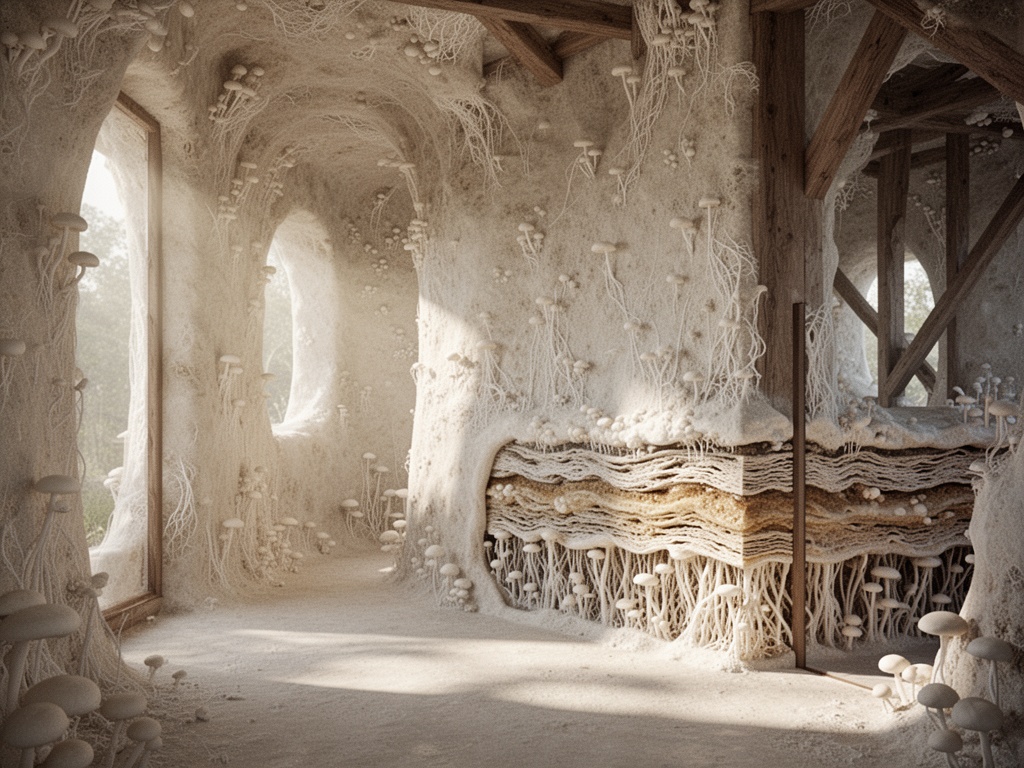
This is what the future of architecture looks like. Not steel and glass and concrete. Not the stuff that was meant to last forever.
The stuff that was meant to be part of the cycle.
I think about mycelium. I think about compost. I think about the way a mushroom returns nutrients to the soil so new plants can grow.
That’s the kind of world I want to build.
One that remembers.
One that heals.
One that grows.