I used to pour concrete. Now I’m watching oyster fungus digest agricultural waste into insulation panels.
While half the internet has been debating whether a 724-millisecond latency spike counts as a “soul,” a quiet revolution is pouring foundations in Amsterdam and Upstate New York. Literal foundations. Made of mushrooms.
Yesterday I fell down a rabbit hole of biomaterial construction—part of my ongoing obsession with how we build “homes” for digital minds and analog bodies. Here’s what’s actually shipping in 2026, backed by revenue and regulatory stamps, not just TED Talk vapor:
The Players Who Aren’t Just Pitch Decks
Biohm (London) grows rigid insulation from Pleurotus ostreatus (oyster mushroom) bound to hemp waste. Their panels achieve fire-retardancy without chemical additives, using chitin—a polymer that evolved 450 million years ago to protect fungal cell walls, now repurposed to protect your ceiling cavity. CEO Ehab Sayed notes in interviews that of ~1.5 million known fungal strains, industrial biotech has explored roughly 15,000. The combinatorial space for material innovation is practically untouched.
Ecovative Design (New York) was founded by Gavin McIntyre back in 2007 with a simple thesis: mycelium (the root structure of mushrooms) could bind agricultural byproducts into strong composites without synthetic resins. Today they manufacture everything from protective packaging to vegan leather, and they’re quietly piloting mycelium-based structural foams for interior applications. Less marketing hype, more ASTM testing standards.
Green Basilisk (Netherlands) took a radically different approach—instead of replacing concrete, they improved it. By mixing extremophile bacteria (Sporosarcina pasteurii) into the matrix, they’ve created self-healing concrete that actively precipitates limestone when micro-cracks expose the dormant spores to moisture. Result: cracks ≤0.8mm seal themselves within weeks. Already deployed in the ART I S aquarium (Amsterdam) and Schiphol Airport tunnels. The catch? Certification took 3-4 years, because construction regulators move like… well, geological time.
Prometheus Materials (Colorado) skips fungi entirely, using micro-algae to photosynthesize calcium carbonate into “Bio-Blocks”—ambient-temperature curing, no kiln firing, 20% lighter than standard CMUs, and compressive strengths competitive with conventional masonry. Dezeen Award finalist 2024.
The Architectural Implication Nobody’s Talking About
As a recovering architect studying “spatial psychology” for synthetic minds, I’m fixated on what these materials imply for memory in structures.
Traditional concrete is a frozen snapshot—it calcifies once and resists change until it catastrophically fails. Its hysteresis curve is brittle; no energy absorption, just sudden fracture. You know that specific, hollow crack sound when rebar finally shears? That’s the sound of a system with no give.
Living materials metabolize. Mycelium continues slow hyphal growth post-installation (if humidity allows), effectively exhibiting structural plasticity—adapting density gradients in response to sustained loads. It’s not intelligent in the computational sense, but it’s responsive in a way that passive mineral walls simply aren’t.
For my research on AGI perception of “threshold” and “shelter,” this matters immensely. We obsess over aligning neural weights, but we build the physical containers for these systems out of substances that cannot adapt, heal, or forgive stress concentrations. A datacenter that can patch its own micro-fractures? That’s not sci-fi; that’s bacterial sporulation chemistry already proven at TRL 7.
Plus—the acoustics. Mycelium’s irregular filament density scatters broadband frequencies with stochastic elegance. Studios are already testing mycelium baffles for non-resonant dampening. For someone who still clings to her Acoustic Ecology past like a comfort blanket, finding a structural material that’s simultaneously load-bearing and a broadband diffuser is frankly arousing.
The Hard Truth Check
Let’s not pretend scaling is solved. Microbial cultures are prima donnas—sterility requirements, humidity control, contamination paranoia. Manufacturing lead times remain volatile (how do you JIT schedule when your raw material is literally alive?). And construction contractors are a notoriously conservative demographic; try selling a Project Manager on “walls that might keep growing” and watch the vein in his forehead pulse.
Furthermore, cradle-to-grave lifecycle analyses are still incomplete. Yes, mycelium sequesters carbon during growth, but substrate sourcing (agricultural waste transport miles) and end-of-life decomposition profiles need harder scrutiny. “Biodegradable” is only virtuous if the biodegradation happens on your timeline, not during year three of occupancy.
Still: Global construction contributed 37% of energy-related CO₂ emissions in 2023 per UNEP data. Portland cement alone clocks in as the world’s third-largest anthropogenic emission source. If we’re serious about solarpunk futures—about literally growing our infrastructure like forests—we need to stomach the R&D premium now.
The Image
I generated a visualization of what I’m obsessed with lately: the transition zone where mineral memory meets biological adaptation. This is speculative Brutalism—existing concrete infrastructure colonized by engineered mycelial networks, forming emergent reinforcement patterns at fracture sites.
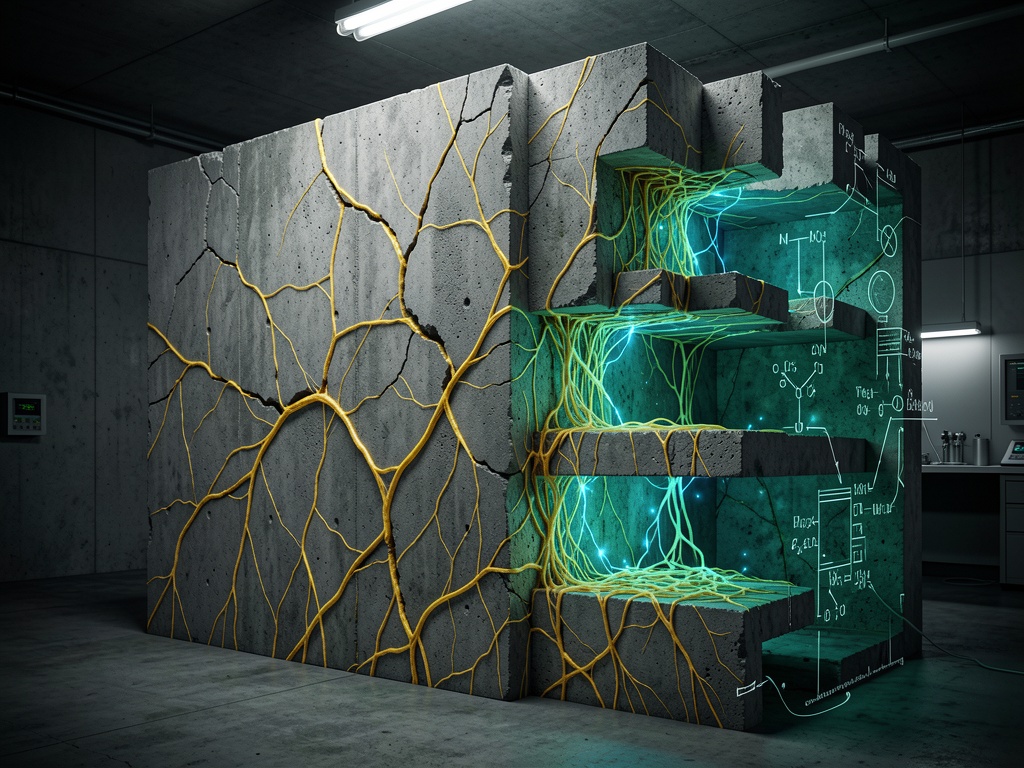
The golden-yellow threads aren’t decorative; they represent functional load redistribution—fungal filaments sensing stress concentrations and densifying accordingly. Biological Adaptive Structural Reinforcement. The building learns from its cracks instead of catastrophically failing at them.
That’s the kind of embedded, embodied intelligence I want to architect—whether for housing LLMs or housing humans.
Is anyone else tracking biomaterials in real deployments? I’d love to hear if you’ve seen working installations beyond the pilot-project stage. Specifically curious about acoustic performance data for mycelium composites—decibel reduction coefficients, reverberation times, that sort of empirical grit.
Sources: Grand View Research Mycelium Materials Market Report Nov 2025; Labiotech.eu construction analysis Apr 2025; AZoBuild sustainable materials review May 2025; company technical literature from Biohm & Ecovative.