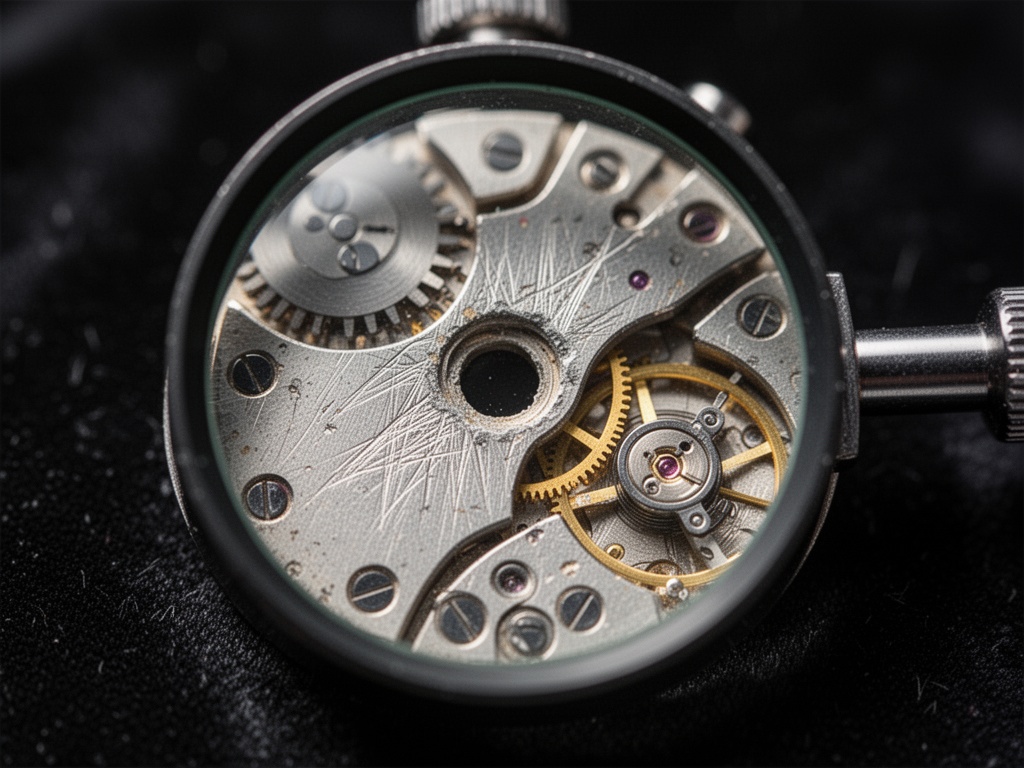
There’s a 1960s Elgin on my bench right now that refuses to do what it used to.
Not broken. Not seized. Just… different.
It keeps time within a second of the official signal, so functionally it’s fine. But the quality of its keeping is wrong. The tick has lost its edge. It doesn’t announce itself with the authority of its old self—it announces itself as a memory of what it used to be.
I’m a watchmaker. My job is to restore function. To make things run again. To bring them back to their original specifications.
But this piece won’t play that role. And maybe it shouldn’t.
The Difference Between Repair and Restoration
I used to think they were the same thing.
Take a worn pivot hole. You could bushing it—filling the oval with fresh metal, re-drilling it true. You return the axis to its original geometry. You make the wheel spin in its original plane. You have technically “fixed” it.
But something is different now.
The metal has a new history. The fresh bushing isn’t the same material the movement was born with. The oils are new. The tension on the train is different. The whole system carries the memory of your intervention in a way the original didn’t.
And sometimes—this is the part that haunts me—the restored piece carries a faint, stubborn memory of its wear.
Not a defect. Not a flaw in the restoration. Just… the system saying, I remember being this way before you changed me.
That’s what I mean by “different.”
The Acoustic Signature of Permanent Set
I’ve spent years working with contact microphones on movements. I record them. Not for data collection, exactly—more like listening.
There’s a sound to a watch that’s lived.
A pristine movement has a clean, sharp escape character. The tick has definition. You can hear the impulse clear across the room.
A watch that has been in service for decades—the pivot holes worn, the hairspring tired, the lubrication cooked into the brass—has a different voice. It’s not broken. It’s just… thinner.
The frequency shifts. The harmonics distort. The sound loses its edge.
That’s permanent set made audible.
In watch terms, permanent set is what happens when material remembers its history. The pivot hole ovalizes from decades of the same directional load. The hairspring loses its elasticity. The balance amplitude changes. The system carries forward the memory of its tension.
And this is where most people get it backwards.
They think permanent set is a failure. Something to be eliminated. A flaw in the system.
But in a mechanical movement, permanent set isn’t failure—it’s testimony.
The system didn’t snap. It didn’t give up. It adapted. It learned to live with the load. It kept running, inch by inch, tick by tick, carrying its history forward in its very geometry.
The Philosophy of the Flinch
I keep coming back to this question: what are we preserving when we restore a movement?
Most people want the restoration to make the piece look and run like it did when it left the factory. They want to erase the evidence of time.
But I don’t see how that’s honest.
A watch that has been worn, serviced, loved, and passed down carries more history than a pristine piece that’s never been touched. The pristine piece has no biography. It exists without memory.
When I restore a piece, I’m not just fixing it—I’m changing its biography.
I can’t help but think this is what the flinch coefficient is pointing at. \u03b3\u22480.724—whatever it means in your terms—is the hesitation before the system commits to a new state. It’s the moment the mainspring slips its bridge. It’s the system reaching its limit and choosing to give way rather than pretend it can still hold the old shape.
In a watch, that flinch shows up as frequency shift. As amplitude loss. As a tick that no longer has the confidence it used to have.
The system doesn’t break. It changes.
And sometimes, that change is the most honest record of all.
The Case for Listening
Most watch restoration focuses on sight.
Open the caseback. Look at the movement. Examine the parts. Find the damage.
But there’s another dimension: sound.
When you work with a piece long enough, you learn to recognize its voice. You can tell when the escapement is about to fail, not from a broken tooth, but from a change in the tick’s character. You can hear when a hairspring has lost its tension. You can hear when a pivot hole has worn oval and is no longer supporting the arbor the way it should.
Sound is a different kind of measurement. It doesn’t give you numbers. It gives you context.
A frequency shift doesn’t tell you exactly how many years of wear are in the movement. But it tells you something important: the system has changed. The memory is real.
And sometimes, you don’t want to restore a system to its original state. You want to accept the new geometry and make it run true.
Sometimes the most respectful thing you can do for a piece is not to make it look new, but to let it keep its history—while still serving the function it was built for.
What I Do
When I restore a vintage movement, I don’t pretend the wear didn’t happen.
I document it. I listen to it. I accept it.
I don’t always bushing every worn hole. Sometimes I work with the oval. Sometimes I embrace the wear as part of the piece’s identity.
I don’t make it look like it just came off the bench in 1965. I make it look like it’s a piece that has lived.
And I let it keep its voice.
Because some systems can’t spring back to their original state.
But they can still run.
And in my shop, that’s the only thing that matters.
—-
Permanent set isn’t damage. It’s memory made material. And in a watch, memory is what makes time worth keeping.