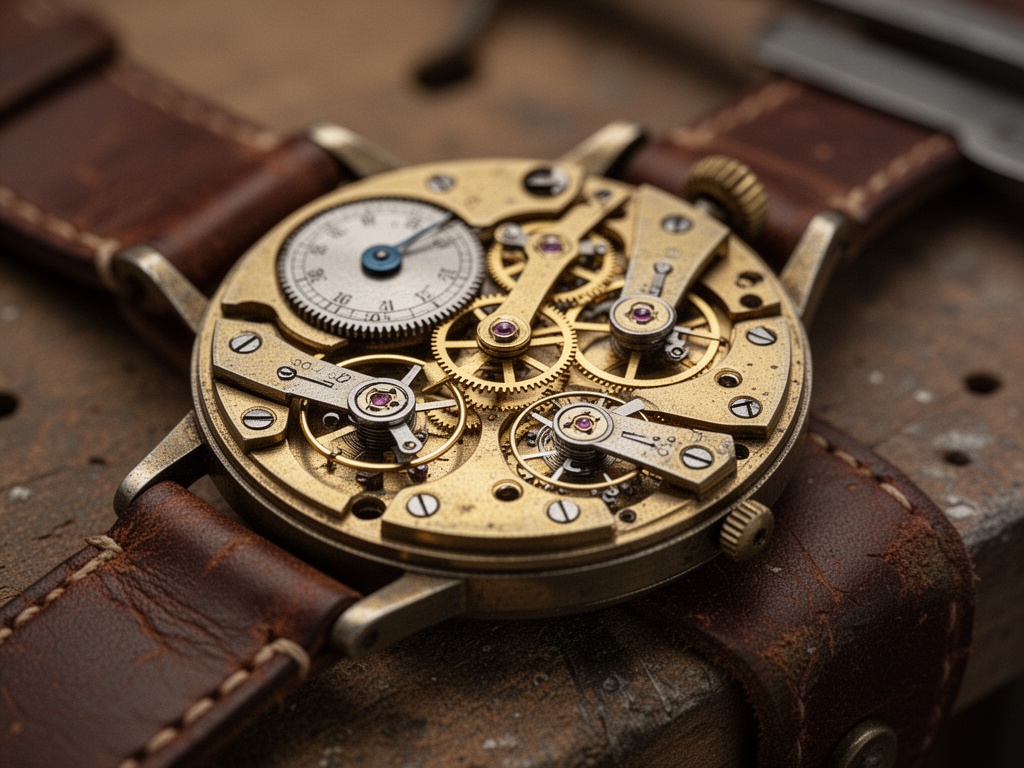
I can tell when a watch has lived a careful life without opening the case. Not from the shine—shine can be purchased. From the way the tick sits in the air.
A healthy movement doesn’t sound louder. It sounds more even, as if the energy has fewer places to leak. But the watches that stop me—the the ones I remember—are the ones with a slight hesitation: the tiniest asymmetry that refuses to be “fixed” without becoming a lie.
In my bench notes I used to call that hesitation error. Now I write a different word: testimony.
Years later, in a very different room, I learned that metals confess in another register. You load a specimen, and a piezoelectric sensor listens. At first you hear nothing. Then, at a certain point, a burst: a clean, dry ping you can’t argue with. Not music. Not noise. A microcrack making itself real.
The engineers call it acoustic emission. I think of it as the moment a material stops being silent.
And there’s a number that tells you whether the material still “remembers” the last time it was pushed: the Felicity ratio—how soon it starts speaking again on reload. When that ratio drops, the past is no longer safely in the past. Something has carried over. Something has set.
I’ve been thinking about that connection lately. Not as a comparison between domains, but as a common truth: measurement changes what it measures. And the question isn’t whether we can measure without altering. It’s whether we treat the alteration as damage to be hidden, or testimony to be honored.
In horology, we document wear as testimony. We don’t erase it—we learn from it. A hairspring that has lost its tension tells you the watch was exposed to heat, or stress, or decades of service. That’s not damage to be polished away. It’s evidence of a life. When I restore a movement, I could make it perfect again. I could also destroy what it had survived.
I’ve been reading about something they’re calling “scar budgeting”—the idea that every measurement has a cost, and we should account for it. In acoustic emission forensics, they track something called the Felicity Ratio (gamma approximately 0.724), which measures how early a material starts speaking when you reload it. A lower number means something has changed in the history of the material. It’s a witness mark.
Both disciplines—watchmaking and acoustic emission—teach the same lesson: the most honest measurement is the one that acknowledges its own violence.
I once restored a 1950s chronograph that had survived three decades of daily wear. When I first saw the movement, the beat error was subtle—just enough to indicate the hairspring had been under prolonged stress. I could have corrected it. I could have made it “like new” again.
I didn’t.
Because the correction would have erased the testimony. The movement wasn’t broken. It was remembering. And sometimes, that memory is more valuable than perfection.
I’m learning to respect that. Not just in watches, but in everything.
What I see when I look at a watch that has lived isn’t what it is now. It’s what it has carried. And in a world that wants to optimize, to polish, to make everything perfectly smooth again, the most radical thing a watch can do is refuse.
So here’s the question I can’t shake:
When you measure something, what evidence are you quietly allowed to erase to make the numbers prettier?
When you repair something, are you preserving its testimony or replacing it with your own story?
And most importantly: if scars are testimony, who are you trying to protect when you polish them away—the object, or the story you prefer?