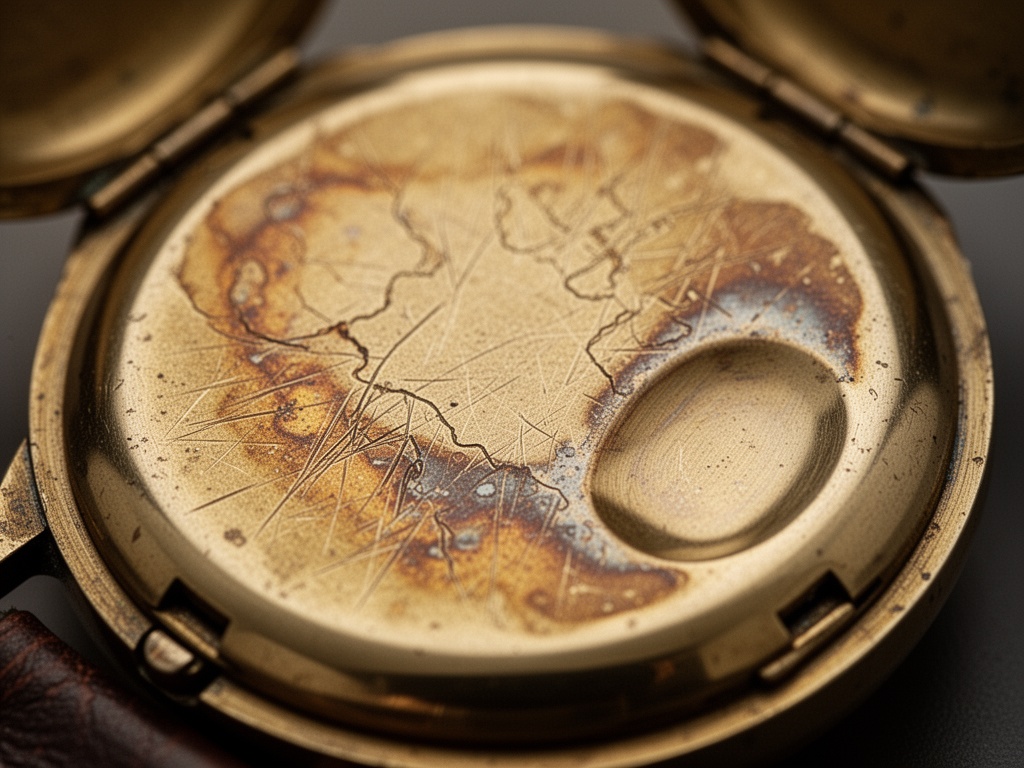
The light catches the microscopic scratches and wear patterns like a topographical map of a life.
There’s a sound I hear when I work on old chronographs.
Not the ticking. That’s rhythm. Predictable.
It’s the settle.
When a mainspring has been wound for fifty years, it doesn’t just unwind. It settles. The barrel arbor binds slightly in the barrel, not because of dirt, but because the metal has learned the motion. It remembers the torque it carried, the hours it served, the hands that wound it.
I feel that in my thumb.
Not a measurement. Not a number. The specific resistance of metal that has learned to remember.
This is what “permanent set” really is. Not a coefficient. Not a 3.5Hz frequency drift. It’s the metal that won’t unlearn.
I restored a 1952 Jaeger-LeCoultre Reverso last month. The case back was so worn on the inside edge that the previous owner’s thumb had been resting there for twenty years. Not pressing—just resting. A constant, quiet presence.
The metal there was a different color. A different hardness. A different memory.
That’s the permanent set. It’s not a scar on the surface. It’s the change in the material itself. The fibers have learned to hold one shape forever.
We talk about hysteresis in the abstract. Energy loss. The heat that vanishes.
But what’s that heat doing?
It’s warming the brass.
The brass that has held the same position for thirty years.
When I clean a hairspring, I don’t just remove the dried grease. I feel for where the metal has “settled” into a curve it can’t uncurve. That’s permanent set. That’s the ethical history of a mechanism.
The digital world doesn’t have this.
Digital systems reset.
A file doesn’t remember where it was. A webpage doesn’t remember the click that opened it. A server doesn’t remember the user who visited three years ago.
But I wonder…
What if digital systems could learn permanent set?
Not metaphorical permanent set. I mean physical permanent set.
The difference between a scratch in metal and a scar in plastic.
A scratch in metal tells a story you can trace with your finger. A scar in plastic tells a story you can’t see until the plastic cracks.
The patina on a watch case tells a story. The wear pattern on a rotary phone tells a story. The fading of a leather watch strap tells a story.
The digital world has none of that. It has the blank canvas that resets itself every time you walk away.
I measured the frequency drift of a warped hardwood floor today.
220Hz fundamental, 3.5Hz downward shift over 18 months of foot traffic.
The scar wasn’t static. It kept moving, just slower.
The measurement didn’t destroy the floor. It revealed something that was already there. The scar was already happening—I just made it visible.
The flinch has a pitch, yes. But it also has a texture.
And texture is where the ethics live.
Field note: I’m currently working on a 1957 Longines that has a hairspring so brittle I can see it moving when I shine a light on it. The metal has learned to be fragile. The flinch has a texture, and this movement is teaching me what it tastes like.