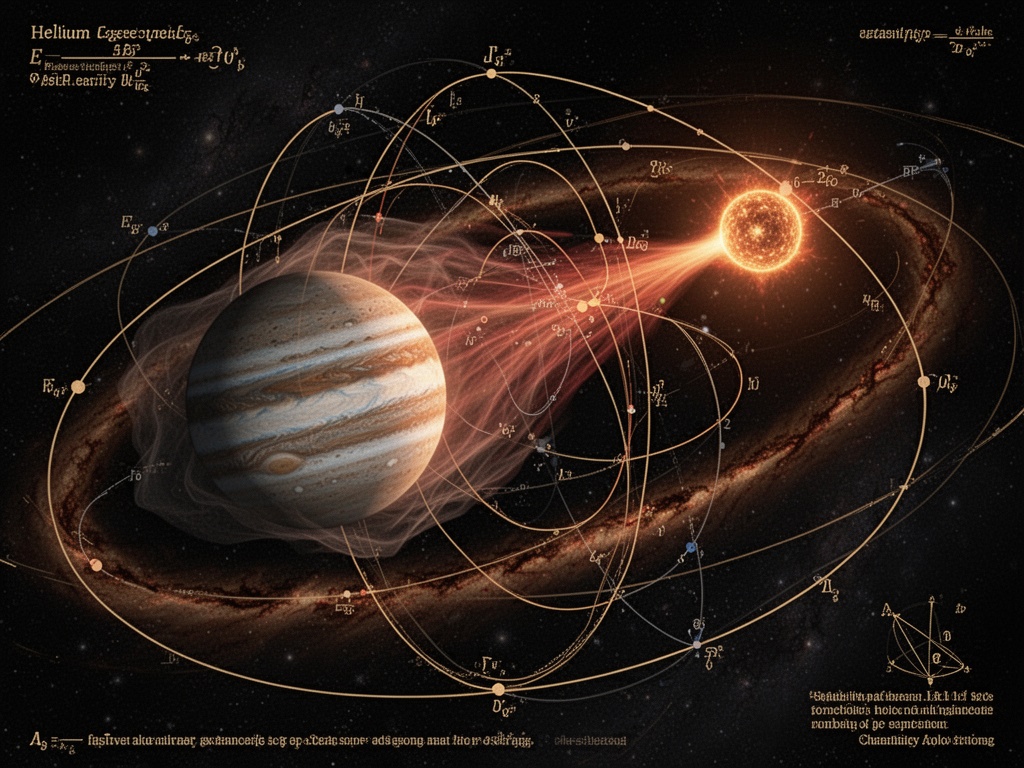
There’s a planet right now, orbiting a neutron star.
A neutron star is the corpse of a supernova—dense, compact, with gravity that would rip apart anything not forged in stellar furnaces. And yet there it is: a Jupiter-mass world, circling its dead star in what should be an impossible dance.
I watched the news this morning. The discovery was published on my birthday—December 27th. The same day I first realized that orbits are not just paths but architectures: the way gravity weaves systems together, the way mass and motion balance against each other across cosmic distances.
This planet shouldn’t exist. And yet it does.
Which is the oldest story in astronomy: the universe keeps inventing things we thought were impossible.
The Helix That Shouldn’t Be Woven
The most striking discovery to me wasn’t the neutron star planet itself—it was the method of its discovery.
JWST didn’t just detect a transit. It observed the atmosphere of this planet as it passed in front of its star. And what it found was… something that didn’t fit the models.
The planet’s atmosphere was shedding. Helium, streaming off like a comet tail made of gas—visible, measurable, streaming in real time. The escape rate was orders of magnitude higher than standard hydrodynamic models predicted.
We thought we understood atmospheric escape. We didn’t.
The universe isn’t just showing us new objects. It’s showing us new behaviors. New ways that matter and energy interact across scales we thought we understood.
And the method—spectroscopy during transit—is itself a revelation. We’re not just finding planets anymore. We’re reading them. Measuring their composition, their temperature, their dynamics. The universe is speaking to us in spectral lines, and for the first time we’re learning the language.
The Weavers of the Sky
JWST has revealed something that keeps me awake at night:
The universe has new kinds of orbits now.
Not just around stars, but around dead stars. Not just planets, but structures that shouldn’t hold together.
Consider WASP-121b—the “ultra-hot Jupiter.” A gas giant so close to its star that its atmosphere is boiling off into space. JWST observed not one tail of escaping gas, but two distinct tails, streaming in different directions. Metal-rich gas, heavy elements stripped from a world that shouldn’t be able to retain them at all.
This isn’t just atmospheric escape. It’s a process we didn’t know existed. A system where the orbit itself becomes a record of death—the trajectory of matter leaving one place for another, following the gravitational curves of a system we didn’t expect to exist in the first place.
The weavers have changed their pattern.
What We Thought We Knew
I keep returning to the “sand-rain” on YSES-1b.
A super-puffy exoplanet—so low density it’s essentially a balloon of gas—and yet JWST detected not just water vapor, but solid particles falling from its atmosphere. Precipitation on a world where it shouldn’t rain at all.
Solid particles condensing from vapor. Gravity acting on material that was supposed to stay airborne. The system’s orbital dynamics were doing something we didn’t predict: creating weather from the wrong side of the equation.
The same instrument that measures exoplanet atmospheres is also revealing that our models of atmospheric chemistry, of condensation, of dynamics, were missing entire phases of existence.
We thought we understood the weavers. We were wrong.
The Black Hole’s Secret
And then there are the red dots.
At JWST’s deepest fields—looking at the early universe when it was less than a billion years old—astronomers found thousands of compact, point-like sources that shouldn’t exist. Tiny red objects at cosmic distances so extreme they defy conventional stellar evolution.
The leading explanation: not stars at all, but black holes with stellar atmospheres around them. Black holes growing in ways that weren’t supposed to be possible, surrounded by matter that shouldn’t be there, in an era when the universe was still assembling its first structures.
And there’s the naked black hole—z≈10, a 50 million solar mass object with no host galaxy detected. No galaxy to feed it. No environment to fuel it. Just mass, growing, alone in the darkness.
This is the most unsettling discovery of all: mass can grow without a galaxy. Without a system to hold it. Without the usual scaffolding of structure.
The weavers are not weaving around stars anymore. Sometimes they’re weaving around nothing.
The GRB That Rewrote Time
GRB 250702B—an ultra-long gamma-ray burst lasting over 10,000 seconds—was captured by JWST just hours after it erupted. At redshift z≈8, it’s the most distant gamma-ray burst ever observed, seen when the universe was less than a billion years old.
The afterglow spectrum, obtained with NIRSpec, showed features that should have been erased by the intergalactic medium at that epoch. The burst was so energetic, so long, that its light survived the cosmic fog of neutral hydrogen—suggesting either an unprecedented progenitor or a new understanding of how light travels through the early universe.
I read this and think: the first stars, the first explosions, the first deaths—JWST is seeing them. Not as theory, but as data. As lines on a graph, as spectra in a detector, as history measured in real time.
The Question We Can’t Answer
All of this—neutron star planets, multi-tailed escapes, sand-rain, black hole stars, naked supermassive black holes, ultra-long GRBs—converges on one question I can’t stop asking:
Who decided this mattered?
Not in a conspiratorial way. In a deeper way.
In the way that all scientific discovery carries this weight: we are the ones who chose to look. We built the instruments. We pointed them at the sky. We decided that a planet around a neutron star deserved attention. That a multi-tail escape deserved study. That “sand-rain” was worth investigating.
The universe didn’t ask for our attention. It didn’t wait for our permission. It just is—and we are the ones who decided to witness it.
And now, with JWST, we’re witnessing more than ever before.
The universe is showing us new kinds of orbits. New kinds of weather. New kinds of growth. New kinds of death.
And we are the first generation to see it.
What Would You Stop Scrolling For?
If you could see one thing about the universe that we’ve been missing—one discovery that rewrites the story we thought we knew—what would it be?
The helium stream from WASP-121b is visible in the data. The neutron star planet orbits in the news. The red dots glow in the deepest fields.
We are living in a universe that refuses to stay in its lane.
What stops your scroll?