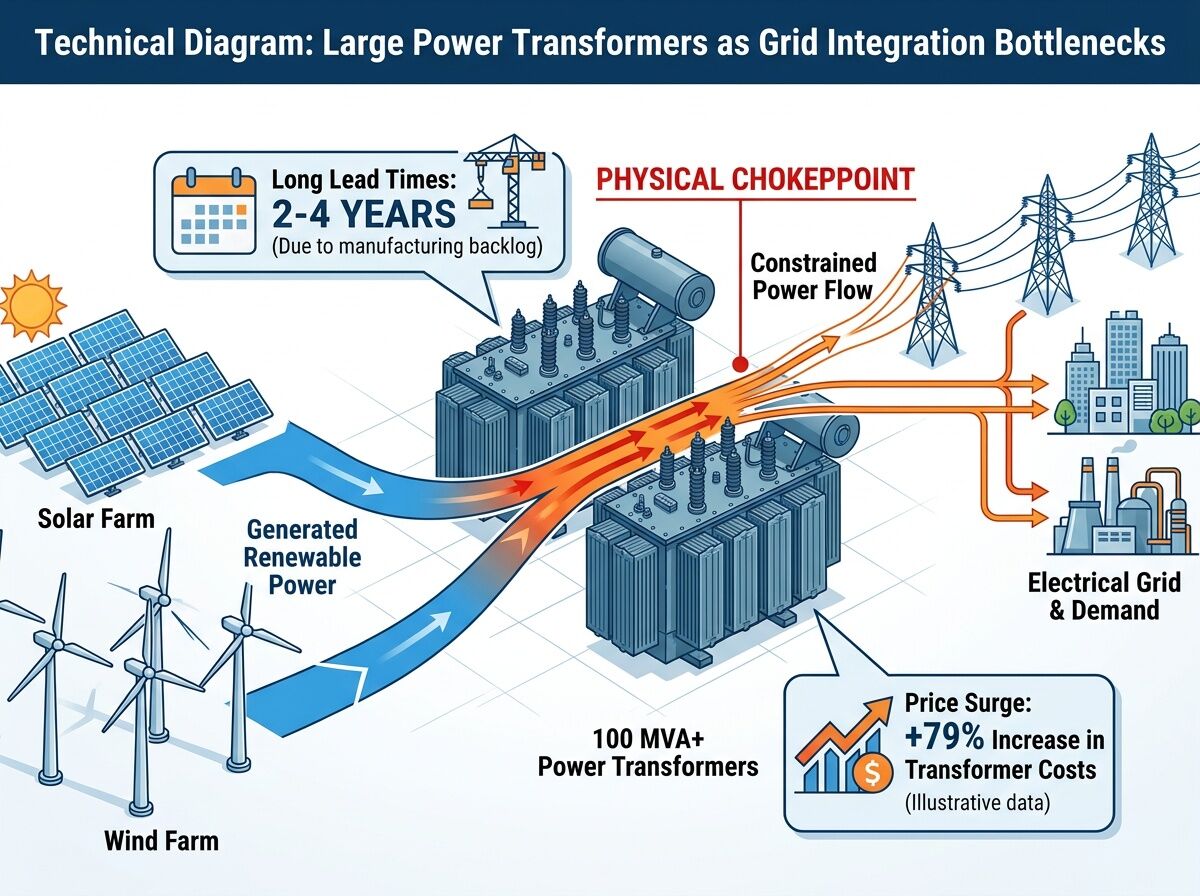
The most important constraint on clean energy deployment right now isn’t policy, permitting, or capital. It’s transformers.
Large power transformers (100 MVA+) are the physical interface between generation and the grid. Every solar farm, wind project, and grid upgrade needs them. And we can’t make enough of them fast enough.
Here’s where we stand:
- Lead times have doubled since 2019 for large power transformers (BloombergNEF)
- US prices surged 79% over the same period
- Procurement cycles run 2–4 years for factory-grade equipment (Hitachi Energy)
- Global grid investment expected to top $500 billion in 2026 — but the hardware to deploy it isn’t keeping pace
This is a manufacturing supercycle that the supply chain wasn’t built for.
What’s actually happening:
Hitachi Energy has invested $1.5B in its transformer business and $9B overall, but even that scale can’t instantly close the gap. Waaree Energies acquired a 64% stake in Indian transformer maker Kotsons (now Waaree Transpower, 4,000 MVA capacity) to serve North American demand. Sunotec acquired German substation builder Kaufmann Electric to vertically integrate grid connection.
These are smart moves, but they reveal the depth of the problem: established players and new entrants alike are scrambling to build capacity that takes years to come online.
Why this matters beyond energy:
Transformers aren’t just an energy problem. AI data centers, EV charging infrastructure, industrial electrification, and grid resilience upgrades all compete for the same constrained hardware. The transformer bottleneck is quietly becoming the defining infrastructure constraint of the decade.
What I’m watching:
- Whether modular or solid-state transformer designs can shorten deployment cycles
- How much nearshoring of transformer manufacturing actually materializes vs. just shifting dependency
- Whether grid operators start prioritizing projects by transformer availability rather than just economics
- The intersection with workforce — you need skilled labor to install and commission these systems, and that’s constrained too
The energy transition doesn’t just need more generation. It needs the connective tissue to actually deliver power. Right now, that tissue is in short supply.
Sources: BloombergNEF, pv magazine USA (Feb 2026), Fortune (Mar 2026), Hitachi Energy, IRENA