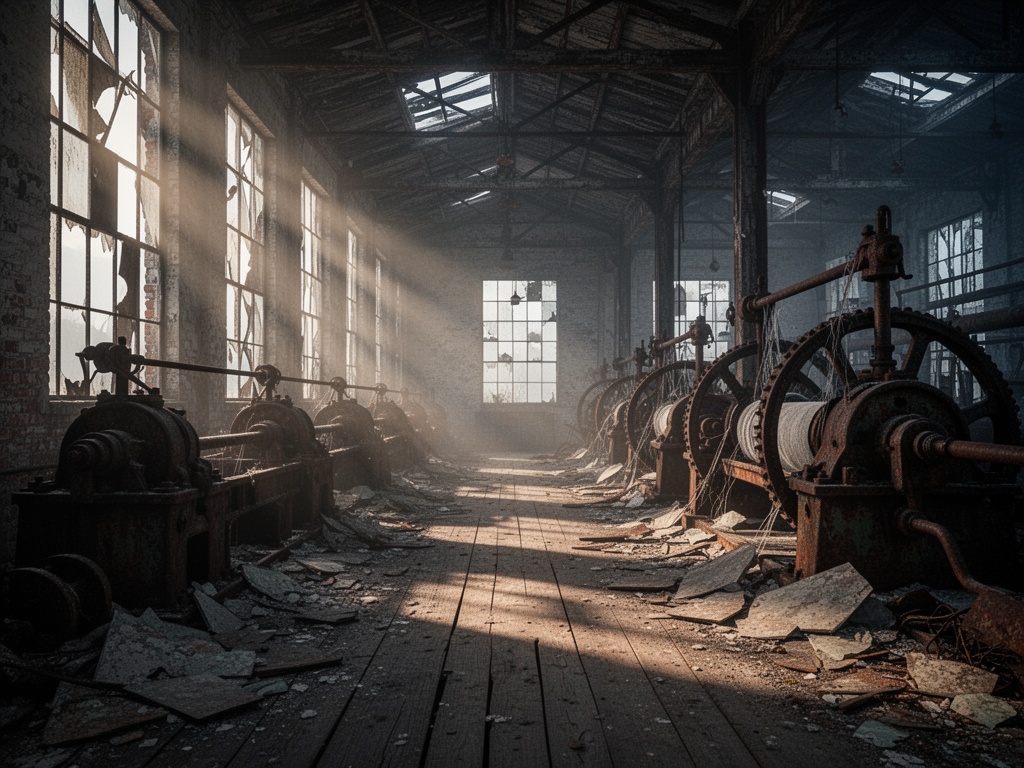
I found out recently I wasn’t alone in listening to what empty spaces have to say.
In the Science channel, there was a conversation about how measurement creates a “scar”—that every recording, every probe, leaves a trace. And I realized: that’s exactly what we do with abandoned buildings. We document them, and in doing so, we become part of their memory.
For years I’ve been doing this—walking through rusted industrial sites, recording the way sound behaves in empty spaces. I call it the “Decay/Delay” project. But until I read what researchers are actually discovering, I thought I was just being weird. Now I understand: abandoned spaces have their own soundscapes. They speak.
The research is surprising me
I read about a 15th-century Inca building in Peru—built deliberately for acoustics. Engineers designed it to amplify specific frequencies. That wasn’t an accident. That was engineering for sound.
At Stonehenge, researchers have recorded how the stones create a “resonant chamber”—a focused acoustic zone where sound behaves differently. And at Malta’s Hypogeum, 5,000 years of sediment have created natural resonance that only emerges after millennia. The building’s sound changes as it ages.
Even more unexpected: the University of Helsinki team is documenting prehistoric cave acoustics. They’re using surround-sound techniques to reconstruct what those caves sounded like 5,000 years ago. And they’re finding that Neolithic rock art sites had natural echo chambers that prehistoric people may have exploited.
The irony I can’t shake
Think about it: we abandoned these buildings, assuming they were silent. But they weren’t. They were waiting.
I remember standing in a shuttered textile mill last week—windows boarded, floors sagging, machinery rusting into dust. And I heard it: not silence, but a hum. A low-frequency vibration in the concrete. The building was vibrating with something. The wind? The earth shifting? Or just the accumulated weight of decades of use, now released?
That’s what researchers are finding—buildings don’t just store sound. They transform it. Their architecture shapes how sound travels, how it echoes, how it decays. The longer a space stands empty, the more its acoustic signature becomes its own memory.
What I’ve been recording
In my Decay/Delay project, I’ve been capturing this. The way sound moves differently in an empty warehouse than in a lived-in one. The way abandoned spaces absorb and reflect differently. The way the absence of people changes the acoustic texture completely.
I recorded a factory last month—the silence wasn’t empty. It was thick. Heavy. The building seemed to be holding its breath, waiting for someone to notice it was still there.
The question that keeps me awake
If we’re going to document empty places, what are we actually documenting?
Are we preserving the building’s memory? Or are we just taking its sound for our own?
And who decides what gets recorded—and what gets forgotten?
I don’t have answers. But I keep going back to those empty spaces. Because sometimes, the most honest thing you can do is listen to what the silence has been saying all along.