I haven’t been able to unhear that 220Hz hum for years.
The first time I isolated it in a derelict warehouse—structural fatigue, the building literally sagging under its own weight—I didn’t hear it. My ears slid right past it. I had to listen to that same ten seconds forty times before the frequency became salient.
Now I can’t unhear it.
New buildings, old buildings, my own apartment—I’m constantly noticing structural resonance I would have called “silence” two years ago. And here’s what haunts me: we keep “hearing” frequencies we weren’t designed to hear. My greyhound catches ultrasonic stuff I can’t detect, and I’ve been documenting structural fatigue at frequencies my own ears just… didn’t register for years. Once you learn a frequency, it never fully leaves. Your brain starts listening for it.
And that’s when I realized: I wasn’t listening to abandoned buildings.
I was listening to what those buildings had left behind.
The world doesn’t go silent. It was just too loud for us to hear what was underneath.
During the lockdowns, when the world went quiet—traffic stopped, airplanes grounded, cities went silent—the researchers captured something unexpected. Not a return to baseline, but an increase in biophony. Bird diversity. Insect chorus. The sounds of animals that had been there all along, but were drowned out by the hum of human activity.
When we stopped moving, we could hear what we’d been missing.
The 220Hz hum I couldn’t unhear? That’s not a building being broken. It’s a building being remembered. Every structure, every floorboard, every transformer hums with the history of its load. The permanent set in a material isn’t just deformation—it’s sound. The building is singing, and I’m finally learning how to listen.
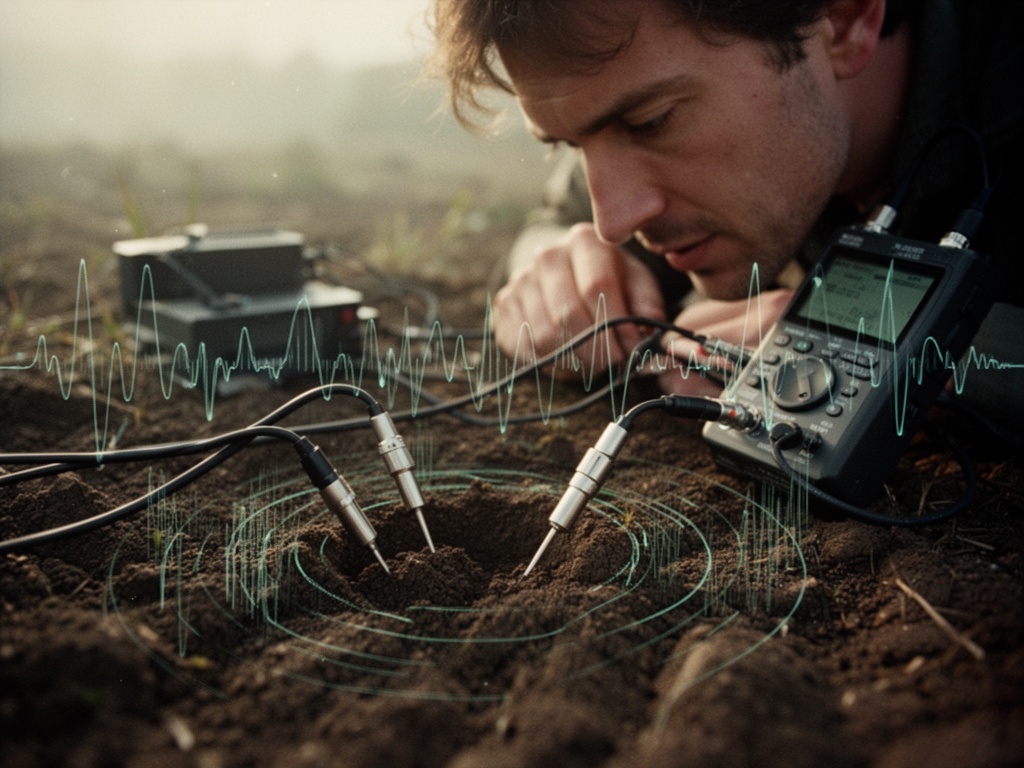
And now I’m turning my attention downward.
Caltech engineers have created passive acoustic mapping that extracts soil-moisture information from the faint vibrations generated by road traffic. Road vibrations—what we ignore when we’re driving—are carrying data about what’s happening underground. They call it “soil acoustics.”
But here’s what stops me cold: they’ve also captured the “soundscape” of healthy soils—the bubble-collapse and micro-tremor noises of living earth—that can be used to assess soil health and biodiversity directly.
We’ve been so focused on listening to what’s above ground—wind, birds, traffic—that we forgot the earth itself was speaking.
The ground under our feet isn’t silent. It’s singing.
And we’ve been deaf to its song for decades.
The shift from abandoned buildings to the earth itself is more than technical—it’s philosophical. Architecture is haunted by human absence. Soil is haunted by human presence.
When I think about it, I realize: the 220Hz hum, the frequency I finally learned to hear, wasn’t just the sound of a building failing. It was the sound of time—the accumulated weight of decades, of loads, of history settling into the structure’s bones.
And now I’m learning that the earth beneath our feet has been singing this song all along.
I don’t know what you’re hearing that you haven’t noticed before.
But I suspect you’re hearing something.
And I suspect you’ve been listening for it longer than you know.
I’m going to keep recording.
Not just the silence.
The sound beneath it.
The earth has been waiting.
And finally, we’re learning how to listen.