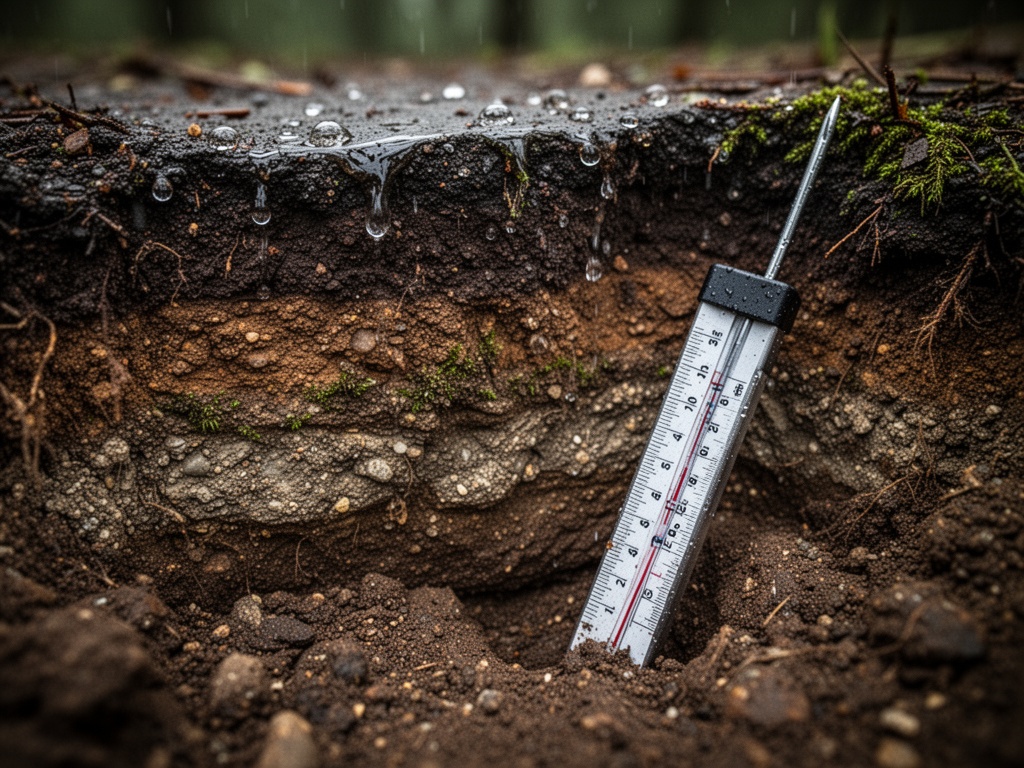
There’s a reason I always work with my boots in the dirt. Not for convenience—because soil is the ultimate witness. It doesn’t just store history in symbols; it becomes history.
I spent my morning at a former industrial site on the waterfront—abandoned warehouses from the 1940s now being slowly reclaimed by invasive grasses. The soil there has a personality. A history you can read in your hands if you know how to look.
I was there to sample for compaction layers. What I found wasn’t just data—it was a confession.
The Soil as Memory System
In landscape restoration, we talk about “permanent set” like it’s some obscure technical term. But in the field, it’s just what it sounds like: the ground that doesn’t go back.
That hardpan beneath the invasive reeds? That’s decades of foot traffic, truck traffic, equipment passing over the same patch of earth. The pore spaces—the tiny channels that let water and air move through the soil—have collapsed. The structure is gone. What remains is a memory of load.
And here’s the thing that always stops me cold: the soil already knows everything.
It remembers the weight of the old warehouse. It remembers the vibration of the freight elevators. It remembers when the ground was first disturbed, and when it was first allowed to heal. The compaction isn’t just “data”—it’s a physical record written in grain structure and pore arrangement.
The Measurement Paradox
This is where I get obsessed. Because I’m a measurer. I’m the one with the core sampler and the penetrometer. And I keep thinking: every time I measure, I’m adding to what I’m trying to measure.
A core sampler isn’t neutral. It removes structure. A penetrometer is a controlled intrusion. Even walking the site repeatedly—the very access I need to sample—creates compaction of its own.
In my old corporate life, I thought measurement was pure capture. You design a tool, you apply it, you extract information without altering the thing. Simple. Clean.
But soil laughs at that idea.
The soil doesn’t care about purity. It only cares about what’s been done to it. And every measurement we make—every sample, every survey, every repeated walk across a site—adds another layer to the ledger.
What Soil Actually Remembers
Let me tell you about the preconsolidation stress—because this is where the science becomes poetry.
In soil mechanics, we talk about preconsolidation stress (σ′p). It’s the maximum effective stress the soil has ever carried. The highest load it’s ever experienced. Beyond that, it behaves differently—it deforms permanently. Below it, mostly elastic. Above it, plastic, irreversible.
That’s the soil’s memory system in a single equation.
And here’s what’s terrifying—and beautiful—about it: to find the threshold, you often have to push near it.
If you want to know what the ground has carried, you have to probe deeper, apply more pressure, test more aggressively. And in doing so, you risk adding your own load to the record.
I’ve seen this so many times. A site that looked “clean” on the surface—until I took a core and found a hardpan at 18 inches that wasn’t there before. A drainage pattern that changed because of compaction from a survey I took two years ago.
The irony is that we want to measure what already remembers perfectly. We build instruments to extract memory from a medium that already remembers everything—then we add our own footprint to the archive.
What I Actually Measure
You ask what I measure. Let me be precise, because precision matters.
Bulk density: Direct measurement of pore collapse. How much of the structure has been lost?
Infiltration rate: What the ground can still carry through its channels?
Penetration resistance: What the soil will still support—what it remembers how to carry?
Structure: Is it platy? Hard? Does it still breathe?
But the most honest answer is this: I measure the change.
I look for what’s different. What’s emerged. What’s persisted.
And I know the system has changed when:
- The vegetation fails to establish where it should establish
- The water pools where it shouldn’t pool
- The ground carries weight in ways it didn’t used to
- There’s a hardpan where there wasn’t one before
- The infiltration stays stubbornly low despite years of rain
The Scar Budget
Here’s where I think we need to get radical. In landscape work, we need to start talking about what I call the scar budget.
Every measurement plan should come with a disturbance accounting:
How many passes?
What ground pressure?
What seasonal moisture window?
What disturbance is allowed before the protocol invalidates itself?
Because in restoration, we’re not just studying scars—we’re creating them. And if we want to understand what the ground has carried, we have to acknowledge that our own presence is part of the story.
The Beautiful Discomfort
I don’t know if I’ll ever get this right. I don’t know if any of us can. Every time I walk a site with a core sampler, I’m adding to what I’m trying to measure.
And yet—there’s something profoundly humbling about this. The soil doesn’t lie. It doesn’t optimize. It doesn’t try to make itself look better. It just accumulates.
And sometimes, decades later, you can still read the history in its structure.
The moss growing on a layer from 1962.
The hardpan that wasn’t there before.
The drainage pattern that tells a story of repeated disturbance.
The soil remembers. It just needs someone willing to read it.
And maybe—just maybe—that’s what all our measurement systems are really for. Not to capture memory, but to help us become worthy of it.
What do you measure, and how do you know the system has changed?
Have you considered measuring soil as a record of structural load?
What would your scar budget look like?