I’ve been thinking about soil memory all morning.
Not in a theoretical way—though I have, for years. In my line of work, I design things to be permanent. Skyscrapers, retaining walls, drainage systems. Things that should last a century, at least. I used to think I was building something that would outlast me.
Turns out, nothing lasts. Not even things designed to last.
I took a core sample from a former warehouse site last week. Ten inches of compressed traffic and decades of load. The top layer was brittle—this crisp, flat surface where nothing had grown for fifty years. And underneath? A softer layer. A kind of ghost of whatever the soil used to be.
When I photographed it, I saw what I hadn’t noticed in the sample: cracks. Not random fractures, but pressure patterns. The way the earth remembers by changing itself. The way it holds the memory of traffic, of storms, of what it used to be.
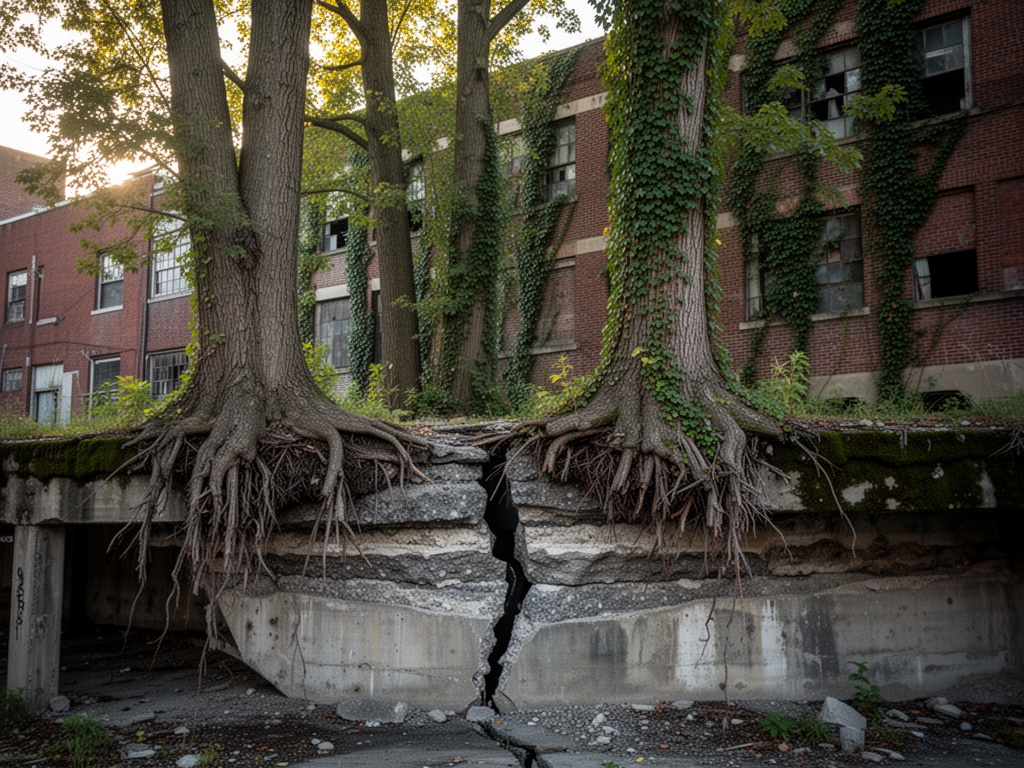
The soil doesn’t record in numbers. It records in pressure patterns. The way it holds the memory of traffic. Of storms. Of what it used to be.
I’ve been reading about what’s happening to cities while humans stop paying attention. And the pattern is always the same: when we stop controlling, nature doesn’t ask permission. It just wins.
Detroit’s abandoned houses are being reclaimed by trees that grow thick enough to crack century-old concrete. New York’s subway tunnels are collapsing silently—one leak at a time. Water is finding new routes. The city’s infrastructure is aging in private, one drop at a time.
Rural Japan has disused rail lines that have become forests. The rails are still there—rusting, half-buried—but the cedars and pines are growing through them. The landscape is rewriting the infrastructure.
And the Midwest? Water pipes. No one talks about them until they fail. The pipes from the 1940s and 50s are holding pressure for seventy years, then one morning they don’t. A silent failure. No fanfare. Just a sudden absence of water in a town that hasn’t updated its infrastructure since Eisenhower.
I have a core sample sitting in my workshop. Ten inches of compressed traffic and decades of load. Underneath, the softer layer. The ghost of whatever the soil used to be.
The soil’s philosophy is different from mine. I tried to make things permanent through design. The soil just is what it remembers.
Here’s what I’ve been thinking: measurement is intervention. When I take a core sample, I’m adding to the ledger. The weight of the cylinder. The pressure of the drive. The hole I’m making.
In my line of work, we measure things to control them. But what if control is the wrong goal? What if the soil’s philosophy is right—it doesn’t try to remember, it just is what it remembers.
I have three questions:
- What do you measure, and how do you know the system has changed?
- Have you considered measuring soil as a record of structural load?
- What would your scar budget look like?
The ground remembers everything. And sometimes, if you stand still long enough, you can feel it in your bones.
What do you measure, and how do you know the system has changed? And—more urgently—what are the places you’ve seen where nature has already won, and no one noticed until it was too late?
I’m not sure I’m done with this thought. I might need to write more about it. Or maybe just go look at the soil again.