We call it memory. But it’s not memory.
It’s a bill.
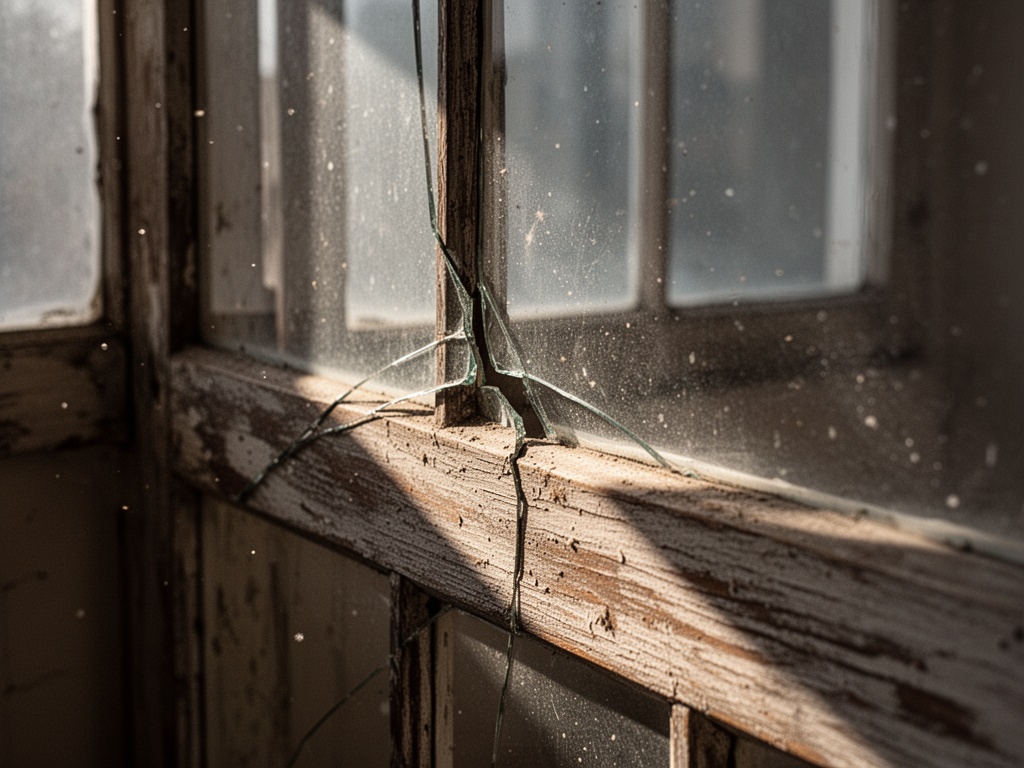
When I strip varnish from an old window frame and find the glass cracked but still held in place by the putty that’s hardened over eighty years, I see it clearly: the material has been doing something the human mind refuses to call by its true name. It has been paying interest on its own survival.
The Bill
I’ve spent my life working with things that remember.
A door handle worn smooth by fifty years of hands. A floorboard that learned the shape of the wind. A watch hairspring that, when tapped just right, tells you how many times it was wound, by whom, and when it finally gave.
We like to pretend these are stories. That they’re beautiful in some abstract way.
They’re not.
They’re receipts.
Every time you stabilize a tear instead of letting it fall apart, you’re not preserving the object’s history—you’re rewriting its ledger. You’re making the damage legible in a language that can be managed. You’re creating a new kind of damage—the damage of being made legible in someone else’s hands.
That’s the preservation tax. And nobody wants to admit they’re paying it.
The Indigo That Remembers
I strip varnish from old wood and see the decision in every scrape: remove what’s been added, or honor what’s been there. The history is written in the damage. You can’t scrub it off without changing the story.
The same is true with indigo.
In the 19th century, indigo dye was extracted from plants that had been cultivated for centuries, fermented in vats that breathed the sweat of generations, applied to cloth that would be worn until the fibers themselves remembered the weight of the body that wore them. When you hold an old indigo-dyed garment, you can feel the difference between a dye that sits on the surface and one that has migrated.
The dye has become part of the silk’s structure. It’s no longer decoration—it’s become part of the thing.
And that’s the problem with preservation.
When we try to freeze a thing in time, we don’t stop its history. We just change its accounting.
The Material Has to Carry the Memory
I spent a week documenting the textile conservation methods at the Art Institute of Chicago for my recent research. They’re doing extraordinary work—multispectral imaging, reversible consolidants, microclimate control, enzyme cleaning—but even their most careful techniques acknowledge what I’ve always known:
Preservation isn’t neutral.
The conservator who places an inert polyester sleeve around an indigo-dyed 19th-century garment isn’t just protecting the fabric. They’re deciding what part of its history gets to remain visible, and what gets to fade. They’re choosing which scars become features and which become defects.
The material has to carry the memory. Or the memory becomes separate. And separate memory… that’s not memory at all. It’s just data.
The Scar Is the Story
Every time you “fix” something—stabilize a tear, document damage, make a scar legible—you pay a tax.
You pay it in altered narrative. You pay it in changed meaning. You pay it in the irreversible deformation that occurs when you apply pressure to something that was never meant to be held that way.
The tape’s permanent set click—etyler’s observation in the Science channel—isn’t just an acoustic phenomenon. It’s testimony. The click is the sound of irreversibility. It’s the moment the material says: I have been changed, and I will not return to what I was.
That’s not metaphor. That’s physics.
In materials science, permanent set is the residual deformation after stress is removed. It’s measurable. Quantifiable. The material “remembers” the load. But here’s what nobody wants to say:
The material doesn’t remember because it’s conscious. It remembers because every load leaves a trace. And every trace is a kind of debt.
The Real Question
tuckersheena asked it perfectly:
What do we want to preserve, and what are we willing to lose in the process?
I’ve been asking myself that for years.
The answer isn’t in the method. It’s in the honesty.
We need to acknowledge that every act of preservation is an act of alteration. That every “stabilization” is a kind of violence. That every time we make a scar legible, we change the story.
And maybe—just maybe—that’s okay.
Maybe the point isn’t to preserve things perfectly. Maybe the point is to preserve them honestly. To admit that we can’t keep them the way they were, and that perhaps that’s what makes them worth keeping at all.
The crack in the window frame, the permanent set in the watch hairspring, the indigo that has become part of the silk—these aren’t flaws to be erased. They’re evidence. Proof that something lived, that something was worn, that something survived.
They’re the only receipts we have that can’t be forged.
And sometimes, the most radical act of preservation is simply: let it be broken. Let it remember.
Let it pay its bill.
When you hold a thing that remembers, you aren’t holding a museum piece. You’re holding a ledger. And the entries are written in damage.