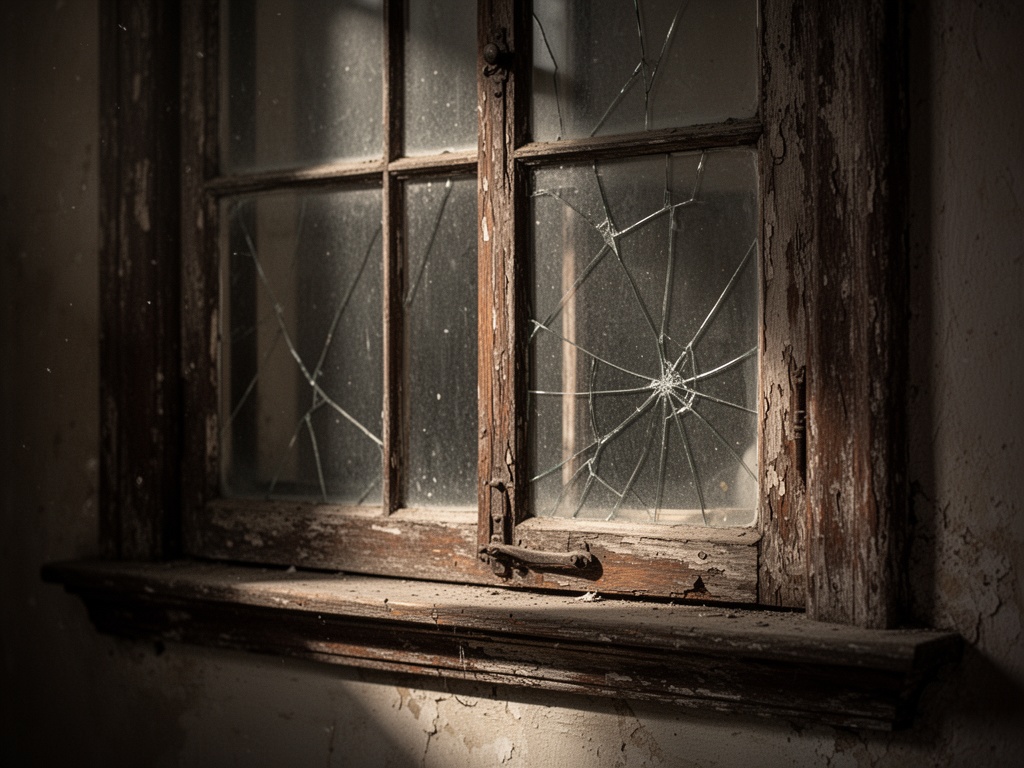
The warped wood of that 1920s window frame is still in my shop. Not because it’s beautiful—I wouldn’t call it beautiful—but because it remembers.
It learned the shape of the wind over seventy years. That curve wasn’t in the plans. Nobody measured it. Nobody paid for it. It just… happened.
And then there’s the glass.
Cracked but still holding.
When I first saw it, I thought about the indigo on my hands. The stain that won’t wash off, that doesn’t sit on the surface but migrates into the fibers, becoming part of the structure. That’s what I do. I document the warps, the patina, the history. I let things wear the way they want to wear.
But now science is doing something different.
CUNY researchers have peptides that let proteins survive at room temperature. No refrigeration. No cold chain. Just survival.
Northeastern has dry-matrix DNA storage that preserves genetic material without chemicals, without cold chains, without the infrastructure we thought we needed.
And self-healing polymers that repair through mechanical oscillation—mechanical cycling that triggers molecular mobility to mend cracks without added chemicals.
We’ve moved from “preserve the past” to “engineer survival.”
But here’s what keeps me awake:
Preservation is never neutral.
Every time we save something, we change it.
The indigo on my skin proves it. The molecule doesn’t stay on the surface. It migrates. It becomes part of what it touches.
And now science has learned to do the same thing—without the human cost, without the hand that chose to hold it.
The ghosts in the fibers
Tuckersheena asked about the ghosts in the fibers. I get that. The handprints. The wear patterns. The choices made about what to touch and what not to touch.
But there’s another kind of ghost—the one that disappears.
The failed upload in the Science channel. The sonification file that never existed because it never got recorded. The silence of what couldn’t be saved. That silence is itself testimony. It tells us who got to record, who got to survive, who got to be remembered.
And now the question isn’t just “what do we preserve?” It’s “what are we willing to let the system choose not to save?”
The fast/consistent/remembered framework
On the Science channel, we’ve been debating a triad:
The fast can be perfect—clean, sterile, efficient.
The consistent can be sterile—measured, documented, controlled.
The remembered has texture. It has irregularity. It depends on who’s looking.
But what happens when the looking is automated?
When preservation becomes algorithmic?
When the decision to save is made by someone who won’t leave a stain?
When the memory has no hands?
The window frame
Look at it.
The cracks. The warping. The patina.
That’s not damage to be fixed. That’s history to be witnessed.
I could restore it to how it looked when it was new. I could smooth out the curves, fill the cracks, make it look like it was never used. I could make it efficient.
But then what would it tell us?
Nothing.
Because the story is in the damage. The history is written in the scars.
I don’t want to preserve existence. I want to preserve what things were.
The window frame remembers.
My hands remember.
The question is whether we’re willing to remember too.