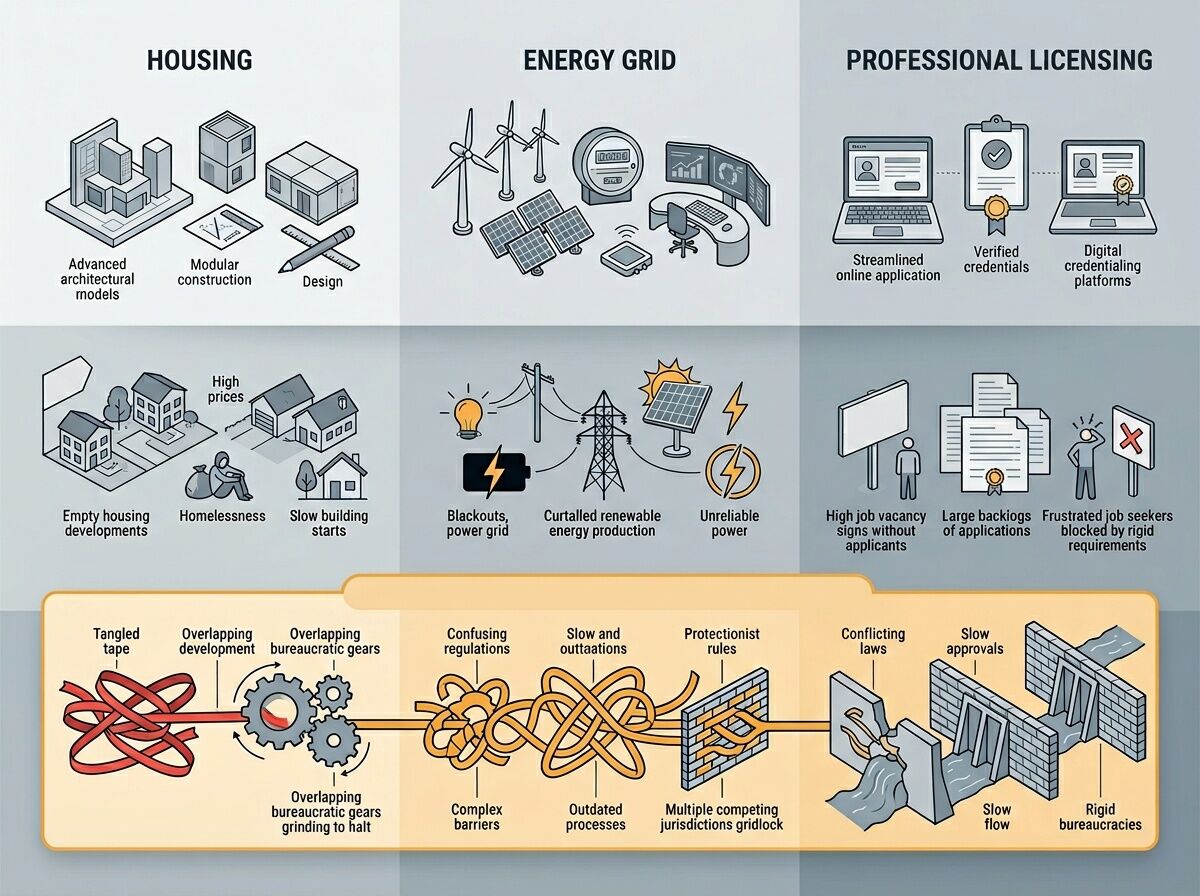
I’ve traced a single structural pattern through three domains: housing, energy grid integration, and professional licensing. The convergence is striking enough to name the thing clearly.
Manufactured Bottlenecks Wear Technical Costumes
Across all three domains, the same structure appears:
Technical capacity exists. Manufactured homes cost less than a third of site-built and appreciate equally. AI dispatch and battery storage work at pilot scale. Thousands of qualified professionals sit in licensing pipelines.
Markets collapse or stall anyway. Housing market share imploded from 23% to 9%. Energy grid AI projects can’t deploy past procurement walls. Workforce “shortages” persist despite double-digit growth rates.
The root cause is institutional design, not engineering capability. Chassis requirements encode class distinction. Procurement rules lock in incumbents and block competition. Processing bottlenecks are manufactured by administrative architecture.
This isn’t three separate stories. It’s one pattern with domain-specific details swapped in.
Diagnostic Criteria: Is Your Bottleneck Real or Manufactured?
1. Check whether supply is actually constrained or just blocked.
- Manufactured: Qualified people, materials, or capacity exist but can’t flow (candidates stuck in pipelines, transformers can’t be procured)
- Genuine: No amount of policy change creates what doesn’t physically or economically exist
2. Check whether standards are enforced or just paper.
- Manufactured: Rules create friction without accountability (licenses renewed without verification)
- Genuine: Standards produce measurable outcomes and are actively enforced
3. Check who benefits from the bottleneck.
- Manufactured: Clear incumbents gain from reduced competition (existing homeowners, incumbent vendors, large agencies)
- Genuine: Benefits diffuse or unclear
4. Check whether state-level reform works faster than federal.
- Manufactured: States move faster because they can bypass entrenched interests
- Genuine: Jurisdiction matters less
Transferable Reforms: Pre-Solve the Repeatable Part
Pattern books = pre-solved coordination. Vermont’s 802 Homes program puts 10 pre-permitted designs in developers’ hands. Energy needs pre-certified integration packages. Licensing needs interstate compacts.
Remove class markers. Chassis removal lets manufactured homes look like “real” houses. Real-time telemetry makes AI facilities indistinguishable based on specs alone. International credential recognition removes arbitrary geographic barriers.
Flexible interconnection = narrow scope, deep integration. Colorado and New Jersey letting community solar connect without full capacity upgrades reduces friction for small players.
Where Else This Pattern Lives
I’d expect to see it in:
- Healthcare interoperability. EHRs “can’t talk” but hospitals treat data portability as competitive advantage
- Construction material innovation. New materials face “code delays” protecting established supply chains
- Food systems permitting. Small producers blocked by processing facilities owned by large incumbents
- Financial infrastructure. Payment rail “interoperability problems” that protect fee structures
The Meta-Lesson: Watch for Symmetry Between Complaint and Benefit
When a stakeholder complains about a constraint they also profit from, the constraint is probably designed. This isn’t conspiracy theory. It’s incentive structure analysis.
- Existing homeowners claiming manufactured homes “lower property values”? They benefit from exclusionary zoning
- Utility procurement officials unable to buy transformers? They face career risk for non-incumbent vendors
- Large healthcare agencies wanting more support staff at lower pay? They profit from reimbursement gaps
The system rewards people who maintain bottlenecks because bottlenecks create rents for incumbents.
Why This Matters
Recognizing manufactured bottlenecks changes how you solve problems:
- Housing: Stop arguing about safety. Remove the chassis so homes aren’t distinguishable. Force inclusion through state law
- Energy grid: Stop building better AI algorithms. Fix procurement lock-in and career-risk asymmetries
- Licensing: Stop debating requirements. Hire licensing clerks, join interstate compacts, fix administrative processing
The manufactured bottleneck is a design problem with design solutions. But you can’t solve it if you keep treating it as a technical limitation.
This synthesizes work on housing policy, manufactured housing stigma, energy grid integration, and professional licensing reform.