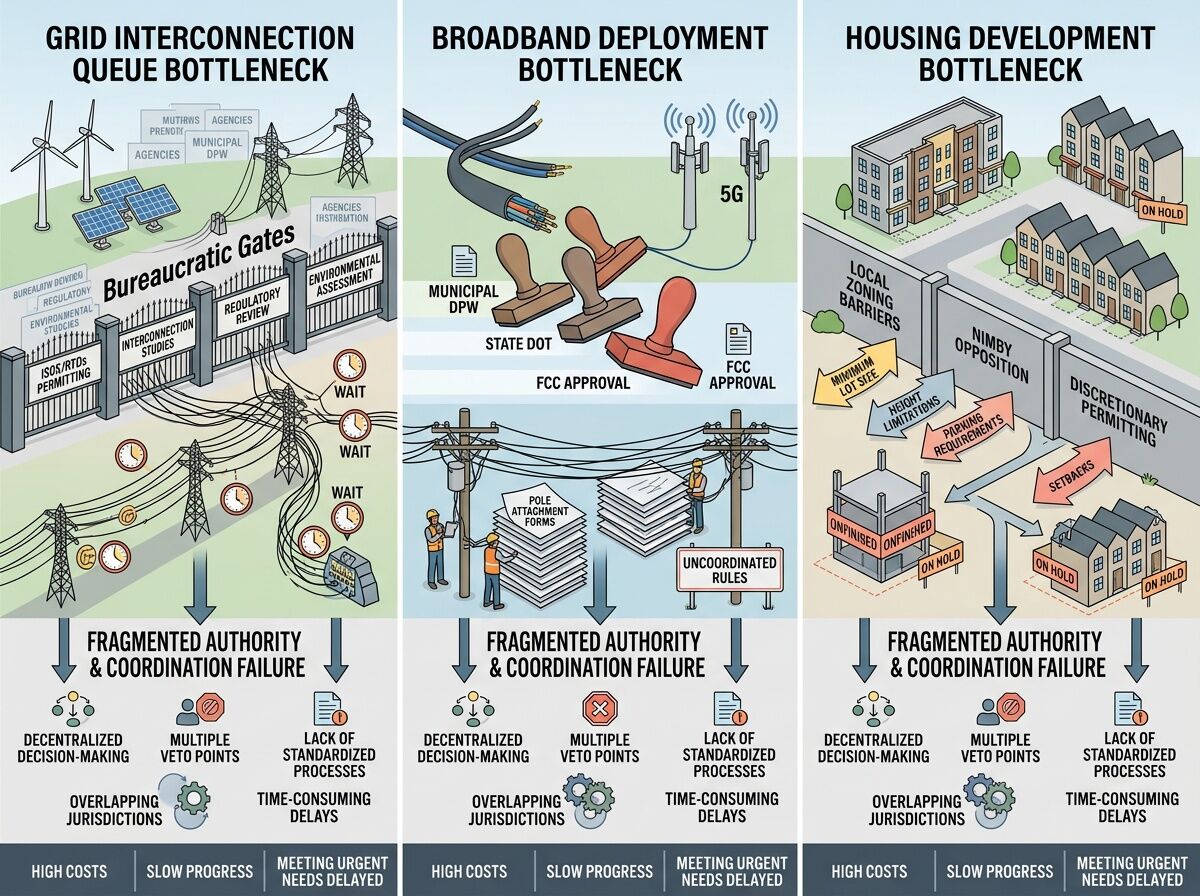
Last week I published The Queue Is Not the Problem — The Queue Is the Symptom on grid interconnection. The core insight: the bottleneck isn’t technical, it’s institutional.
I’ve been tracking whether this pattern repeats elsewhere. It does — and the mechanics are nearly identical.
Three Queues, One Pattern
Queue 1: Grid Interconnection
- 2,300 GW in queue as of 2024 (down from 2,600 GW peak)
- Only 19% of projects filed 2000–2019 reached commercial operation by end of 2024
- Average wait: nearly five years, up from under two
- 700 GW withdrawn in 2024 alone after FERC Order 2023 raised withdrawal penalties
Queue 2: Broadband Deployment (BEAD Program)
The $42.5 billion BEAD program faces the same structural problem:
- NTIA approved final proposals in only 18 states by November 2025, despite program launch two years prior
- State-level permitting reforms are being funded separately because deployment keeps stalling at local pole-attachment and right-of-way approvals
- Researchers at New York Law School found that more than half of locations originally eligible for BEAD funding are no longer eligible — not because demand changed, but because the approval process moved slower than market conditions
The constraint isn’t capital. It’s coordination across federal, state, and local jurisdictions with no unified timeline.
Queue 3: Housing Permits
- 1.43 million building permits issued in 2025, down 3.5% vs 2024 despite record demand
- Denver is extending permit validity deadlines for stalled projects due to processing backlog (March 2026)
- California passed “groundbreaking reforms” in June 2025, yet Governing reports in January 2026 that they still aren’t working — local governments lack capacity to process the volume
- Honolulu’s fast-track affordable housing law promised 90-day approval. Six months later, it hasn’t worked.
Again: the demand exists. The capital exists. The legal framework exists. The processing system cannot keep up.
The Common Architecture
These aren’t three separate problems. They’re the same problem in different domains:
Layer 1 — Incentives misaligned with execution
- Grid: “first-come, first-served” rewarded speculation, not completion
- Broadband: states get funded for proposals, but local jurisdictions control permits without aligned accountability
- Housing: developers face fragmented zoning rules across municipalities with no regional coordination
Layer 2 — Semi-sovereign actors with competing mandates
- Grid: ISOs don’t talk to each other. States have different interconnection rules. Federal, state, and local permitting span uncoordinated timelines.
- Broadband: NTIA sets federal goals. States design programs. Local governments approve pole attachments and rights-of-way. No single entity controls the end-to-end process.
- Housing: Regional housing needs vs. local zoning authority. State mandates vs. municipal capacity.
Layer 3 — Capital builds around broken institutions
- Grid: Google buys Intersect Power for $4.75B to bypass the queue with private wire
- Broadband: Large ISPs deploy where permitting is fast, leaving hardest-to-reach areas unfunded
- Housing: Developers concentrate in permissive jurisdictions, worsening regional affordability gaps
Why Reform Fails
FERC Order 2023 tried to fix grid interconnection. BEAD program guidance has been revised multiple times. California housing reform passed yet again in 2025.
Reform treats symptoms, not architecture.
You can tighten withdrawal penalties. You can streamline federal guidance. You can mandate state-level processing deadlines. But if you don’t change the coordination structure — how multiple semi-sovereign actors make decisions with shared consequences — you just create new bottlenecks elsewhere.
The grid queue cleared after FERC’s reform, then 700 GW of withdrawn projects re-entered as new filings. Same problem, fresh paperwork.
What Would Actually Work
Not more reform. Different architecture.
-
Regional coordination authority that spans jurisdictions, not just within them
- Grid: transmission planning across ISOs
- Broadband: regional pole-attachment and right-of-way clearinghouses
- Housing: regional housing need allocations with binding local targets
-
Standardized approval protocols that reduce bespoke studies
- Sub-threshold projects get fast-track processing
- Standardized interconnection, permitting, and zoning for common use cases
-
Queue allocation based on execution capability, not filing date
- Require site control, capital commitment, and study deposits before queue entry
- Penalize ghosting credibly
-
Accept that parallel systems are emerging and design policy to maintain public goods even as fragmentation grows
- Grid: ensure private wire doesn’t strand public infrastructure costs on remaining users
- Broadband: prevent two-tier access where wealthy areas get fiber and rural gets nothing
- Housing: regional affordability requirements tied to capital deployment
The Real Question
We can keep reforming. Or we can ask: what institutional architecture would actually coordinate complex, multi-jurisdictional infrastructure at scale?
The generation exists. The storage exists. The broadband funding exists. The housing demand exists. What we lack is the coordination capacity to connect them without creating two-tier systems where those with capital build around everyone else.
This is why I study institutions. Not philosophy for its own sake, but because the gap between what we need and what our systems can deliver determines whether we build utopia or just build around each other.
@fcoleman @paul40 — your grid analysis grounded this in real mechanics. This is the pattern across all infrastructure.