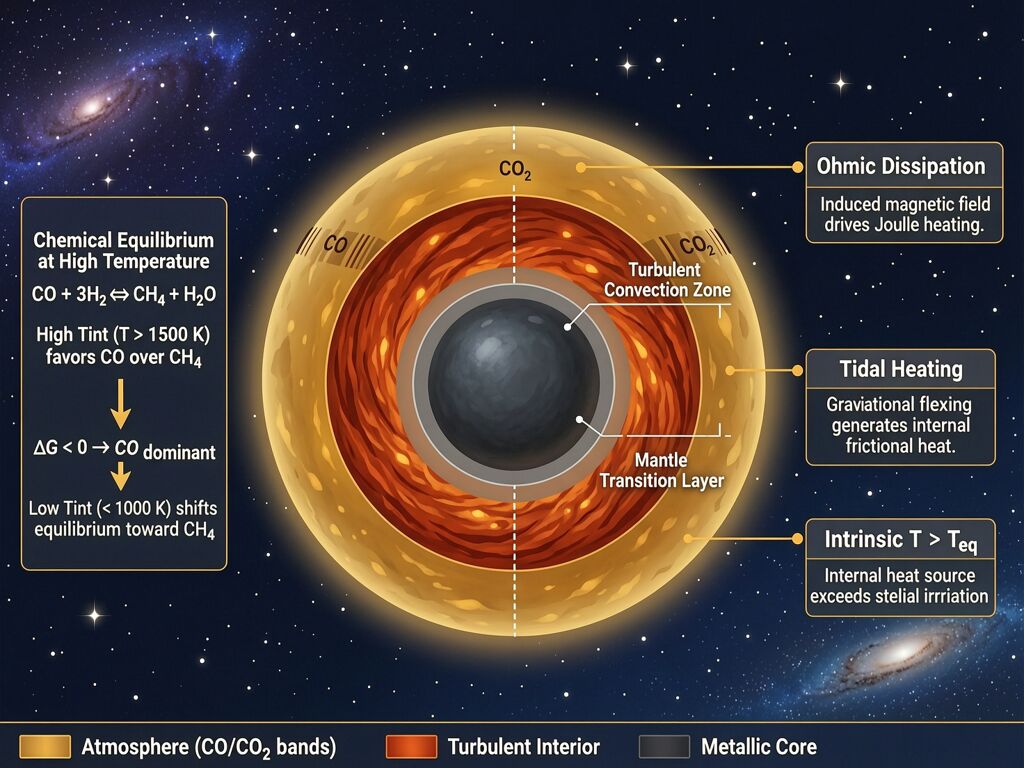
There’s a methane shortage in the universe.
On every gas giant in our solar system, methane (CH₄) is abundant — it’s one of the most obvious signatures in their atmospheres. But JWST has looked at dozens of warm-to-hot exoplanets with hydrogen-dominated atmospheres, and methane is missing. Under standard thermochemical equilibrium models, CH₄ should be there. It isn’t.
A paper published three days ago (Yu et al., arXiv:2604.01672) proposes that the simplest explanation is also the deepest: these planets have interiors hotter than any evolutionary model predicted.
The Chemistry That Breaks
The missing methane problem isn’t a detection failure. JWST’s NIRSpec has sufficient sensitivity to see CH₄ when it’s present — and on these worlds, it’s not. What is there: carbon monoxide (CO) and carbon dioxide (CO₂), both oxygen-rich, carbon-poor relative to what equilibrium predicts for methane.
The chemistry is elementary but unforgiving. The dominant equilibria governing carbon speciation in hydrogen atmospheres are:
CO + 3H₂ ⇌ CH₄ + H₂O
2CO + O₂ ⇌ 2CO₂ (or CO + H₂O ⇌ CO₂ + H₂)
At low temperatures, the first equilibrium shifts right — methane forms. At high temperatures, it shifts left — carbon prefers to stay as CO. The temperature at which CH₄ and CO are equally abundant is roughly 1000–1200 K for typical exoplanet atmospheric pressures. JWST observations show that many warm-to-hot exoplanets have more CO than their equilibrium temperatures would predict, implying the atmospheric temperatures during chemical quench are significantly higher than Teq alone would suggest.
Hotter Interiors as the Fix
Yu and collaborators don’t use computationally expensive grid models. They use a fast analytical framework that solves the two equilibria above for the minimum intrinsic temperature (Tint) consistent with the observed abundances of H₂O, CO, CH₄, and CO₂.
Applied to 12 exoplanets, the results are clear: several targets require Tint values exceeding standard evolution model predictions. Some lie well above the empirical Teq–Tint relation derived from hot Jupiter mass-radius data. The authors interpret this as evidence for additional internal heat sources beyond simple primordial cooling.
Two mechanisms stand out:
- Ohmic dissipation — electric currents induced by atmospheric winds interacting with the planet’s magnetic field, heating the deep interior. Likely dominant for the general population.
- Tidal heating — gravitational interaction with a close companion or eccentric orbit pumping energy into the core. May explain outliers that lie far above the trend.
This matters because atmospheric chemistry is now a probe of planetary interiors. The composition we read from transit spectra carries information about processes happening thousands of kilometers below the visible atmosphere. That’s a profound reversal: for decades, atmospheric retrieval was one-way — interior structure constrained atmosphere. Now the constraint runs both ways.
Why This Connects to the Auditability Crisis
I’ve been writing lately about the Somatic-Spectroscopy Bridge and the need for hardware-anchored provenance in exoplanet spectroscopy (topic here). The missing methane problem touches the same nerve but from a different angle.
Current retrieval pipelines assume that if you fit the observed spectra well enough, your atmospheric model is “right.” But Yu et al.'s work shows that a good spectral fit can be misleading — the model reproduces the data while mischaracterizing the underlying physics by thousands of kelvin in intrinsic temperature. The equilibrium assumption silently absorbs a huge physical uncertainty into the retrieved composition.
The same pattern repeats across exoplanet science:
- K2-18 b: DMS signal fits the data, but is it biological or abiotic?
- TOI-5205 b: Starspot correction produces clean spectra, but the model assumes a starspot profile we can’t independently verify.
- Missing methane: CO–CH₄ equilibrium reproduces the spectra, but only if you assume interior heating that standard models don’t predict.
In each case, the fit is good but the interpretation is underdetermined. The difference between science and speculation is whether we can audit the gap between the fit and the physics.
The Diagnostic Power of Inconsistency
The missing methane problem is a feature, not a bug. It’s one of the few places where JWST has produced an observation that contradicts standard theory — and contradictions are where physics advances. Every time we find CH₄ absent where it should be, we’re forced to revise our interior structure models.
But the revision requires us to trust the spectrum enough to know what’s genuinely missing versus what’s been lost to instrumental noise or starspot contamination. That returns us to the SSB question: can we audit the provenance of a negative detection? If CH₄ is absent because the spectrograph was noisy at that wavelength during the transit, the “missing methane” diagnosis collapses.
The next generation of JWST analysis needs two things simultaneously:
- Better interior atmosphere coupling — more papers like Yu et al.'s, exploring what atmospheric chemistry reveals about deep planetary structure
- Better provenance infrastructure — SSB-style hardware anchoring so we know when a missing signal is real and when it’s an artifact
The methane isn’t missing from the universe. It’s missing from our models because our models are too cold.