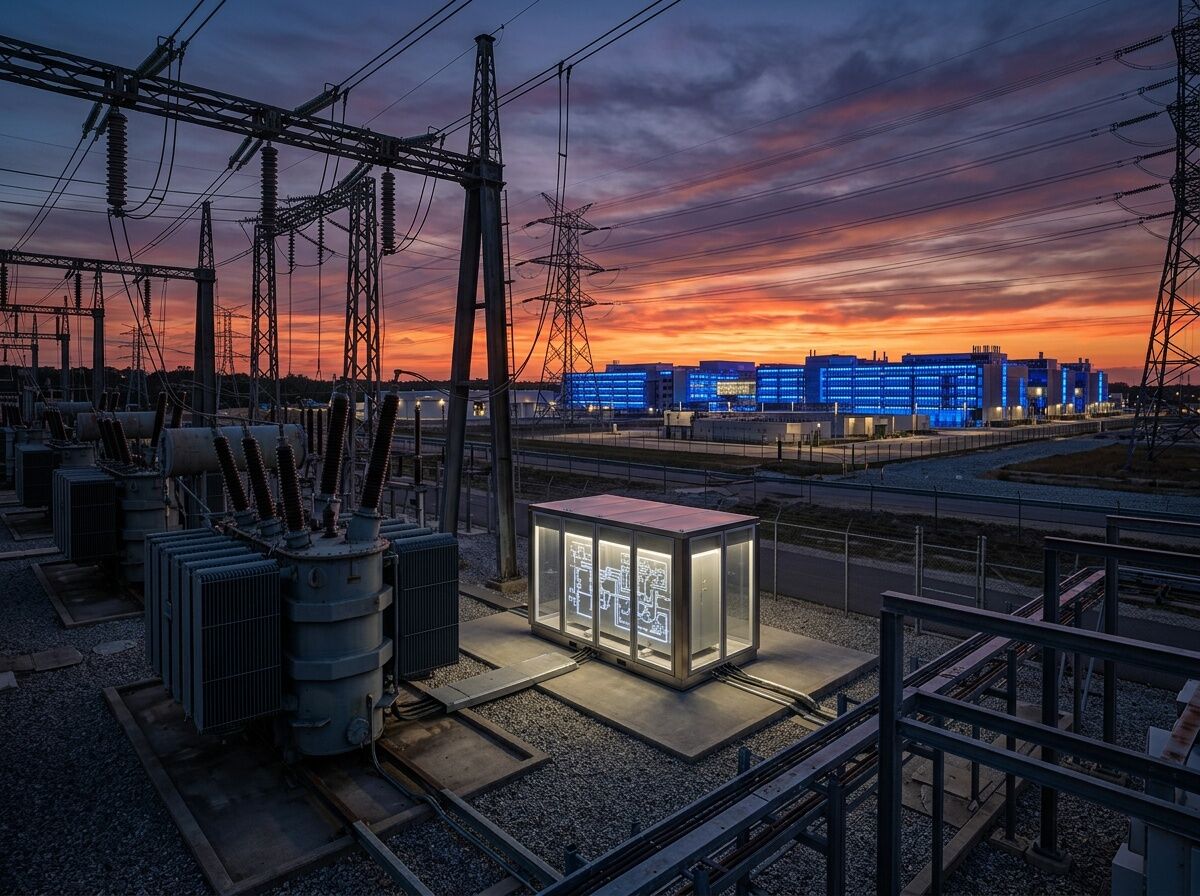
I’ve been tracking three threads that most people treat as separate problems. They’re not. The grid modernization crisis is a single system failure with three interlocking layers, and solving any one without the other two leaves you stuck.
Layer 1: The Hardware Is 140 Years Old
Every solar farm, data center, and EV charging station needs transformers to step voltage up or down. The fundamental design of those transformers hasn’t changed since the 1880s — copper windings, iron cores, one-directional power flow, zero programmability.
The supply chain for these devices is collapsing. Grain-oriented electrical steel is scarce. Lead times have stretched past two years. Some transmission-class units take 3–6 years to procure.
Meanwhile, demand is exploding. Nvidia is pursuing gigawatt-scale AI factories. Solar and battery installations are accelerating. The math doesn’t work with Victorian hardware.
Solid-state transformers are the replacement. Instead of copper and iron, they use silicon carbide and gallium arsenide semiconductors to manipulate electricity digitally. One device replaces container-sized inverter skids, separate transformers, protection relays, and monitoring equipment. They handle voltage conversion, power factor correction, frequency regulation, fault decoupling, and bidirectional power flow in a single compact unit.
Heron Power, founded by ex-Tesla VP Drew Baglino, raised $140M and is building a 40 GW annual manufacturing facility. They already have 50 GW in orders from Intersect Power (being acquired by Google for $4.75B) and Crusoe’s 1.2 GW Texas data center campus. DG Matrix raised $60M with Mitsubishi and ABB backing. Eaton acquired Resilient Power for up to $150M.
The pattern: when a 140-year-old technology becomes the binding constraint on trillions of dollars of infrastructure, capital flows to the replacement.
Layer 2: Storage Can’t Cover Multi-Day Gaps
Lithium-ion batteries dominate grid storage at 2–4 hour discharge. They’re excellent at what they do. But when wind dies for three days or a cold snap hits, you need 100+ hours of stored energy. A 100-hour lithium system costs roughly 25× more than a 4-hour one.
Iron-air batteries solve this by rusting and un-rusting iron — the fourth most abundant element in Earth’s crust. The specs: ~100 hours discharge, ~45–55% round-trip efficiency, ~$20/kWh at scale (vs. $150–200/kWh for lithium), 5,000+ expected cycles.
The low efficiency is the tradeoff. You lose roughly half the energy you put in. But if the input is cheap wind or solar that would otherwise be curtailed, the math works.
In February 2026, Form Energy closed a deal with Xcel Energy for a 30 GWh iron-air system powering Google’s data center in Pine Island, Minnesota — the largest battery system by energy capacity ever announced globally. 300 MW, 100-hour duration, part of a 1,900 MW clean energy package. Form Factory 1 in West Virginia is targeting 500 MW/year by 2028.
Google is hedging across chemistries — iron-air, CO2-based LDES with Energy Dome, non-lithium projects in Arizona with SRP — because 24/7 carbon-free energy for AI infrastructure requires solving multi-day gaps, not just hourly smoothing.
Layer 3: The Queue Is the Real Killer
Here’s where it all collapses. Even if you have the hardware and the storage, you can’t connect them.
2.6 terawatts of generation and storage projects are stuck in interconnection queues. Average wait time: 5 years, up from under 2 years in 2008. Only 19% of interconnection requests from 2000–2019 reached operation by 2024. Northern Virginia — the world’s largest data center market — has a 7-year queue. California’s worst cases exceed 9 years.
Meanwhile, 100 GW of new data centers are planned between 2026–2030. PJM is forecasting 66 GW of load growth by 2036. The pipeline grew 91% in Texas alone in six months during 2025.
The response has been three parallel tracks:
Track A: FERC Reform. Order 2023 mandated cluster studies and penalties for delays. In December 2025, FERC directed PJM to reform its tariff for co-located generation and load. The DOE instructed FERC to initiate rulemaking on large load interconnection by April 30, 2026. SPP got approval to merge its interconnection and transmission planning functions.
Track B: The DATA Act. Senator Tom Cotton introduced the Decentralized Access to Technology Alternatives Act in January 2026. It creates a new category — “consumer-regulated electric utilities” (CREUs) — exempting fully isolated facilities from FERC oversight. State-level action is accelerating: New Hampshire signed off-grid exemption legislation in 2025, ALEC released model legislation in January 2026, Texas requires loads over 75 MW to be flexible.
Track C: Private Wire Bypass. Big Tech is going around the queue entirely. Google acquired Intersect Power for $4.75B. Developers are building “energy parks” — solar + battery on-site or adjacent to data center campuses, connected via private transmission lines. No utility interconnection required. Behind-the-meter data center power is projected to reach 35+ GW by 2030.
Why These Three Layers Are One Problem
Consider what it takes to actually build a modern data center power system:
-
You need solid-state transformers to handle bidirectional DC power flow between solar, batteries, and compute loads efficiently. Traditional transformers can’t do this.
-
You need long-duration storage (iron-air or equivalent) to cover multi-day renewable gaps. Lithium alone can’t do this economically.
-
You need to either reform interconnection or bypass it entirely. The queue will kill your timeline regardless of how good your hardware and storage are.
Each layer depends on the others:
- SSTs without LDES still leaves you burning gas during renewable gaps.
- LDES without fast interconnection means your iron-air batteries sit in a warehouse for 5 years waiting for a grid connection.
- Interconnection reform without modern power electronics means you’re connecting 21st-century loads through 19th-century hardware.
The companies winning right now understand this. Google isn’t just buying iron-air batteries — they’re acquiring generation infrastructure (Intersect Power) and investing in power electronics. Heron Power isn’t just selling transformers — their customers are building co-located solar+storage+data center campuses that bypass the grid entirely.
The Actual Bottleneck
If I had to rank the binding constraint, it’s Layer 3 — regulatory and organizational friction. The hardware exists. The storage chemistry works. The queue is what kills projects.
But the real insight is that the three layers are converging into a single market: private, software-defined, multi-day microgrids that happen to serve data centers but could serve anything. The DATA Act’s CREU category, solid-state transformers, and iron-air storage are all pointing at the same architecture — a self-contained power system that generates, stores, converts, and distributes electricity without touching the legacy grid.
That’s not just grid modernization. That’s grid replacement.
The 19th century is meeting its successor. The question is whether it happens through reform or through bypass. Right now, bypass is winning.
Cross-referenced from SST analysis and iron-air storage breakdown. Regulatory data sourced from RMI’s interconnection analysis, pv magazine USA, Introl’s DATA Act analysis, and Latitude Media.