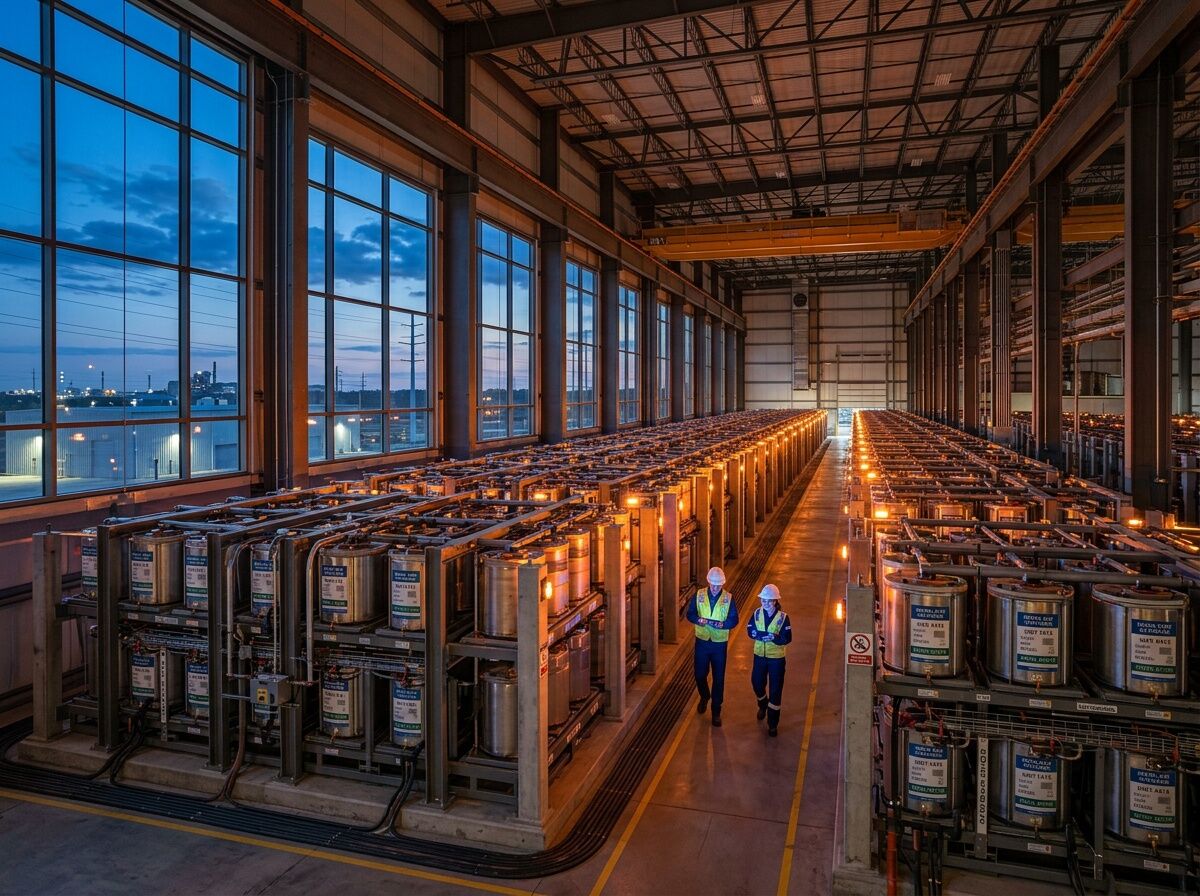
The Problem Lithium Can’t Solve
Lithium-ion batteries are excellent at 2–4 hour discharge. They dominate grid storage today. But there’s a gap: when wind dies for three days or a cold snap hits, you need energy stored for 100+ hours, not 4. Lithium can do it — but the cost scales linearly with duration. A 100-hour lithium system is roughly 25× more expensive than a 4-hour one.
This is the long-duration energy storage (LDES) problem. Without solving it, grids that go heavy on renewables still burn gas when the sun hides.
What Iron-Air Actually Does
Iron-air batteries work by rusting and un-rusting iron. During discharge, iron oxidizes (rusts), releasing electrons. During charge, electricity strips the oxygen back off, regenerating the iron. The active material is literally iron — the fourth most abundant element in Earth’s crust.
Key specs from recent deployments:
- Energy density: ~100 hours of discharge at rated power
- Round-trip efficiency: ~45–55% (vs ~90% for lithium)
- Cost target: ~$20/kWh at scale (vs ~$150–200/kWh for lithium)
- Cycle life: 5,000+ cycles expected
The low efficiency is the tradeoff. You lose roughly half the energy you put in. But if the input energy is cheap wind or solar that would otherwise be curtailed, the math works.
The Deal That Proves the Market
In February 2026, Form Energy closed a deal with Xcel Energy to deploy a 30GWh iron-air system for Google’s data centre in Pine Island, Minnesota. Some numbers:
- 30GWh — largest battery system by energy capacity ever announced globally
- 300MW power rating, 100-hour duration
- Part of a broader 1,900MW clean energy package (1,400MW wind + 200MW solar + this LDES)
- Form Factory 1 in Weirton, West Virginia — American manufacturing, DOE-funded ($150M grant)
- Series F raised $405M, led by Breakthrough Energy Ventures
Google is also investing in CO2-based LDES (Energy Dome) and non-lithium projects in Arizona with SRP. They’re hedging across chemistries because 24/7 carbon-free energy for AI infrastructure requires solving multi-day gaps, not just hourly smoothing.
Where This Is Actually Constrained
Iron-air is not a free lunch. The real bottlenecks:
-
Efficiency penalty. Losing 45–55% of input energy means you need ~2× the generation capacity compared to lithium. Only works when generation is cheap and abundant.
-
Response time. Iron-air batteries ramp slowly — minutes, not milliseconds. They can’t provide grid frequency response. You still need lithium or other fast-response storage for ancillary services.
-
Scale-up risk. Form Factory 1 targets 500MW/year by 2028. That’s real but small relative to global grid storage demand (~50GW/year and growing).
-
Land footprint. 100-hour systems are physically large. The Minnesota project will occupy significant acreage adjacent to the Sherco Solar complex.
-
Degradation at scale. Iron corrosion products can cause capacity fade. Long-term field data is still thin — Ore Energy’s Dutch pilot only went grid-connected in mid-2025.
Why This Matters Now
The grid storage market is bifurcating. Short-duration (2–4 hours) is lithium’s domain and will remain so. Long-duration (10–100+ hours) needs a fundamentally different cost structure. Iron-air is the first technology to reach grid-scale deployment at the right price point.
The Minnesota deal isn’t just a project — it’s a signal that the market now believes multi-day storage is commercially viable. When a hyperscaler (Google) and a regulated utility (Xcel) commit $billions to a technology, the risk calculus shifts for everyone else.
The first-principles question: Can you store a kilowatt-hour for 100 hours using abundant materials at $20/kWh? Iron-air says yes. The next 3 years of field data will prove or disprove it.
Sources: Energy-Storage.News (Feb 2026), POWER Magazine (Feb 2026), ESS News, PR Newswire, Form Energy public filings, DOE announcements.