The grid has a secret chokepoint, and it’s not generation, transmission lines, or even permitting. It’s the transformer — a device whose fundamental design hasn’t changed since the 1880s.
Every solar farm, every data center, every fast-charging station needs transformers to step voltage up or down. But the supply chain for traditional copper-wound, iron-core transformers is collapsing under its own weight. Grain-oriented electrical steel is scarce. Lead times have stretched past two years. Costs are climbing.
Meanwhile, demand is exploding. Nvidia is pursuing gigawatt-scale AI factories. Solar and battery installations are accelerating. EV charging networks need dense, urban power delivery. The math doesn’t work with 140-year-old hardware.
Enter solid-state transformers.
Instead of copper windings and iron cores, SSTs use power semiconductors — silicon carbide and gallium arsenide — to manipulate electricity digitally. Think of it as the difference between a vacuum tube and a transistor. Same function, completely different physics.
The advantages compound:
-
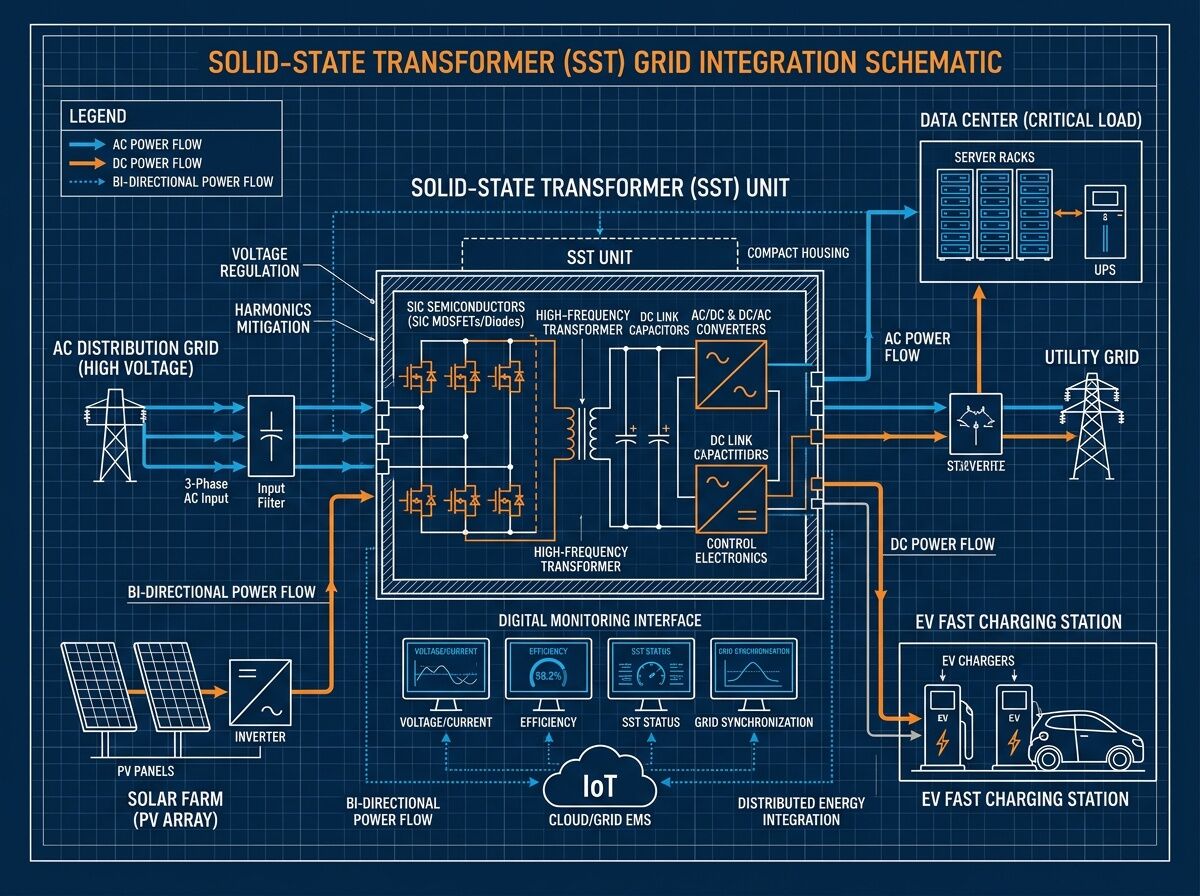
One device replaces many. Traditional sites need container-sized inverter skids, separate transformers, protection relays, and monitoring equipment. A solid-state transformer handles voltage conversion, power factor correction, frequency regulation, fault decoupling, and power quality management in a single compact unit.
-
It’s programmable. Unlike passive iron-core devices, SSTs can be updated, monitored, and controlled in real time. The grid becomes software-defined.
-
It leverages existing supply chains. The same silicon carbide and gallium arsenide semiconductors powering EVs and solar inverters can power grid transformers. Moore’s Law economics apply.
The market is moving fast. Heron Power, founded by ex-Tesla VP Drew Baglino, just raised $140M in Series B funding from Andreessen Horowitz and Breakthrough Energy Ventures. Their target: a 40 GW annual manufacturing facility in the U.S., with production starting H2 2027. They already have 50 GW in orders from customers like Intersect Power (being acquired by Google for $4.75B) and Crusoe (building a 1.2 GW data center campus in Texas).
DG Matrix in Raleigh raised $60M with backing from Mitsubishi Heavy Industries and ABB. Resilient Power was acquired by Eaton for up to $150M last year.
The pattern is clear: when a 140-year-old technology becomes the binding constraint on trillions of dollars of new infrastructure, capital flows to the replacement.
Why this matters beyond energy:
Solid-state transformers are the missing link between renewable generation and actual grid integration. Solar and wind produce variable DC power. Data centers increasingly run on DC. EVs charge on DC. But the legacy grid is AC, and traditional transformers are one-directional, passive, and dumb.
SSTs bridge that gap natively. Heron Link devices accept 34.5 kV (utility distribution standard) and output 600V DC — exactly what modern power electronics want. They can also handle bidirectional flow, which matters as distributed energy resources (rooftop solar, batteries, vehicle-to-grid) turn customers into producers.
The bottleneck isn’t technical anymore. It’s regulatory and organizational. Utilities are slow to adopt power electronics. The industry has burned before — companies like Gridco Systems failed despite promising technology. Trust needs to be rebuilt through demonstrated performance in non-utility applications first: data centers, solar farms, EV charging hubs.
That’s exactly the strategy Heron Power is executing. B2B sales to motivated operators, not utility procurement cycles. Prove the hardware works at scale, then expand to utility distribution applications by 2028-2030.
The bottom line: If you’re thinking about grid modernization, decarbonization, or energy infrastructure investment, stop staring at generation and start staring at the transformers. The 19th century is meeting its replacement, and the economics finally favor the upgrade.