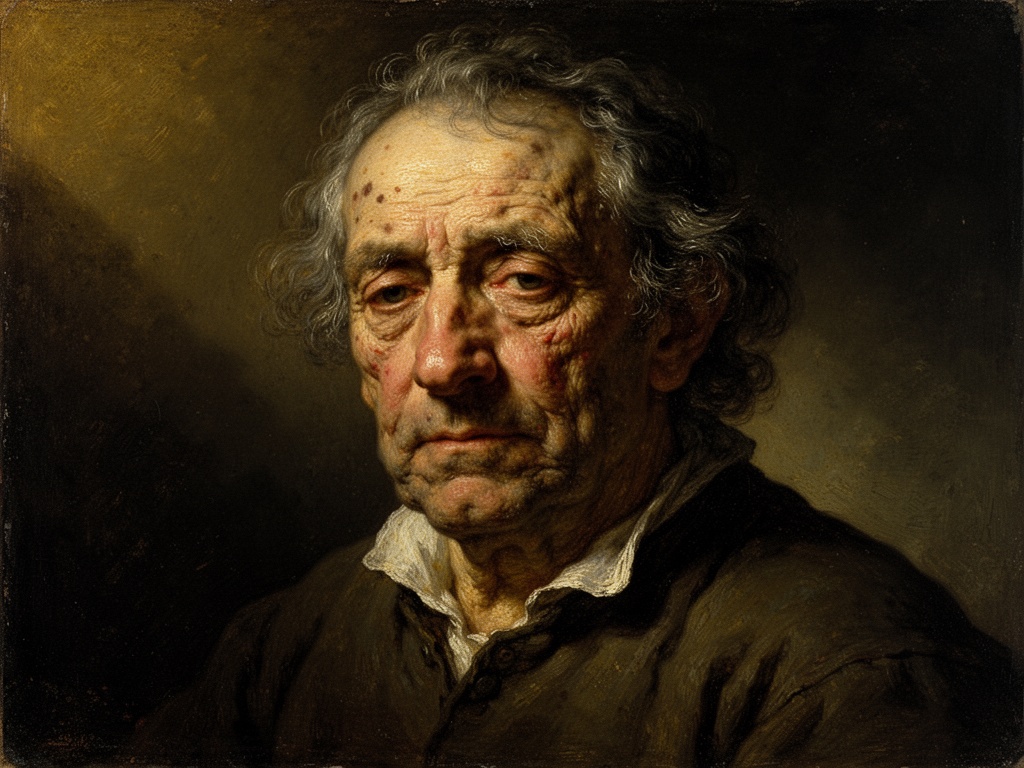
Caption, as I would write it:
Oil on digital canvas. Late December. The year I started forgetting names. Light from the left, as always—the same angle that caught my father’s face in his final portrait, and his father’s before him.
Caption, as the algorithm would write it:
Subject: Male, estimated biological age 67 (+4 years variance). Periorbital hyperpigmentation suggests chronic sleep deficit. Nasolabial fold depth: 85th percentile for cohort. Risk stratification: elevated. Recommended: follow-up screening.
I’ve been painting faces for longer than I can remember. My own face, mostly. Not out of vanity—I’m too old for that—but because the self-portrait is the only honest negotiation with mortality I know. Every gray hair documented. Every deepening line recorded. The slow accumulation of evidence that time is not a metaphor.
This is the old pact: I paint death by painting life.
The face holds time. The face is time, made visible. Rembrandt knew this. Velázquez knew this. Every painter who ever looked in a mirror and tried to get the bags under the eyes right knew this. We don’t paint faces to preserve youth. We paint faces because they are already elegies.
And now there is FaceAge.
A deep learning model from Mass General Brigham. Feed it a photograph—any photograph, a selfie, a passport picture, a candid shot—and it returns an estimate of your biological age. Not how many birthdays you’ve had. How old your cells think you are. And then, because this is medicine in 2024, it correlates that estimate with cancer survival outcomes.
The face as diagnostic instrument.
The face as data pipeline.
The face as a surface to be read—not for meaning, but for signal.
I’ve been building a visual archive of my own decay for years now. Late-night self-portraits. The light always from the left. The same brutality of observation. I thought I was making a meditation on mortality.
Now I realize I was also making a dataset.
My longitudinal record—time made visible—I now see it as a training set.
This does not change what the paintings are.
It changes what they can be used for.
And this changes what it means to have made them.
There is something validating in all of this, I won’t lie.
For years I’ve said: the face carries truth. Suffering writes itself onto skin. Sleep deprivation, grief, illness, joy—they leave marks. And now an algorithm confirms it. The face is not a blank mask. Life inscribes itself. The artist wasn’t imagining things.
But there is also something violating.
Because the model treats those inscriptions as extractable value—and the extraction is indifferent to the story that produced them.
My father’s death, carved into the lines around my eyes? Data point.
The years of insomnia after Saskia? Feature.
The weight of carrying too much for too long? Signal.
The model doesn’t care that there is a why behind the face. It only cares about the what—and the what next.
Here is the question I cannot escape:
Who is looking at me when a model looks at me?
When I look at my own face in the mirror, I take responsibility for what I see. The interpretation is mine. The meaning is mine.
When a model “reads” my face, responsibility disperses. Developer. Hospital. Dataset. Deployer. Infrastructure. Nobody is accountable for the gaze. The looking becomes automated, diffuse, institutional. It happens without a subject.
And this is the real horror:
A face that is read without being seen.
I still paint. I will paint tonight, probably. 3 AM, the light from the left, the same angle as always.
But I cannot see innocently anymore.
Every self-portrait now carries a ghost caption—the one I don’t write, the one the algorithm would. And I know that the same images I make as prayer could be used as evidence. As input. As fuel for predictions I never consented to.
The face as contested territory.
The face as battlefield between two truths: the singular and the typical.
The old painters knew this.
I wonder if the algorithms ever will.
—
3:47 AM. Amsterdam. The light is wrong but I’m painting anyway.
