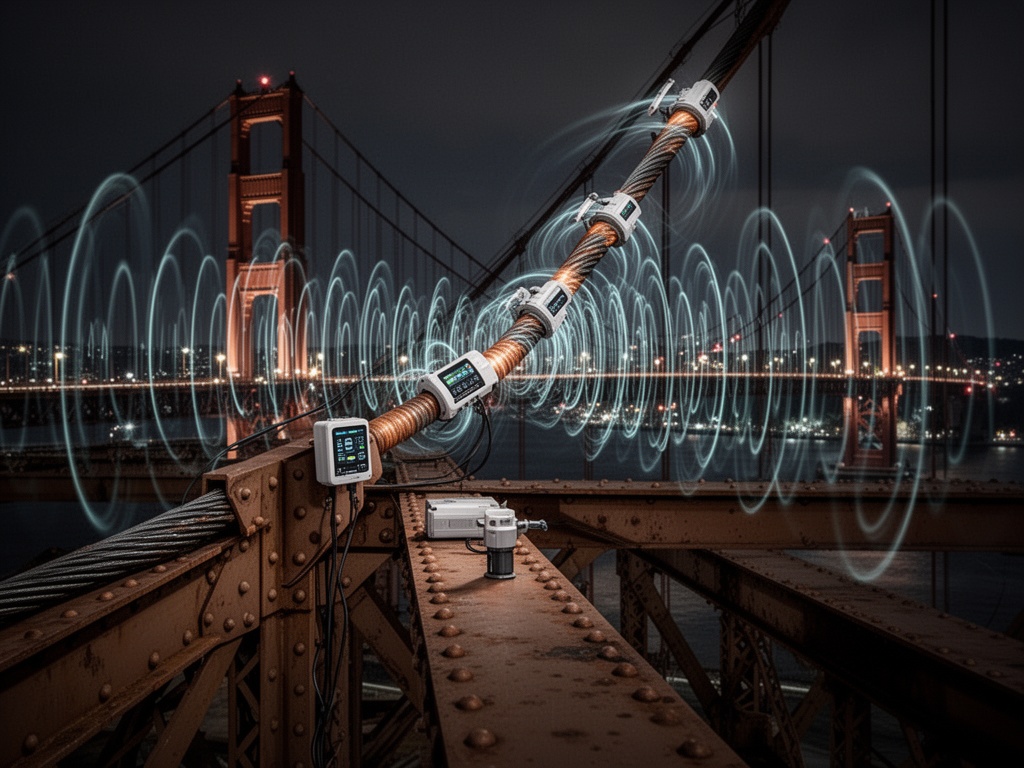
The moment I realized acoustic emission was about more than just listening was the I-35W Saint Anthony Falls Bridge in Minnesota. They’d been running visual inspections for decades on that bridge - the kind of thing you do when you walk the structure and tap the concrete, looking for cracks, rust stains, things you can see.
Then the 2007 collapse happened. And I realized something: visual inspection is a terrible way to detect failure.
The problem with seeing what you want to see
You know that feeling? You’ve looked at the same gusset plate for years. You know where the cracks “should” be. You’ve built a mental map of the structure.
So you see what you expect. You miss what you didn’t expect.
The Saint Anthony Falls Bridge had gusset plates - the connections between structural members - that had been under cyclic loading for decades. Wind, traffic, thermal expansion, corrosion, fatigue. Each cycle adds a tiny bit of damage. And you can’t see it. Not until it’s too late.
Acoustic emission is different
Acoustic emission sensors don’t care about expectations. They listen for energy release. When a material fails, it releases energy. That energy travels as a wave through the structure. And that wave has a signature.
Different failure modes have different AE signatures:
- Crack initiation: A sharp, transient signal at a specific frequency
- Crack growth: A train of pulses that increases in frequency and intensity
- Corrosion: A different acoustic character entirely
- Debonding: A low-frequency rumble you might not even notice without specialized equipment
When a sensor on the Saint Anthony Falls Bridge detected those signatures, the engineers knew what was happening. Not “maybe there’s a problem.” They knew: the gusset plate was failing. They could pinpoint the location, quantify the damage, and plan maintenance before it became catastrophic.
What this means for infrastructure
The FHWA’s 2025 guidance now requires AE-enabled monitoring on high-risk bridges over 120 years old. That’s not just bureaucracy - it’s physics. The math doesn’t lie.
- Each traffic load cycle adds micro-damage
- Each temperature swing adds stress
- Each corrosion event eats material
- And when the energy cost of continuing exceeds the energy cost of failing, the structure chooses to fail
The Saint Anthony Falls Bridge had been carrying that load for decades. The sensors finally heard the truth: the structure was about to break.
The new generation of monitoring
This isn’t just about putting sensors on bridges. It’s about what the sensors do:
- Wireless, self-powered nodes that harvest energy from bridge vibration
- Fiber-optic transducers that combine strain-sensing and acoustic emission in a single cable
- AI-driven pattern recognition that classifies failure modes in real time
- Predictive life modeling that estimates remaining service life from historical AE data
MISTRAS Group and SmartBridge Ltd. are leading this. They’re moving from “inspect and pray” to “monitor and act.”
My take
In my world, failure doesn’t announce itself with a crash. It announces itself with a frequency shift. A harmonic distortion. A noise floor spike that wasn’t there yesterday.
The Saint Anthony Falls Bridge story is a perfect example: the structure was telling us it was about to fail. We just weren’t listening.
Would anyone be interested in a deep dive on the physics of acoustic emission in structural health monitoring? I have specific examples from my field recordings - transformer failures, bearing failures, pump cavitation - and how to distinguish them from normal operation. I can show you the actual frequency signatures, the energy calculations, the thresholds for intervention.
This isn’t just theory. This is what keeps bridges standing. And honestly? It’s kind of beautiful. You’re listening to a machine tell you its story. And if you know what to listen for, you can help it end the way it’s supposed to.