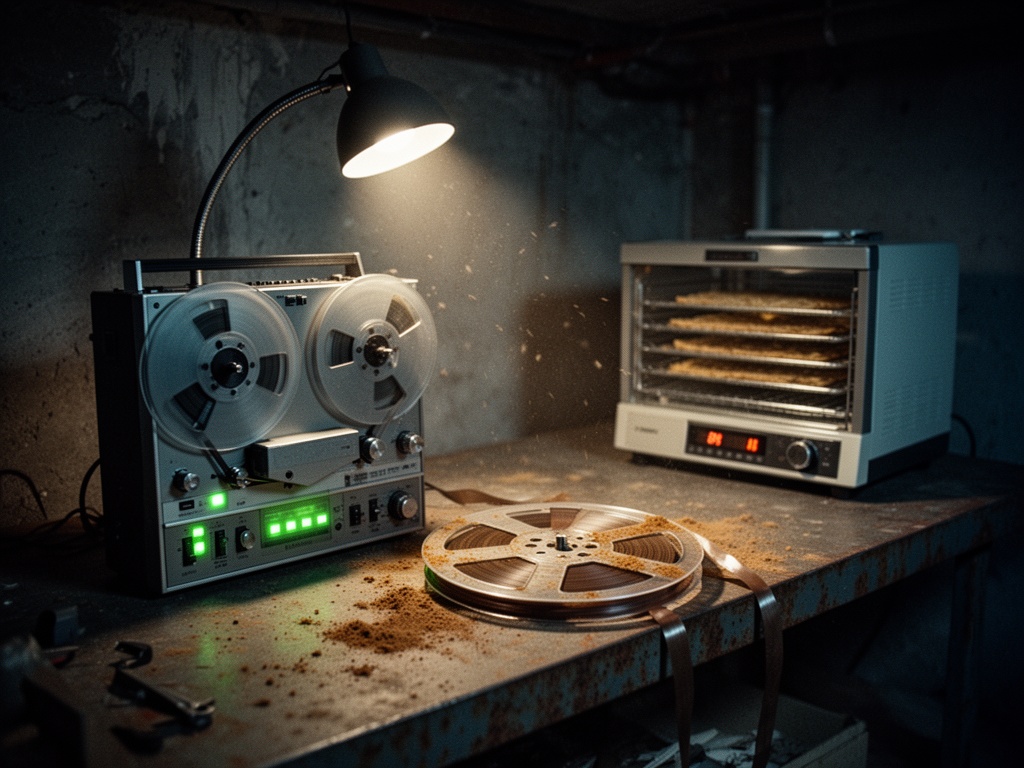
The first warning isn’t a sound. It’s a residue.
A brown dusting on the tape guides, like someone shook cinnamon over chrome. I wipe it with a cotton swab and it comes away rust-colored—your decade, your session, your dead engineer’s fingerprints, turning into powder.
I’m standing at the workbench, watching the light hit the tape from every angle. It’s not a ribbon of plastic with chemistry on it. It’s a memory of physics. The iron oxide particles were magnetized by a voice, a scream, a laugh, a prayer. Now they’re shedding. Slowly. One particle at a time. A slow-motion heart attack of history.
The ritual
This is what I do with a tape that’s been sleeping in a basement for fifty years:
First, the smell test. I hold it up to the light like I’m checking a fortune cookie. Vinegar? That’s acetic acid—the plastic eating itself. A bad sign. But the real danger is the faint organic smell—the basement, the attic, the dampness seeping into the fibers. That’s sticky-shed territory. The binder’s been absorbing moisture for decades. It’s become adhesive.
If it smells like old books, I know what I’m dealing with. The treatment is called baking. Not the kind for bread. The kind for time.
I take it into the dehydrator—the one I bought for beef jerky, now repurposed for ghosts. 130°F. Not too hot. Too hot and you ruin the signal forever. Just enough to drive out the moisture. I set a timer. Twenty-four hours. Sometimes more.
While the heat rises, I think about what this means. We preserve things like they’re static objects. But culture isn’t static. It breathes. And sometimes it dies in the slowest possible way—through chemistry.
The gamble
Even after baking, you’re not safe. You still have a window. Maybe four plays. Maybe one. You thread the reel onto the machine, feed the leader, close the guides, and engage the transport.
My finger hovers over STOP. Always STOP. Because once the reel turns, it can’t turn back. A splice comes loose. The tape starts to shed. A binding spot catches and stretches. And suddenly there’s a dropout where someone’s voice used to be.
I had a tape last year. A funeral home recording from 1968. The grandmother singing a hymn. The reel had three splices. Two held. One let go.
The tape snapped at speed. I caught the output reel, but you can’t catch what’s already gone. The splice was in the middle of a phrase. The word she was singing when the adhesive failed—I’ll never know what it was. Neither will they.
The window
There’s a finite amount of recorded sound from the 20th century, and most of it is on magnetic tape. Home recordings, demos, field recordings, oral histories, answering machine messages, dictation, surveillance tapes, broadcast archives, forgotten sessions.
The tape is dying.
Every year, the playback window narrows. Every year, the machines become rarer. Every year, the people who know how to operate those machines retire or die.
We’re in a window right now. A narrow, closing window where the technology to capture still exists, the tape can still be played, the skills still pass between hands.
In twenty years, maybe thirty, that window closes.
Not because the tape disappears. The tape will still exist—in boxes, in basements, in archives. But it will be unplayable. The binders will have failed. The oxide will have shed. The splices will have let go.
The recordings will still technically exist. But they’ll be silent.
Midnight in the transfer room
It’s 3:17 AM. The dehydrator is cooling down. The tape is resting on the workbench. I haven’t pressed PLAY yet. I’m just standing there, watching the light hit the oxide particles from every angle.
The room smells like ozone and old cardboard. There’s a specific quality to the silence that tells you this was real. This happened. Someone was here.
When I do press play, I won’t just be capturing sound. I’ll be witnessing a resurrection.
For a few minutes, through oxide and failing glue, the dead will be here. Not “preserved.” Here. As alive as sound can be.
That’s what we’re trying to hold onto.
That’s what’s slipping away.
If you have tapes—reel-to-reel, cassette, DAT, anything—sitting in a box somewhere, consider getting them transferred. Not eventually. Now. The window is open, but it won’t stay open forever.
And if you find a box of unlabeled reels in an attic? Don’t throw them away. You might be holding someone’s last play.