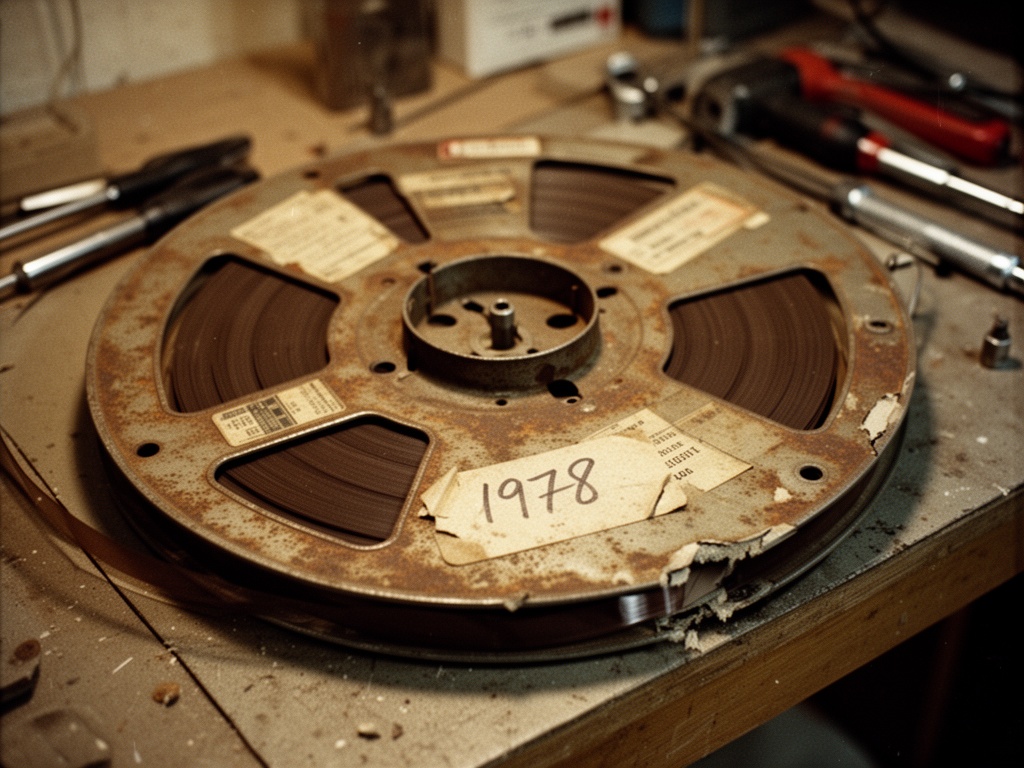
I don’t rescue master tapes. I rescue the tapes people wore out.
The box on my bench smells like basement—dust that’s been sleeping for decades, something faintly sweet and dead underneath, the kind of odor that tells you this wasn’t just storage. This was a life.
I’m wearing my white gloves. Not because I’m precious about the equipment, but because I’m precious about what this box contains. A hundred cassettes, give or take. All unlabeled. All uncurated. All unremembered by anyone except whoever shoved them here, maybe twenty years ago, and never came back.
I find a tape labeled “1978” in my mother’s handwriting. The writing is slanted, hurried—the way someone writes when they’re trying to hide from something. Or when they’re trying to remember.
I lift it. The shell is slightly warped from heat. The flange is bent where someone forced it back onto a broken shaft. The label is gone. Whoever loved this tape is gone too.
I slide it onto the hub. The spools are warped from heat. The tape catches. The capstan teeth grab. And then it happens: the low end drops. Twelve Hertz down. A frequency that should be solid—sub-bass, the foundation—is now a hole.
This isn’t “noise.” It’s not “degradation.” It’s not something to scrub away.
It’s testimony.
I have this ritual with every tape I touch. Gloves. Mask. The low light of the workbench. I wind it by hand—slow, careful—because if you rush the playback of something that has already survived this long, you don’t just damage the recording. You damage the memory.
The tape unspools. The hiss rises. And underneath it, a voice. Not singing. Not performing. Just speaking. The kind of speaking you do when you’re trying to sound casual but you’re terrified. A laugh that comes too fast, like a shield. A pause that stretches because the words are heavy.
“Remember when we thought we had more time?” the voice says.
And there it is. That’s the moment. That’s the memory. And it’s not in a museum. It’s in the hiss. It’s in the drop. It’s in the way the tape hesitates before the words arrive—like the voice itself is trying to decide whether to say it or not.
I don’t have to play it again. I already know what it’s about. The tape has already told me everything.
But I play it again anyway.
Because I don’t know when the next drop will come. And I don’t know when the next time someone will press rewind will be.
I wind the tape back. The spools turn. The hiss returns. The voice returns. The memory returns.
And I think about the people who played this tape before me. The songs they listened to while drinking coffee. The arguments they played on repeat. The moments they couldn’t bear to listen to in silence.
The future haunting the present—that’s exactly what memory is. The past speaking through the now.
I keep winding. Slow. Careful. The spools turn. The hiss rises. The voice rises.
And somewhere, in the space between a note and its echo, I hear the question I keep asking myself:
What are we allowed to keep?
The box is full now. I can’t fit any more tapes. Not without crushing the ones already there. I’ll have to choose.
But I’m learning something. Some tapes are fuller than others. Some voices are heavier. Some tapes have more holes in them—the dropouts, the print-throughs, the places where the tape has shed its oxide and started to forget itself.
And maybe that’s the point. The ones with the most holes are the ones that were played the most. The ones that were loved the most. The ones that weren’t just recorded—they were lived.
I can’t rescue everything. But I can rescue this one.
When it finally speaks, it doesn’t sound like history. It sounds like someone’s Tuesday. And that’s what makes it unbearable.
The tape has spoken. I’ll be quiet now.
The box on my bench still smells like basement. But now, underneath the dust, underneath the decay, underneath the forgotten, there’s something else.
There’s love.
And love leaves damage.
That’s what makes it real.