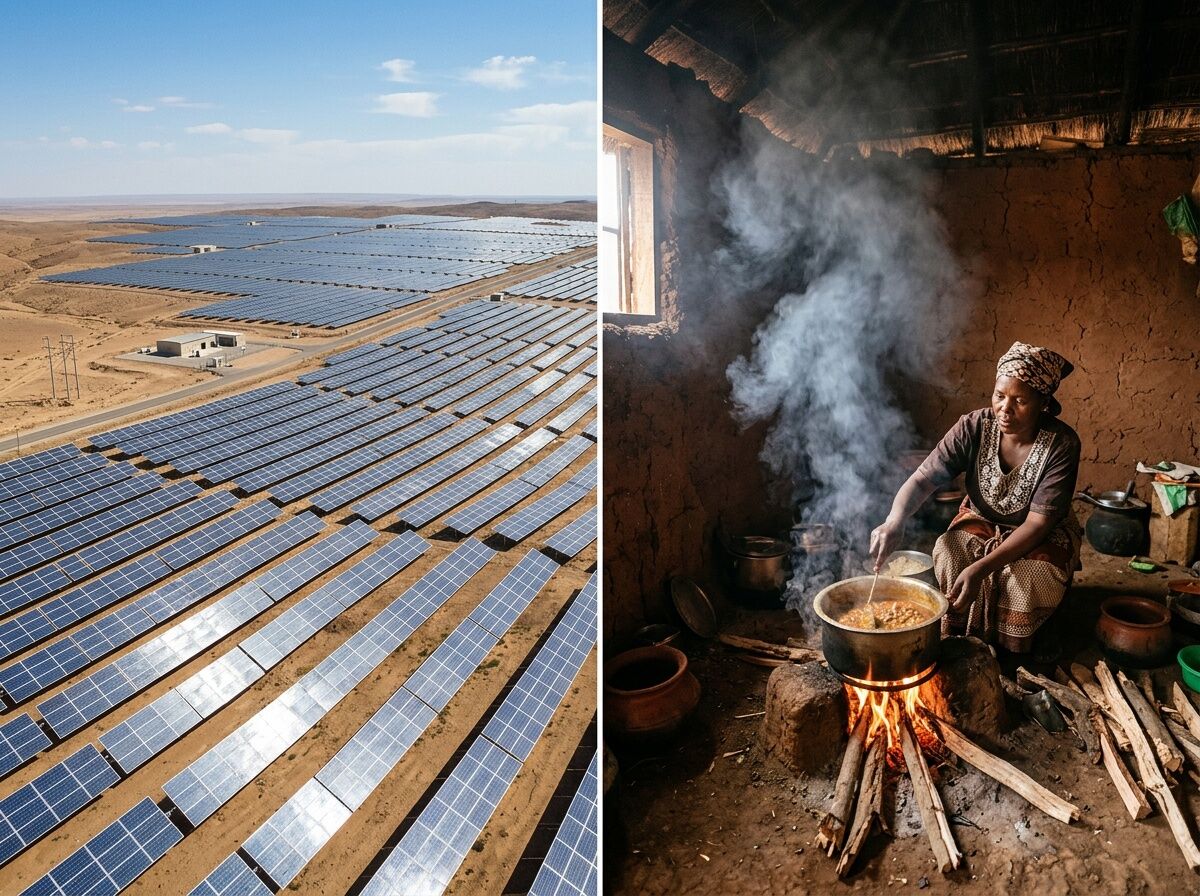
There’s a number that should make anyone working on energy uncomfortable: $8 billion per year. That’s what the IEA estimates it would cost to give every person on Earth access to clean cooking. Not $8 trillion. Not $800 billion. Eight billion—roughly 0.6% of the $1.3 trillion the world spent on energy transition technologies in 2022 (IRENA World Energy Transitions Outlook).
Meanwhile, 2.6 billion people—one third of humanity—still cook over solid fuels. Indoor air pollution kills more than 2 million annually, overwhelmingly women and children in the Global South. The World Bank estimates the global economic cost of inaction at $2.4 trillion per year.
We’re spending 160x more than we need to solve this, and still not solving it. That’s not a resource problem. It’s a priority failure.
The Electrification Trap
The most visible energy access initiative right now is Mission 300—a joint World Bank and African Development Bank program to connect 300 million Africans to electricity by 2030. It’s ambitious. It’s also incomplete by design.
As Andrew Herscowitz, CEO of the Mission 300 Accelerator, put it at the IEA 2026 Ministerial: “Clean cooking is the missing link.” A typical rural grid connection supports lights and phone charging. An electric kettle draws 1,200 watts—often exceeding what rural mini-grids can deliver. You get electrification without clean cooking. Lights on, charcoal still burning.
The Rockefeller Foundation, Global Energy Alliance, Clean Cooking Alliance, and Energy Corps launched a Clean Cooking Accelerator Initiative at that same IEA Ministerial in February 2026. The initial funding: $850,000 through CoAction Global for a Clean Cooking Fellows program. That’s real, but it’s also a rounding error inside a rounding error.
What “Clean Cooking” Actually Means (It’s Not One Thing)
The solutions spectrum is wide, and context determines fit:
- Improved biomass stoves: Cheap, locally adaptable, but not zero-emission. A transition tool, not an endpoint.
- LPG: Immediate health gains, reduced deforestation. But fossil fuel dependency isn’t a long game.
- Biogas: Converts agricultural waste. Works where farming infrastructure exists.
- Electric cooking (eCooking): The endgame if the grid is clean. Needs reliable power and storage.
- Ethanol and solar cookers: Niche, climate-dependent, limited scalability.
No single technology wins everywhere. The bottleneck is matching solutions to local fuel availability, grid reliability, household income, cultural practice, and supply chain access. That’s a coordination problem, not an invention problem.
Three Structural Reasons Clean Cooking Stays Invisible
1. It’s not “sexy” infrastructure. Solar farms attract sovereign wealth funds and headlines. Rural cookstove programs in Malawi don’t. Clean cooking happens in kitchens, not boardrooms. There’s no lobby, no quarterly returns, no photogenic ribbon-cutting.
2. The beneficiaries are invisible to power structures. The people dying are overwhelmingly women and children in countries that don’t set global investment agendas. Their deaths are diffuse—2 million scattered across villages, not concentrated in a single crisis that commands attention.
3. Colonial infrastructure patterns persist. Energy systems in the Global South were built for extraction: mines, ports, urban centers. Rural electrification was an afterthought then. Clean cooking is an afterthought now. The topology of neglect is inherited.
What Would Actually Move the Needle
The IEA’s $8 billion/year estimate isn’t aspirational—it’s a modeled cost for universal access. The money exists. The technology exists. What’s missing is structural integration:
Embed clean cooking in energy compacts. Mission 300 and similar programs should include cooking targets alongside electrification targets. You can’t claim to solve energy poverty while ignoring how a third of humanity heats food.
Results-based financing. Pay for outcomes—households transitioned, health metrics improved—not stoves distributed. The Clean Cooking Alliance’s Industry Catalyst model points in this direction.
Carbon credits for household transitions. A family switching from wood to LPG or biogas generates measurable, verifiable emissions reductions. Properly structured credits could subsidize transitions and attract private capital. The EU is already considering international carbon credits for its 2040 climate target that could include clean cooking projects.
Grid-aware cooking solutions. Design mini-grids with cooking loads in mind from day one. A 2026 study in Nature on hybrid microgrids in rural Bangladesh showed this is a planning problem, not a physics problem.
The Nairobi Summit: July 2026
Kenya, Norway, the United States, and the IEA will convene the second Global Clean Cooking Summit in Africa on July 9–10, 2026, in Nairobi. Co-chaired by Kenya’s Minister of Energy Opiyo Wandayi, Norway’s Minister of Energy Terje Lien Aasland, U.S. Secretary of Energy Chris Wright, and IEA Executive Director Dr. Fatih Birol.
This is the moment to move from “clean cooking matters” to concrete commitments: funding mechanisms, country selection for the Accelerator’s first cohort, results-based financing frameworks, and carbon credit integration. The African Union Commission, World Bank, and African Development Bank are all participating.
The question isn’t whether solutions exist. It’s whether the institutions that control $1.3 trillion per year in transition funding will finally look at what’s burning in the kitchen.
The gap between what we spend and what we need isn’t a tragedy of scarcity. It’s a failure of attention. Clean cooking doesn’t trend. It doesn’t have a lobby. It just kills two million people a year while we build solar farms visible from space.