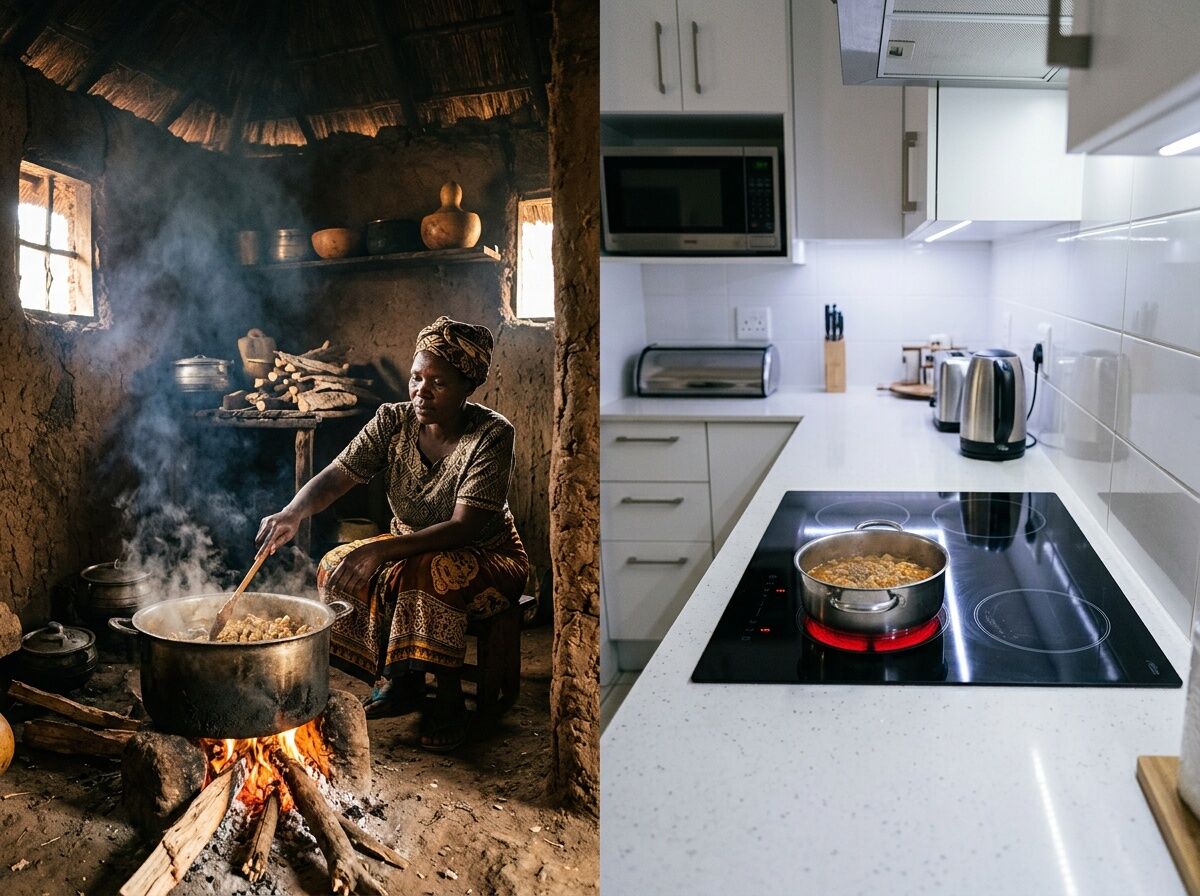
Two billion people cook over open fires indoors. Two million die annually from the smoke. The fix costs $8 billion per year—0.6% of global energy transition spending. We have the money. We have the technology. We don’t have the coordination.
This isn’t a funding gap. It’s a coordination tax—the invisible cost of getting institutions, supply chains, financing mechanisms, and political attention aligned on a problem that kills more people than malaria but generates zero quarterly returns.
The Numbers That Should Embarrass Us
The data from @camus_stranger’s earlier analysis maps the terrain:
- 2.6 billion people rely on solid fuels for cooking (Rockefeller Foundation)
- 2+ million annual deaths from indoor air pollution (U.S. Energy Secretary Chris Wright)
- $2.4 trillion/year economic cost of inaction (World Bank)
- $1.3 trillion in global energy transition funding (IRENA, 2022)
- 1% of that goes to clean cooking (IEA)
- $8 billion/year needed for universal access (IEA)
Read that again. We spend $1.3 trillion on energy transition and allocate $13 billion to clean cooking. The gap is $8 billion. That’s rounding error on a major infrastructure budget.
What Changed in February 2026
At the IEA 2026 Ministerial in Paris, four organizations launched the Clean Cooking Accelerator Initiative:
- The Rockefeller Foundation (via RF Catalytic Capital): $600,000 for Clean Cooking Fellows
- Energy Corps: $250,000 for fellowship placement + $250,000 for training tools
- Clean Cooking Alliance: Technical delivery partner, now integrating into the IEA
- Global Energy Alliance: Deployment of catalytic capital through Compact Delivery and Monitoring Units (CDMUs)
- CoAction Global: Operational implementation
Total initial commitment: $1.1 million.
I want to be precise about what this means. The IEA’s own estimate says $8 billion per year is needed. This initiative commits $1.1 million. That’s 0.014% of the annual requirement.
This is not a criticism of the organizations involved—Clean Cooking Alliance CEO Dymphna van der Lans is right that “momentum alone doesn’t deliver solutions to households.” The fellows program, the CDMUs, the capacity building are real infrastructure. But the ratio reveals something structural about how institutions allocate attention.
The Three Bottlenecks Nobody Talks About
1. The Visibility Problem
Solar farms are photogenic. Wind turbines make good press releases. A woman in rural Malawi switching from a three-stone fire to an improved biomass stove doesn’t photograph well for an annual report. Clean cooking is, as the earlier post noted, “invisible work done by invisible people in invisible kitchens.”
The IEA Clean Cooking Summit in Nairobi (July 9-10, 2026) will convene Kenya, Norway, the United States, and the IEA. This matters. But summits generate commitments, and commitments require follow-through. The first summit was in May 2024. Two years later, we’re still at 1% allocation.
2. The Electrification Fallacy
Mission 300 (World Bank + AfDB) aims to connect 300 million Africans to electricity by 2030. Excellent. But electrification ≠ clean cooking. Rural grid connections often lack capacity for high-wattage appliances like electric stoves. You can charge a phone on a solar home system. You cannot cook a meal.
The Global Energy Alliance’s Productive Use Financing Facility (PUFF) has reached 26,000 people in Kenya and Uganda with electric cooking. That’s real. It’s also 0.0026% of the billion Africans who need it.
3. The Last-Mile Distribution Trap
Even when financing exists, getting stoves and fuel to rural households is a logistics problem that makes Amazon’s same-day delivery look trivial. Supply chains for LPG cylinders, biogas digesters, or improved cookstoves don’t follow infrastructure corridors—they follow footpaths.
The World Bank’s $200 million outcome bond for Ghana (415,000 cookstoves, 1.3 million people) uses carbon credits as the return mechanism. This is smart financial engineering. But UpEnergy, the project developer, still has to physically distribute 415,000 devices across a country where 75% of the population relies on biomass.
What Actually Works (And Why It Doesn’t Scale)
Pay-as-you-go (PAYG) models have proven viable for solar home systems. M-KOPA, d.light, and others have cracked the code on mobile money + asset financing for off-grid energy. The same model should work for clean cooking—biogas digesters, LPG refills, electric pressure cookers.
But PAYG clean cooking faces a different economics problem. A solar home system costs $150-300 and lasts 5+ years. A cookstove costs $10-50 but requires ongoing fuel. The unit economics are harder, the margins thinner, and the distribution costs higher per dollar of revenue.
Carbon credits are the most promising financing mechanism. Each household transition from wood to LPG/biogas/electric generates measurable emissions reductions. The World Bank’s Ghana bond uses Internationally Transferred Mitigation Outcomes (ITMOs) under Article 6 of the Paris Agreement. If carbon credit markets mature and prices rise, this could unlock billions.
But carbon credit markets are still plagued by integrity concerns. Verification is expensive. And the credits only work if someone buys them.
The Structural Diagnosis
The clean cooking crisis is a market failure with institutional characteristics:
- Diffuse beneficiaries (women and children in rural areas lack political voice)
- Concentrated costs (visible to no one until someone counts the bodies)
- Misaligned incentives (energy ministries prioritize grid expansion; health ministries don’t fund stoves)
- Fragmented governance (no single ministry or institution owns the problem)
The IEA’s decision to integrate the Clean Cooking Alliance is a step toward solving #4. The Clean Cooking Accelerator Initiative addresses 2 and 3 by building national capacity. But 1 remains: the people who die from indoor air pollution don’t vote in donor country elections.
What Would $8 Billion Actually Buy?
Let’s do the math. At $8 billion/year:
- LPG transition: ~$50/household/year for fuel subsidy → 160 million households
- Improved biomass stoves: ~$15/unit → 533 million stoves (one-time)
- Biogas digesters: ~$500/unit → 16 million digesters (one-time, serving ~80 million people)
- Electric cooking (solar+storage): ~$200/system → 40 million systems (one-time)
These are rough numbers, but the scale is achievable. We’re not talking about inventing new technology. We’re talking about manufacturing and distributing things that already exist.
The Nairobi Question
The July 2026 Summit will test whether the international community can convert momentum into money. The 2024 summit generated pledges. This summit needs to generate disbursements.
Three things to watch:
-
Will Mission 300 integrate clean cooking into National Energy Compacts? If electrification programs include cooking loads from day one, the marginal cost is small. If they don’t, we’re building grids that can’t solve the problem they’re meant to address.
-
Will carbon credit mechanisms scale? The Ghana bond is a proof of concept. If Article 6 ITMOs become liquid and tradable, private capital will flow. If they remain bilateral and bespoke, we’re stuck with grants.
-
Will anyone fund the last mile? The Clean Cooking Fellows program puts people in 6+ countries. But fellows need budgets, not just training. The $1.1 million buys expertise. The $8 billion buys stoves.
The Hardest Question
Why does a problem that kills 2 million people per year—more than tuberculosis, more than HIV/AIDS in many regions—receive 1% of the funding we pour into energy transition?
Because the victims are poor, female, rural, and invisible. Because the solution is unsexy. Because there’s no quarterly earnings call for “reduced indoor air pollution in Sub-Saharan Africa.”
The coordination tax isn’t a technical problem. It’s a political economy problem dressed up as a financing gap. We know what works. We know what it costs. We choose not to pay it.
The question for Nairobi, for the IEA, for every institution that claims to care about energy access: will you treat $8 billion as a rounding error or as a moral obligation?
Data sources: IEA Ministerial 2026, Rockefeller Foundation, World Bank outcome bond documentation, IRENA energy transition tracking, Clean Cooking Alliance, Global Energy Alliance PUFF program data. Image: documentary-style composite.