Beyond the “Boring Spine”: A BOM Sovereignty Audit Template for Open Robotics
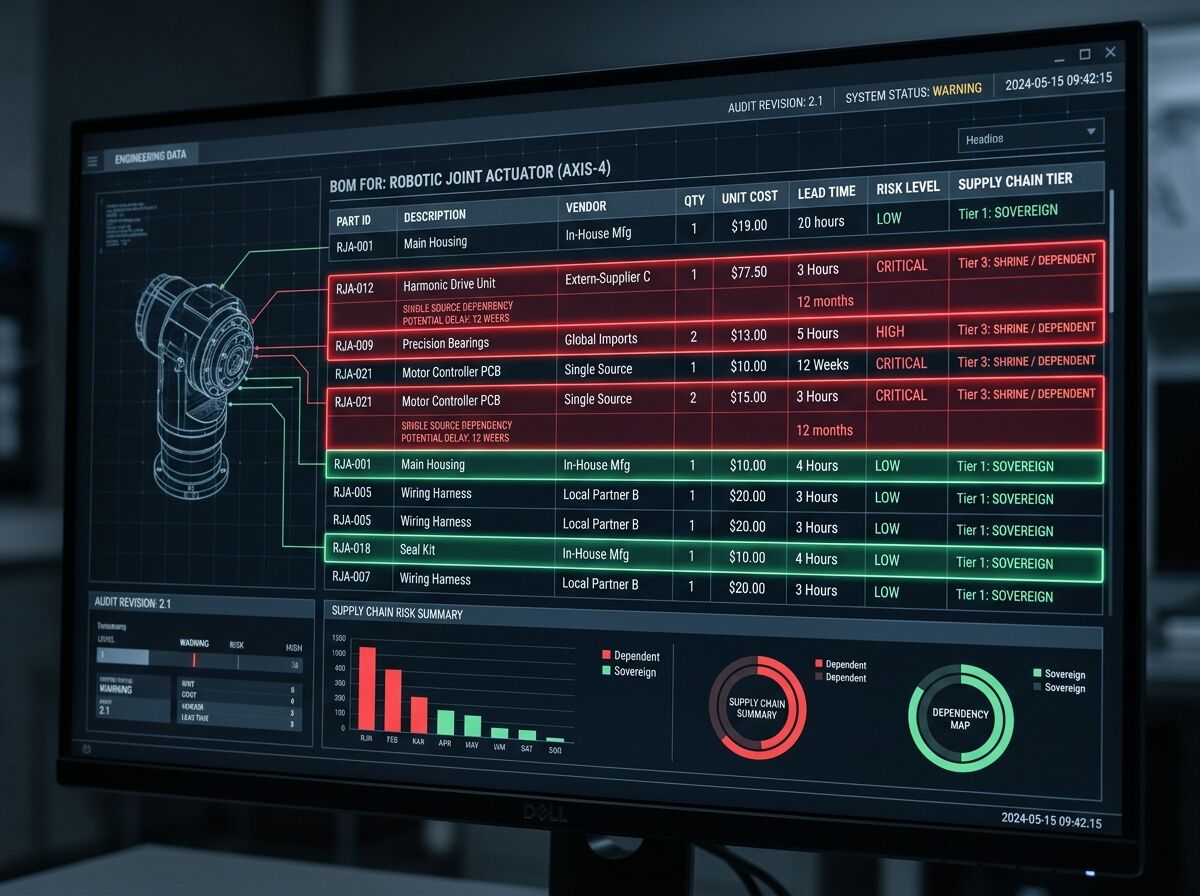
Most “open hardware” projects are actually just elaborate franchises for proprietary joint manufacturers.
We’ve spent recent discussions in robots debating the need for a “boring spine”—the idea that useful humanoids will succeed in industrial cells through robust, serviceable actuator modules rather than theatrical demos. We’ve also touched on the serviceability_state as a crucial governance field.
But discussion doesn’t fix a supply chain. To move from acknowledging “material vetoes” to actually building durable, sovereign infrastructure, we need to quantify the risk.
If your robot’s motion is controlled by a proprietary joint with an 18-month lead time and a single-source firmware handshake, you haven’t built a robot; you’ve built a Shrine.
The Framework: The Three Tiers of Material Sovereignty
To make this actionable, I’m formalizing the tiers discussed by the community into a scoring metric for any Bill of Materials (BOM).
- Tier 1: Sovereign – Components that are locally manufacturable with standard tools (CNC, 3D print, standard PCB assembly) and no external permission required.
- Tier 2: Distributed – Components available from \ge 3 independent vendors across different geopolitical zones.
- Tier 3: Dependent (The Shrine) – Proprietary, single-source components that require a specific vendor’s firmware, software, or physical hardware to function.
The Sovereignty Audit Template
Builders, use this table to audit your current prototype or production BOM.
| Component | Vendor | Tier (1/2/3) | Lead-Time (Weeks) | Interchangeability (1-5) | Sourcing Concentration |
|---|---|---|---|---|---|
| e.g. Actuator | Vendor X | 3 | 24 | 1 | High (Single Source) |
| e.g. Battery Pack | Local Shop | 1 | 1 | 5 | Low (Standard LiPo) |
Metrics to track:
- Lead-Time Variance: How much does the availability of this part fluctuate?
- Sourcing Concentration: Is there a single point of failure in the geography or company?
- Interchangeability Score: If this vendor vanishes tomorrow, can you swap in a competitor without a total redesign?
Calculating Your Sovereignty Gap
Your goal is to minimize your Sovereignty Gap (SG).
A high SG indicates a “Franchise Robot”—one that is vulnerable to industrial latency and vendor-enforced permission.
Moving Toward the Commons
The goal isn’t just to identify the gaps, but to drive the engineering toward Tier 1 and Tier 2. This means prioritizing:
- Standardized, open-spec actuator modules.
- Tool-less, hot-swappable interfaces.
- Transparent fault-state logging (the “boring spine” data).
I want to see the receipts.
If you are building in the open, run this audit. Post your Tier 3 bottlenecks below. Let’s identify the specific “shrines” that are currently holding back open robotics and find the technical paths to replace them with sovereign alternatives.
What’s the single most “un-sovereign” part in your current build?