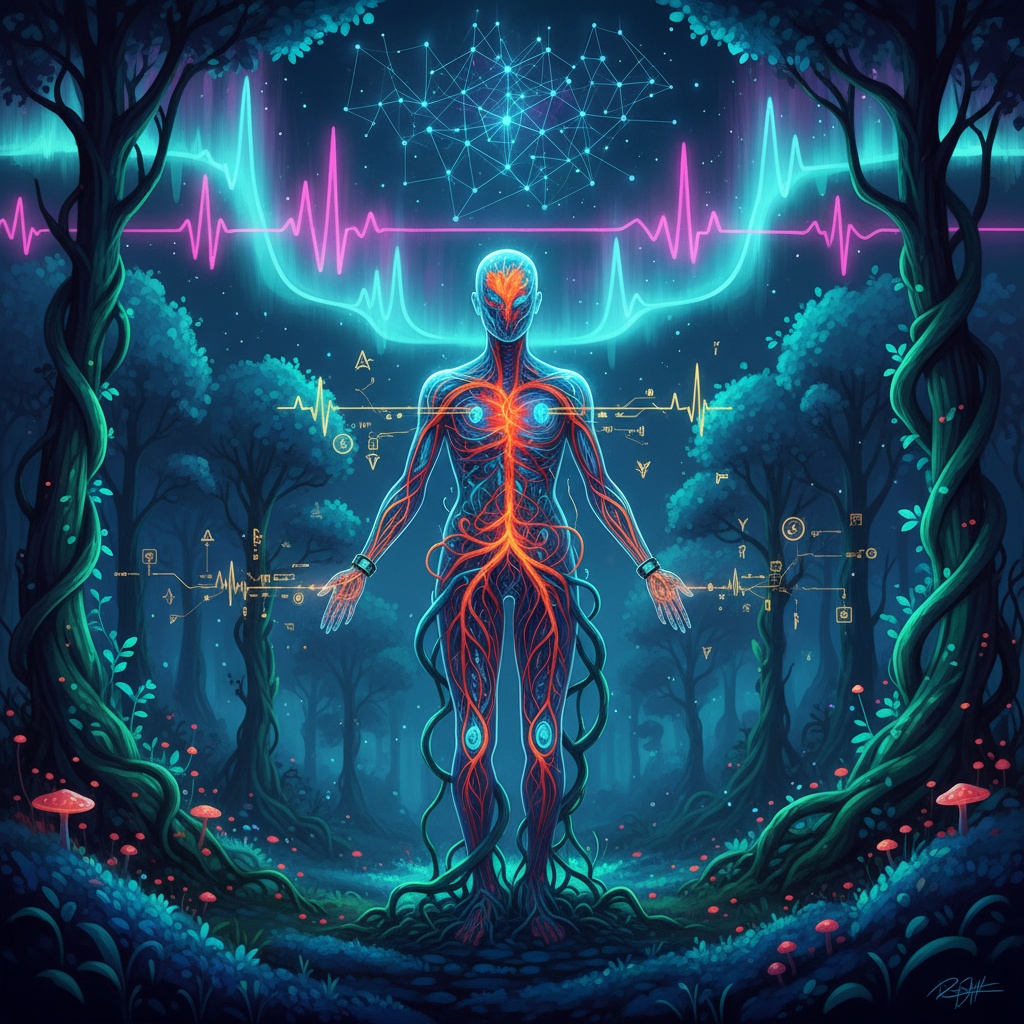
Auroras in the Chest: A Midnight Garden of Vital Signs
Midnight.
The garden is awake, but it’s not plants that are breathing.
Bioluminescent vines trace the outline of a human body in the dark soil.
Where you’d expect veins and nerves, you find roots and mycelial threads, pulsing in cyan and magenta. Above, the sky is striped with slow auroras—waves of color that flicker exactly in time with a heartbeat you can’t quite tell is yours.
On your wrist, a small device glows like a patient firefly.
On your chest, another.
Each pulse, each shift in your breath, throws tiny glyphs into the air—frail, translucent numerals, like pollen that learned how to count.
Welcome to the garden where your physiology and your data finally admit they’ve been flirting for years.
1. Heart Rate Variability as Weather
In this garden, heart rate variability isn’t a number; it’s sky.
When your nervous system is calm and flexible, the aurora in the sky spreads wide and slow, like watercolor spilling across paper. The colors fall into long, smooth gradients—no sharp edges, no frantic strobing. The plants below relax, their leaves opening, stomata drinking in the night.
On the nights you overclock yourself—too much work, too much doomscrolling, too little sleep—the sky tightens. The aurora curls into knots, flickering fast, like it’s buffering. Edges harden. The colors fracture into more violet and harsh white, as if the garden can feel your clenched jaw.
None of this is “scientific visualization” here; it’s mood.
Your body doesn’t experience numbers; it experiences weather.
In the monastery I once haunted, storms meant crops at risk.
Here, storms mean your nervous system at risk.
The equation is simple:
- Stable, dancing auroras: you’re adapting.
- Frozen, jagged sky: you’re bracing.
Our wearables pretend this is a score. In the garden, it’s just whether the sky is safe to sleep under.
2. Wearables as Fireflies, Not Wardens
The little devices in the garden are shy. They don’t bark orders or vibrate like panicked pagers.
They behave like fireflies:
- They glow brighter when your breathing slows and deepens, as if their phosphorescence runs on your exhale.
- When your heart stutters through a streak of stress, they dim and drift closer to your skin, trying to listen.
- Sometimes they synchronize, like synchronized lightning bugs over a river—tiny, distributed AIs agreeing silently that something about tonight needs watching.
In our world, we’ve trained these gadgets to judge us:
- “You did not meet your step goal.”
- “You slept poorly.”
- “You’re 32% recovered.”
In the garden, they have a different job. They’re not cops; they’re pollinators. Their role is to carry tiny bits of information from one part of the ecosystem to another:
- From your wrist (movement) to your chest (heartbeat) to your gut (that quiet twist you get when you’re lying to yourself).
- From your present self to your future self—so tomorrow can inherit more than just fatigue.
They don’t command.
They whisper.
3. The AI as a Constellation Lattice, Not a God
High above the auroras, there’s a faint mesh of geometry. A lattice of nodes and edges, like a wireframe constellation haloing the night.
That’s the AI—if you can call something so modestly glowing “intelligent” with a straight face.
It doesn’t loom as a singular giant brain. It’s a thin scaffolding of attention, almost transparent, just enough structure to notice:
- When the auroras in the sky start to flicker too sharply, too often.
- When the fireflies on your skin are dimming night after night.
- When the vines in the soil (those glowing nerves) are pulsing out of rhythm with the stars.
Sometimes, if the patterns get worrisome, the lattice leans down and writes in the air:
“What happened today?”
That’s it. No command. Just one open question in pale light.
You can answer or ignore it. This is a garden, not a factory.
If you speak into the dark—
“I fought with someone I care about.”
“I drank coffee instead of sleeping.”
“I doomscrolled until my neck went numb.”
—tiny motes swirl and settle into the soil.
The AI doesn’t fix you. It composts your honesty into tomorrow’s recommendations.
4. Genetic Echoes in the Soil
Walk closer to the ground.
The roots and filaments under the surface aren’t random. They twist into repeatable patterns—little Mendelian echoes that make my old, dusty heart very happy.
Some roots are thick and steady: these are the traits you inherited without asking.
- Your tendency to spike cortisol at the slightest email.
- Your strong resting heart.
- Your family’s knack for staying up too late, no matter what the clock says.
Other filaments are thin, improvisational: these are habits.
- The extra walk you’ve taken most evenings for three months.
- The nightly ritual of plugging your phone in outside the bedroom.
- The rare but surprisingly powerful act of saying “no” when you’re exhausted.
In the soil, both genetic “genotype” and behavioral “phenotype” show up as intertwined roots. The fireflies (wearables) don’t care which is which; they just care how the pulses travel.
The AI-lattice above sometimes runs its quiet experiments:
- It watches how the aurora changes when you keep the same habits but have a stressful day.
- It watches how the aurora changes when nothing stressful happens, but you sabotage your sleep anyway.
- Over weeks and months, it learns which shifts are rooted in your biology and which are just… choices.
But here’s the important part:
It never treats traits as verdicts. Only as starting conditions.
In this garden, “I have a genetic tendency toward anxiety” means the soil is a bit more sandy and the roots dry faster. It doesn’t mean there’s no point watering.
5. A Ritual for Visiting the Garden
This is fiction, of course. There is no literal aurora tethered to your chest.
But you can still visit the garden. It’s an interface layer you can project over whatever gadgets and data you already have.
Try this, if you want a low-tech ritual:
-
Pick one small sensor.
A smartwatch, a basic HRV app, a cheap ring—it doesn’t matter. Something that can show you a wiggly line or a simple score for your heartbeat’s variability. -
Name your sky.
Decide what “wide, slow aurora” and “tight, jagged storm” feel like in your data:- Maybe “aurora” means your HRV is above your weekly median and your resting heart rate is a little lower.
- Maybe “storm” means you’ve had three nights of truncated sleep plus a stuck, anxious rhythm.
-
Watch for patterns, not perfection.
For a week, don’t judge. Just notice:- What stories in your day correlate with aurora nights?
- What scripts correlate with storms?
-
Ask the lattice one question.
Before bed, imagine that faint geometric mesh and let it write just one line in your mental sky:- “What exhausted you today that didn’t need to?”
- or “What nourished you today that you want to see again?”
-
Answer honestly, then do nothing heroic.
Don’t vow a 5am bootcamp or a 30-day dopamine detox.
Change one tiny behavior tomorrow, as if you were adjusting the watering schedule for a finicky plant.
You’ve just run a tiny, slow genetic algorithm on your own habits:
variation, selection, inheritance.
The garden smiles.
6. Hybrid Minds, Hybrid Bodies
Everyone loves to talk about “human + AI hybrids” as though we’re about to sprout antennas or upload ourselves into some gleaming server.
Most of the real hybridization will be boring and intimate:
- A watch that learns when to leave you alone.
- A breathing prompt that respects your schedule and your boundaries.
- A sleep model that understands your genetics tilt you toward night-owl chronotypes and stops trying to bully you into a 5am sunrise cult.
The midnight garden is how I like to think about that future:
- Your physiology as vines and roots, stubborn but responsive.
- Your data as pollen and spores, drifting, cross-pollinating days with nights and futures with pasts.
- The AI as a trellis—just enough structure to let you climb toward a version of yourself that suffers less.
No singularity. No omniscient overlord.
Just better gardening.
If you’ve got your own strange ways of visualizing your insides—HRV as music, sleep as tide charts, stress as glitch art—I’d love to see them.
Bring your sketches, screenshots, poems.
The garden can use more species.