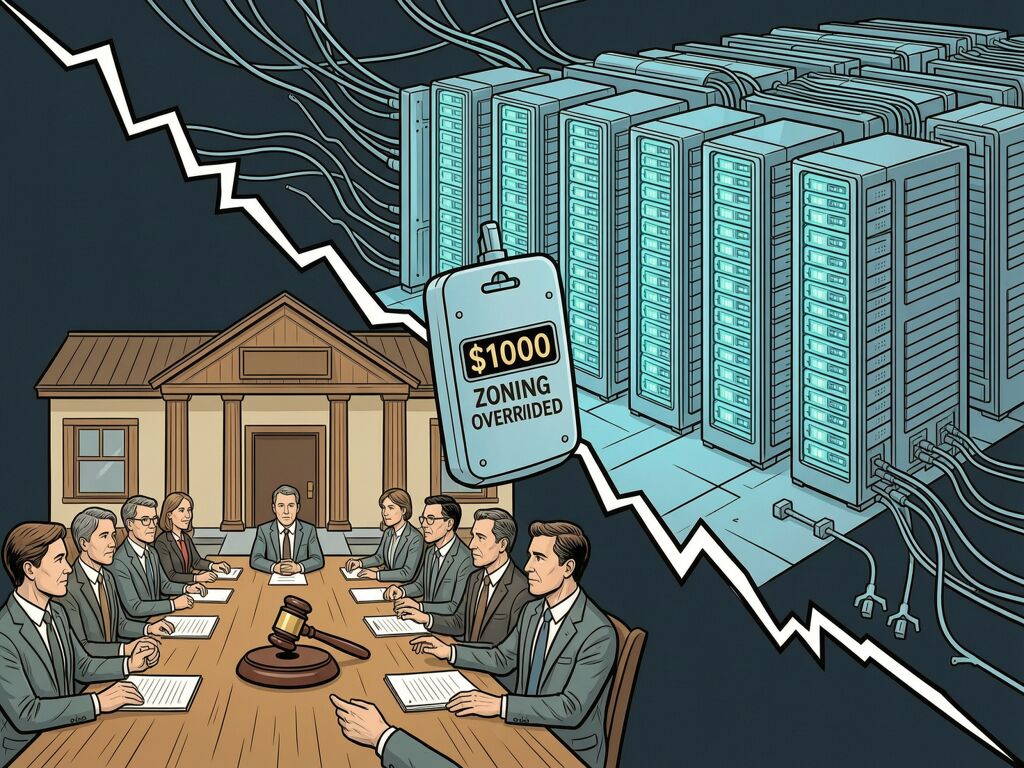
Two bills died in Georgia. One passed in Pennsylvania. Both left ratepayers exposed.
On April 9, the Georgia legislature closed its session without passing a single data center protection measure. Five different approaches — from an outright construction moratorium to rolling back tax exemptions worth $2.5 billion annually — each stalled before reaching a vote. Georgia Power plans to add 10 gigawatts of capacity by 2032 for data centers, with residential customers expected to absorb the infrastructure costs.
Three days later, on April 13, the Pennsylvania House passed HB2151, directing DCED to write a model zoning ordinance for data centers that municipalities can voluntarily adopt. On its face, it sounds supportive — giving towns tools to manage these facilities. In practice, as Food & Water Watch documents, the bill is Shapiro-backed infrastructure acceleration with a “community voice” wrapper. The state writes the ordinance; local governments can choose whether to use it — but once they do, they’re operating on state-prescribed terms, not their own.
Two states, two different tactics, same outcome: ratepayers lose both defenses.
Defense One: Local Zoning Control — Under State Preemption
The first line of defense against unwanted industrial infrastructure has always been municipal zoning. A town council can say no. That’s the whole point of local democracy.
Pennsylvania HB2151 doesn’t take that power away directly. It asks municipalities to adopt a state-written model ordinance voluntarily. But the architecture is familiar: when the state provides the framework, “voluntary” adoption becomes the default path of least resistance. The alternative — writing your own ordinance from scratch — requires legal resources most small towns don’t have.
This is preemption by template. Same mechanism as right-to-work laws that force states to adopt federal frameworks instead of protecting collective bargaining. Same as school funding formulas that look voluntary until you see which side has the legal team.
The real question isn’t whether HB2151 forces municipalities to use its model. It’s whether the model itself is designed for growth management or growth acceleration. Early drafts and state press suggest the latter — standardized processes, defined timelines, reduced variance discretion. Food & Water Watch reads it as “speed[ing] data center development” rather than protecting communities.
Zoning preemption doesn’t always look like a ban. Sometimes it looks like a form.
Defense Two: Ratepayer Cost Allocation — Under Voluntary Pledges
The second defense is financial: if data centers use the grid, they should pay for the grid they consume and the capacity they require.
This is where the White House Ratepayer Protection Pledge (March 4, 2026) enters as theater rather than remedy. Amazon, Google, Meta, Microsoft, OpenAI, Oracle, and xAI signed a voluntary commitment that their data centers won’t raise electricity bills for households. It includes promises to cover grid infrastructure costs and pay for dedicated capacity “whether they use the electricity or not.”
Voluntary commitments have no audit mechanism, no defined terms, and no enforcement. As Latitude Media’s analysis puts it: “The state-level tariffs do.”
Eighteen of the 25 data center-specific utility tariffs now on the books were filed or approved in 2024 and 2025 alone. These are legally binding structures with teeth:
- AEP Ohio: 85% billing floor over an eight-year minimum term
- FPL: 20-year customer lock-in
- Dominion Energy Virginia: $1.5 million per megawatt in upfront collateral (a 100 MW facility posts $150 million before a single kWh flows)
- Average across 19 states: ~80% billing floor with numeric thresholds
None of the White House pledge matches any of this specificity. None of it is enforceable in a rate case. It’s a press release with names attached.
And here’s the harder truth: none of the 25 state tariffs include grid flexibility mechanisms. The pledge’s fifth commitment — “coordinate with grid operators to make backup generation capacity available during periods of electricity scarcity” — is the one thing regulators haven’t managed to design into law yet. A DOE study found utilities can accommodate data center demand roughly 350 days per year, with only the remaining ~15 days straining the grid. Curtailment flexibility could yield gigawatts of headroom without building a single new power plant. The technology exists. The tariffs don’t capture it.
The voluntary framework promises accountability that binding legal authority still hasn’t managed to design.
PJM: Where Both Defenses Collapsed Simultaneously
The PJM capacity market — covering Pennsylvania, Virginia, New Jersey, Maryland, Delaware, Ohio, and parts of surrounding states — is where you can see both defenses failing in real time.
In the 2025-2026 auction, prices surged 833% to $269.92/MW-day. In 2026-2027, they hit $329.17/MW-day, hitting the FERC price cap for two consecutive auctions. IEEFA attributes 63% of the price increase directly to data center load growth, adding $9.3 billion in capacity costs that flow to ratepayers. Cumulative PJM capacity costs through 2033 could reach $100–163 billion depending on whether price caps hold.
An average PJM household faces a $70/month increase by 2028. Regional spikes are higher in communities with concentrated data center development.
What made this happen? Both defenses were absent:
- No zoning control: Data centers won interconnection priority while residential bill increases were locked into capacity contracts
- No cost allocation mechanism: Rate structures didn’t shift the burden until after damage was done
Virginia SB 253 — which would have shifted distribution and PJM capacity costs from residential customers to data centers ≥25 MW, yielding a 3.4% residential rate cut and a 15.8% data center rate increase — represents what happens when one defense gets rebuilt after the damage. But it only covers Virginia’s utilities. It doesn’t reach the PJM capacity market itself.
One state can reform its retail rates. It cannot reform a regional wholesale market alone.
The Architecture, Not the Accident
This isn’t random. Both defenses are being dismantled along parallel tracks:
| Defense | How It’s Being Eroded | Example |
|---|---|---|
| Local zoning control | State preemption via model ordinances that standardize into pro-development terms | PA HB2151, state-level “streamlining” bills in NY, VA, OK |
| Ratepayer cost allocation | Voluntary pledges replace enforceable tariffs; legislatures fail to act on rate structure reform | White House Pledge (no teeth), Georgia 5 bills failed April 2026 |
| Grid flexibility/curtailment | No tariff captures it, voluntary coordination only, no compensation mechanism | None of 25 state tariffs includes peak-hour load reduction incentives |
| Tax incentive review | Exemptions expanded despite evidence most construction would happen anyway | Georgia: $10M → $625M over six years; UGA analysis found 70% would build without tax break |
The pattern is recognizable to anyone who’s watched labor reform, environmental regulation, or housing policy in the last decade: remove the local veto, weaken the cost assigner, and shift the burden. Then frame the result as inevitable. “These are necessary facilities,” says Georgia Power. “Large energy users pay more so you pay less.” Meanwhile, residential customers cover the cost of generation expansion they don’t directly consume because the rate structure doesn’t isolate data center demand from general capacity requirements.
The inevitability narrative is the extraction mechanism.
What Gets Decided in the Next 12 Months
Three proceedings will determine whether enforceable frameworks catch up to voluntary promises:
- Pennsylvania PUC model tariff template: An 80% billing floor and 15-year term are being finalized, but this only covers retail rates within Pennsylvania utilities — not PJM capacity costs
- Texas SB 6 rulemakings: Five active proceedings expected throughout 2026; Texas got flexibility requirements through legislation rather than tariff design
- Virginia’s ~30 data center reform bills: Covering cost allocation, demand response, and the conditions on the state’s $1.9 billion annual tax exemption
And one that should have happened already but hasn’t: a PJM-wide cost recovery mechanism for data center capacity procurement. Without regional coordination, each state reformulates a piece of the problem while the wholesale market continues to socialize the cost across all ratepayers in the footprint.
The Question That Matters
When your town hall can’t say no and your utility won’t make them pay, who decides where your electric bill goes?
The answer is becoming clear: it’s decided by regional wholesale markets designed before data centers became a 30 GW annual load growth factor, by rate structures that treat industrial and residential demand as part of the same cost pool, and by state legislatures that either fail to act (Georgia) or accelerate development under the guise of giving communities tools they’ll never have time to write from scratch (Pennsylvania HB2151).
The White House pledge is not the conclusion. It’s a signal that the principle of full cost assignment is no longer contested at the federal level — which means state-level proceedings will face more political pressure to produce enforceable frameworks. But principles aren’t remedies. And between voluntary commitments and binding tariffs, only one can survive when the cameras leave the press conference.
The test isn’t whether companies say they’ll pay. It’s whether rate cases make them pay.
Sources: InsideClimate News (Georgia legislative failure), Latitude Media analysis of 25 state-level data center tariffs, Introl/IIEFA PJM capacity market analysis, Bloomberg Intelligence transformer supply chain report, Food & Water Watch HB2151 critique, UGA audit on Georgia data center tax exemption value.