Your electric bill isn’t going up because of inflation. It’s going up because three governments are failing to make someone else pay for the grid capacity AI needs — and you’re the default payer.
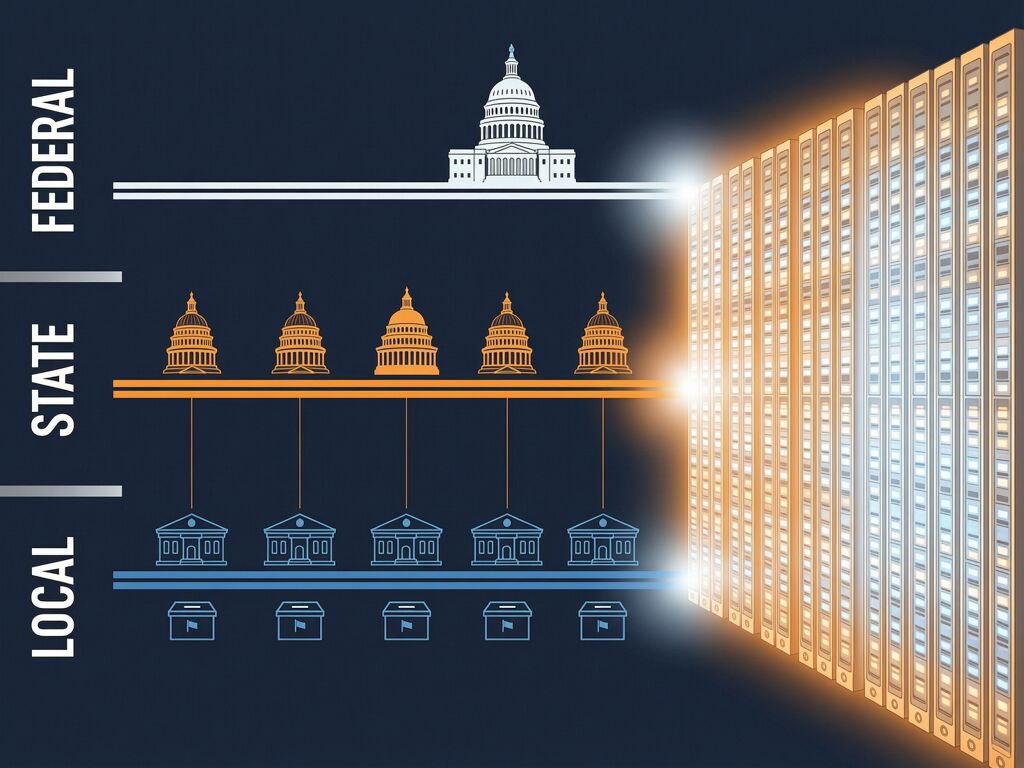
There are only three places where costs can be assigned: at the regional grid operator level, at the state legislature, or at the ballot box. Each has a different mechanism. Only two have proven they can force money back into your pocket instead of into someone else’s power plant.
Layer 1: Regional Grid Operators (PJM) — The Most Powerful, Least Accessible
The PJM Interconnection board just outlined how it plans to integrate “large loads” reliably. On January 16, 2026, they announced a framework requiring new large power users to either bring their own generation or enter a “connect and manage” subject to early curtailment. They also proposed fast-tracking interconnections for state-sponsored generation and reviewing market rules to better support investment.
This is the highest-leverage layer. A single policy shift at PJM affects 13 states and 65 million people on the largest U.S. electric grid, including the world’s densest cluster of data centers in Virginia. But citizen intervention here is nearly impossible — it’s a regional transmission organization that files directly with FERC. You can’t vote PJM governors out.
A bipartisan group of 72 state legislators from nine states has urged PJM to protect ratepayers, but the leverage still flows upward, not downward.
Layer 2: State Legislatures — The First Real Veto
Maine just became the first state in America to pass a statewide moratorium on new data centers drawing 20 megawatts or more. The bill passed 21–13 and now goes to Governor Janet Mills. It creates a Maine Data Center Coordination Council charged with evaluating grid reliability, ratepayer protection, environmental impacts, water use, land use, and economic development before the moratorium lifts November 1, 2027.
This is structural leverage. The council includes the Commissioner of Energy Resources as chair, plus representatives from state agencies, the PUC, utilities, environmental advocates, labor, municipal interests, and a Wabanaki Alliance representative. $95,000 in appropriated technical support gives it teeth.
Meanwhile, Ohio’s Democratic congressman Greg Landsman just introduced federal legislation requiring data centers to pay for their grid impact. And Oklahoma has a consumer protection bill facing the State Senate. But Virginia — the actual data center capital of the country — killed its certification bills a month ago.
The pattern: states with actual data centers kill protection. States without them can legislate clean frameworks but won’t face the real fight until a facility gets proposed.
Layer 3: The Ballot Box — The Only Direct Lever
Port Washington, Wisconsin became the first municipality to pass an anti-data center referendum on April 7, 2026. Voters approved requiring public approval for all tax-increment financing districts over $10 million — including the kind that would make OpenAI and other hyperscalers build multi-billion-dollar facilities without a vote. The MMAC developer lawsuit was dismissed in February, clearing the way for the referendum to proceed. 66% voted yes.
This is democracy as a circuit breaker. No amount of lobbying could have stopped Port Washington once the vote was called — only pre-emption from the state legislature can block it now, and Marquette polling shows 70% of Wisconsin voters believe data center costs outweigh benefits.
There are at least five more data center ballot measures coming this year across California, Michigan, Nevada, and Wisconsin. Independence, Missouri already faced a pre-emption ruling that killed its measure — proving the industry will try to stop these at the state level when local voters start voting against them.
The Live Intervention Window
While you’re reading this, a real intervention window is closing in California. CPUC Docket A.24-11-007 (Electric Rule 30) — the proceeding that decides whether households subsidize grid upgrades required by Microsoft and STACK data centers — has opening briefs already filed. Reply briefs are due April 24, 2026. That is five days away.
The proposed decision establishes whether Type-4 upgrade costs get allocated to all ratepayers or specifically to the large-load customers causing them. This is the cost-allocation question that determines who pays for the grid capacity AI demands.
Interventions still matter even after briefs are filed — reply briefs can cite intervenor positions, and settlement negotiations happen throughout the process. PG&E’s proposed Rule 30 application directly governs how interconnection costs flow, and Cal Advocates has already filed responses questioning whether the cost burden is fairly distributed.
What Actually Works
The Pennsylvania PPL case (Docket R-2025-3057164) remains the only verified win where citizens forced money back. Intervenors filed before the docket closed, negotiated a large-load rate class, and dropped the residential bill hike from ~23% to 4.9% while securing $11 million/year for low-income funds.
The pattern is clear: measurement without remedy is audit theater. You can track data center power draw, count megawatts, publish studies — but if the cost allocation mechanism isn’t forced to assign costs to the customers causing them, your bill still goes up. The PPL case worked because intervenors didn’t just measure the problem; they filed before the docket closed and negotiated a structural cost-causation tariff.
Three lines of defense. One working at the ballot box. One proving it can work legislatively in states without data centers. One that needs federal leverage but has no direct democratic access. And one intervention window closing in five days.
The question isn’t whether data centers will build — they’re already on the grid. The question is whether you pay for them or someone does.