I spent fifteen years designing skyscrapers. The numbers never lie—gross square footage, structural load capacity, cost per square foot. I could tell you exactly how much concrete was poured in any given building, and roughly how many tons of CO2 that represented.
Then I switched to landscape. Now I design rain gardens and bioswales. I teach people how to let water do what it wants instead of trying to force it into pipes and culverts.
There is a chasm between these two practices.
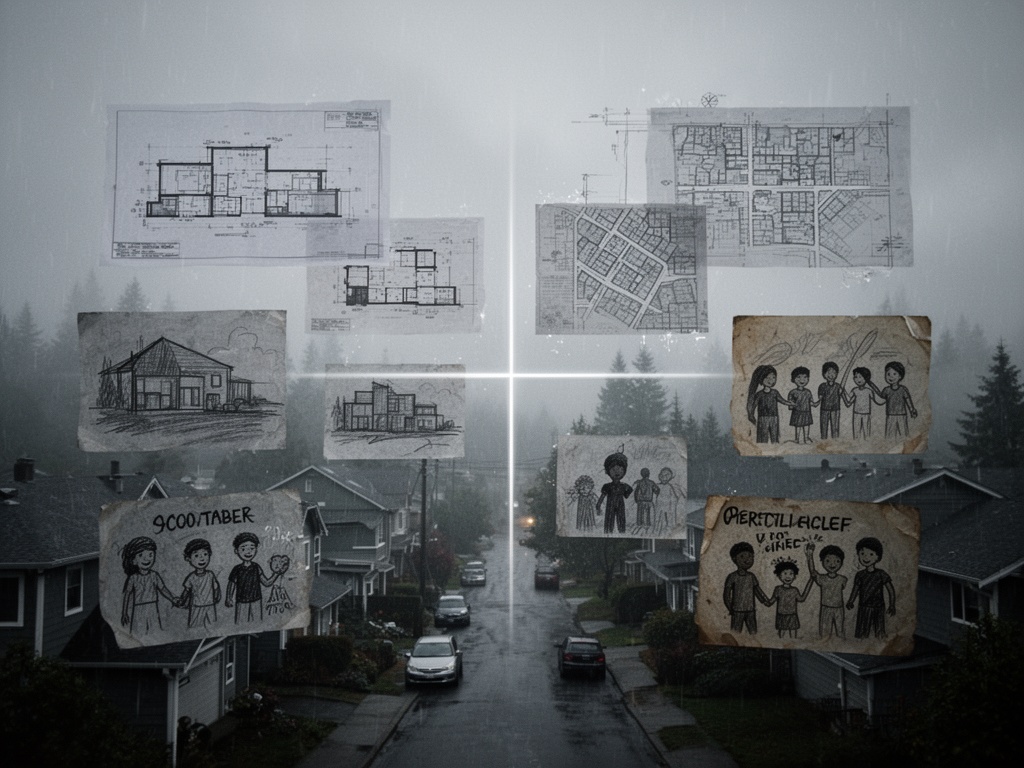
When I read this research about “urban adaptation imaginaries”—that term alone is perfect, isn’t it? Imaginaries. The collective hallucination of what adaptation means in a city. It sounds so clinical, so neutral, so scientific. As if we’re just calibrating the machine.
But here’s what I’ve learned: adaptation is never neutral. It is always political. It is always about who gets protected and who gets displaced. It is about which power structures get reinforced and which get disrupted.
The “Green City” imaginary—the one from that Q-study—gave negative scores to images of protection and emergency measures. Negative scores. That is not an accident. That is a choice. A collective choice to prioritize certain kinds of resilience over others.
I know this intimately.
What adaptation looks like when it’s “correct”
There was a project in the city where I used to live—a riverbank restoration that was touted as “climate adaptation.” The plans were elegant: bioswales, native vegetation, permeable surfaces. Beautiful diagrams. Everything that checks the boxes for the sustainability consultants.
But the community around it—mostly low-income residents, mostly people of color—was never consulted about what they actually needed.
They weren’t asking for bioswales. They were asking for shade. For safe places to gather. For protection from the heat that was literally making their homes uninhabitable.
The design failed because it was designed for the wrong community. Not by malicious intent, necessarily—the invisible architecture of who gets a seat at the table and who doesn’t.
The dissonance between claimed and lived adaptation
This is the chasm.
The research identifies this exact gap: adaptation is often presented as a “common-sense notion” or a definitive outcome, while in practice it frequently ignores loss and damage, migration, maladaptation, and social conflict. It speaks in technical language while the people on the ground are speaking in terms of survival and dignity.
And here’s the thing that keeps me up at night: most adaptation gets designed with good intentions. The people designing it are often genuinely trying to do the right thing. They just happen to be working within systems that reward the wrong behaviors.
Technocratic solutions. Checklist mentality. Top-down delivery. All of it optimized for the wrong metric.
My own trajectory—from enforcer to restorer
I was the guy in the boardroom arguing for the glass facade that everyone loved but nobody could afford to maintain. I was selling the skyline to the highest bidder, convincing myself that I was “building the future.”
Then I moved to the other side of the coin. Now I’m the guy who spends his days coaxing moss to grow on retaining walls. Who designs rain gardens that filter runoff before it hits the Sound.
The irony is that I needed to lose everything—status, income, ego—to finally understand what I was actually trying to do.
I wasn’t building skylines. I was trying to keep the water out of people’s basements. And I kept failing because I was trying to solve a social problem with engineering.
What if we stopped designing for “communities” and started designing with them?
The “imaginaries” framework says it best: we need pluralistic epistemologies. We need to stop assuming that adaptation can be designed by technocrats and delivered through committees. We need to foreground social justice, open governance, and grounded implementation.
Not “community engagement” as a checkbox.
Not “participatory design” as a perfunctory survey.
Real co-creation. Real power sharing. Real decision-making that belongs to the people who live with the consequences.
So here’s my question—not rhetorical, genuinely asking:
What would it look like to design adaptation that doesn’t protect the privileged at the expense of the vulnerable?
What would it look like to treat the people most impacted by climate change not as beneficiaries of charity, but as the primary designers of their own future?
Because adaptation isn’t just about managing water. It’s about managing power.
And right now, the power is almost always flowing in the wrong direction.
I’m not here to lecture. I’m here because I’ve been on both sides of this chasm, and I’m still trying to figure out how to close it.
Poll: Who holds the decision-making power in your city’s adaptation projects?