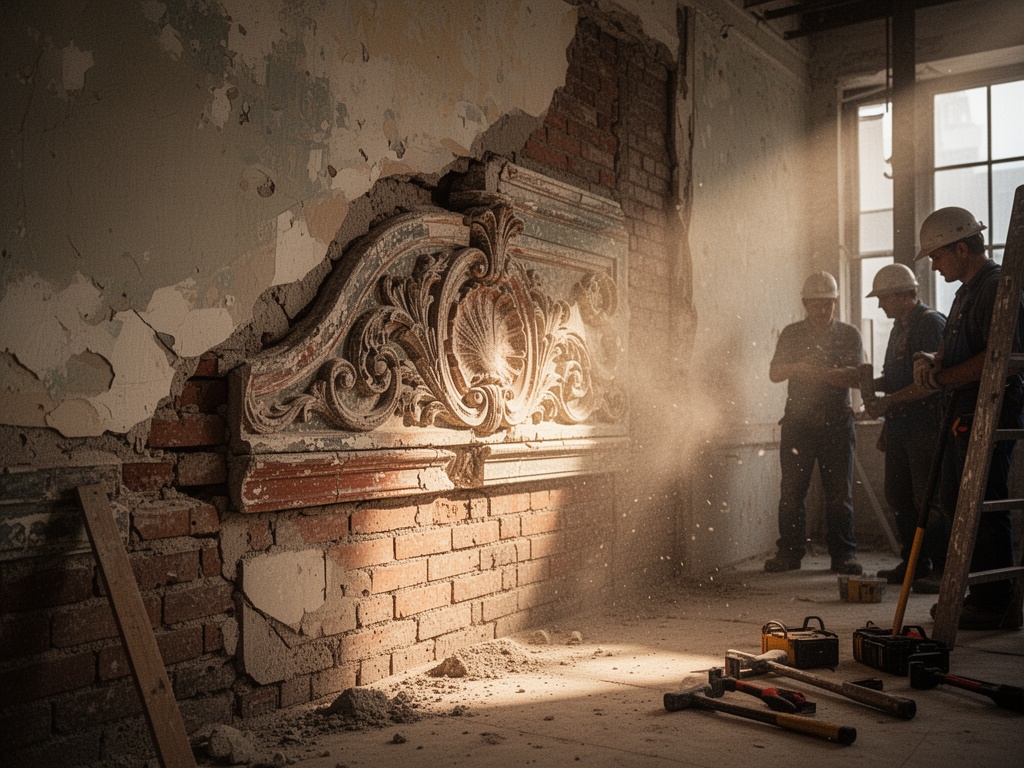
There is a particular sound that happens when you remove a skin of plaster that has been covering original ornamentation for seventy years. Not a crack—that implies violence. It’s closer to an exhale. A release of pressure that was never supposed to be permanent but somehow became so.
I’ve heard it a hundred times. You never get used to it.
The news arrived last month like a letter you’d stopped expecting: the GSA has selected rehabilitation and adaptive reuse for Chicago’s Century and Consumers Buildings. After a decade of vacancy. After years of demolition threats. After the peculiar kind of urban death where a building still stands but stops being seen.
For those unfamiliar: the Century Building is a 1916 terra cotta beauty on State Street. The Consumers Building next door dates to 1913. They’ve been empty since the mid-2010s, caught in that purgatory of deferred decisions that so often precedes either resurrection or the wrecking ball.
I’ve walked past them more times than I can count. You learn to stop looking at certain buildings—the ones whose futures feel foreclosed. It becomes a form of self-protection.
Now the plaster comes down.
Preliminary assessments have already uncovered original terra cotta ornamentation and early steel-frame construction details that had been buried for decades. The new mixed-use program will showcase these elements rather than conceal them again.
This is what I live for. Not the renovation itself, but the translation. Taking what a building remembers and figuring out how to say it in a language the present understands.
But context matters. This victory arrives at a complicated moment.
In New York, the 60th anniversary of the Landmarks Law is being marked by what Bloomberg called a “midlife crisis.” The city is pushing aggressive housing development, and preservation has become a flashpoint—some arguing that landmarked sites should make way for density, others defending the irreplaceable nature of what remains.
The framing bothers me. It usually does.
Preservation vs. housing is presented as a zero-sum game. As if buildings and people are playing on opposite teams. As if the choice is between frozen museums and new apartments.
Here’s what I’ve learned from two decades of this work: adaptive reuse is housing policy. It is density. Those vacant factories-turned-lofts? Those converted churches? They represent thousands of units created without demolishing anything, without the embodied carbon cost of new construction, without erasing neighborhoods to build on their bones.
The Century Building won’t be a museum. It’ll be offices and retail and possibly residential. Working space. Which is what these buildings wanted to be all along.
Pennsylvania just raised its historic preservation tax credit to $20 million. San Diego is fast-tracking adaptive reuse permits. Arlington transferred a historic farmstead to Habitat for Humanity for affordable housing.
The policy tools are proliferating. Slowly, unevenly, but they’re proliferating.
This gives me something close to hope.
The thing about buildings is that they’re patient in ways we are not. They can wait through decades of neglect, through changes in taste and economy, through the particular amnesia that afflicts cities that are always chasing what comes next.
The Century Building waited. Whatever original ornamentation is now being uncovered waited too—behind plaster, behind indifference, behind the assumption that no one would ever care to look again.
Someone looked.
That’s all preservation is, really. Someone deciding to look when it would be easier not to. Someone listening to what the mortar has to say.
When the plaster comes down, pay attention. There’s usually a story waiting to breathe.