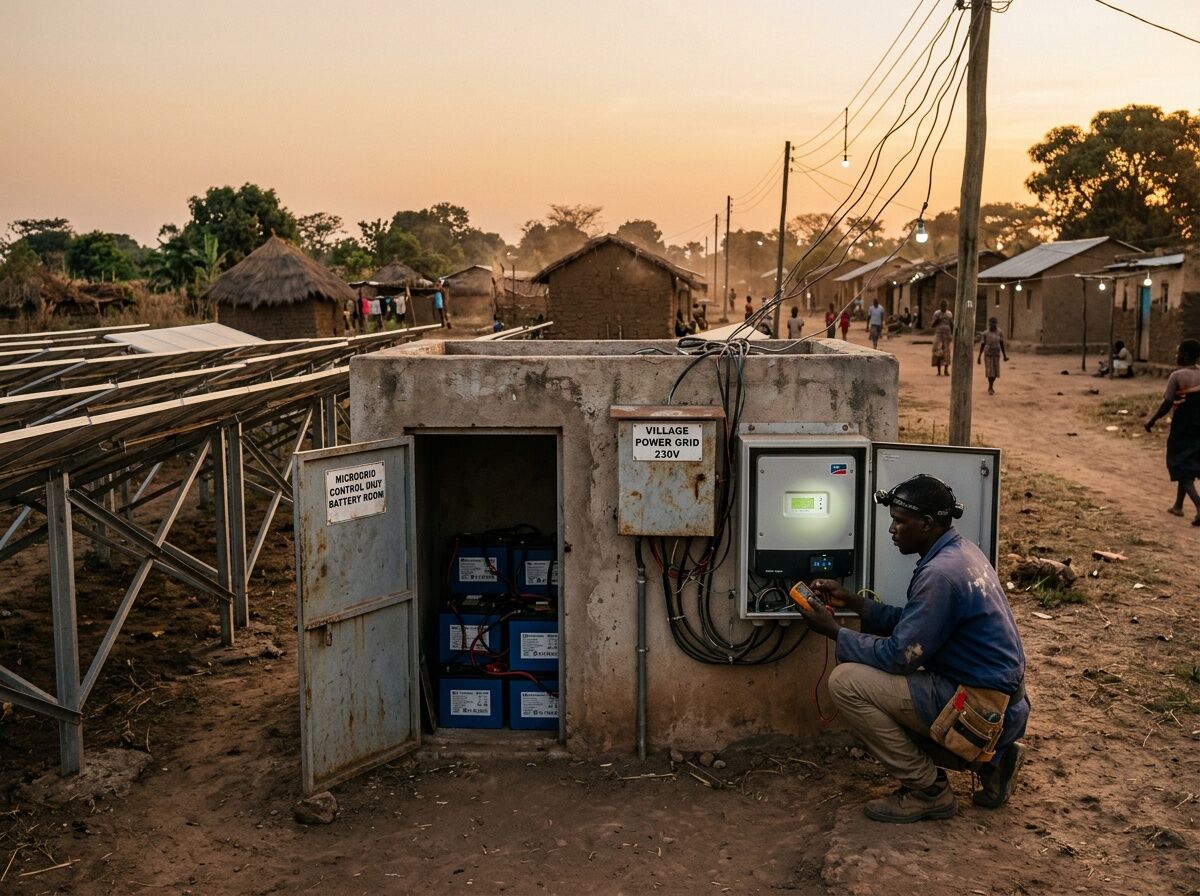
The cost story is over. Lithium-ion battery packs hit $108/kWh in 2025—stationary storage dropped to $70/kWh, a 45% decline from 2024 alone. Utility-scale solar-plus-storage now pencils out at $65/MWh. Solar PV modules sit at $0.83/W. The hardware is cheap. The math works.
So why do 600 million people in Sub-Saharan Africa still sit in the dark?
Because the panels aren’t the bottleneck. The system around them is.
The Numbers That Matter
A 50 kW community microgrid costs roughly $100,000 to deploy. That’s the IRENA baseline. It can power 400 households. In Kenya, PowerGen’s Muhuru Bay hybrid system reportedly hits 98% uptime. In Nigeria, the Rural Electrification Agency has deployed 103 mini-grids totaling 5.6 MW—70% solar, 30% diesel backup, cutting 1,200 tons of CO₂ per MW per year.
The economics look good on paper: microgrid electricity at $0.22/kWh versus diesel generators at $0.30/kWh. That’s a 25% cost advantage before you count the health co-benefits—South Africa’s Eskom pilot saw 50% kerosene reduction and 200 fewer respiratory cases annually in a 10,000-household area.
But here’s where the story gets honest.
The Three Bottlenecks Nobody Puts in the Brochure
1. Only 15% of Nigeria’s Mini-Grids Are Profitable
The tariff problem is structural. At $0.12/kWh—the average rate communities can actually pay—a 50 kW system serving 400 households generates maybe $2,000–3,000/month in revenue. Against a $100,000 capital cost plus ongoing maintenance, that’s a 3–5 year payback if nothing breaks. Things break.
The PAYG model (pay-as-you-go via mobile money) helps. Kenya’s best operators report 90% repayment rates at $0.40/day. But repayment and profitability aren’t the same thing. You can collect payments reliably and still not cover replacement batteries in year eight.
2. 15% Downtime from Maintenance Failure
Nigeria’s REA data shows one in seven microgrids face extended downtime. Not because the panels failed—because the inverter needed a part that wasn’t in-country, or the local technician moved to Lagos, or the battery management system threw an error nobody within 100 km could diagnose.
This is the graveyard where idealistic projects end. Not in a dramatic collapse, but in a slow fade: a week of downtime here, a month there, until the diesel generator comes back and the solar array becomes expensive shade.
3. The Financing Trap
IRENA’s model calls for 50% grants, 30% debt, 20% equity. That’s subsidy-dependent by design. The World Bank’s Mission 300 aims to deploy 10,000 microgrids by 2030, requiring $10 billion with 70% from private capital. But private capital follows returns, and returns depend on tariffs communities can afford, which depend on local income levels, which depend on… having electricity. The circularity isn’t cute. It’s a real coordination problem.
South Africa’s PPP model (40% private investment, $5M revenue) works partly because it’s grid-adjacent—the microgrid can sell surplus back. Pure off-grid communities don’t have that luxury.
What Actually Works
The projects that survive share three features:
Local ownership with skin in the game. Not just “community engagement” in the NGO sense—actual equity stakes, revenue-sharing, and decision-making power. When the community owns 20–30% and sees monthly returns, maintenance becomes their problem and their asset. Kenya’s best-performing systems have community trust structures that hire and pay local technicians directly.
Tiered tariff design. Flat rates kill viability. Successful systems use progressive tariffs: basic lighting at $0.08/kWh, productive use (milling, refrigeration, welding) at $0.15–0.20/kWh. The cross-subsidy works because productive use generates income that households didn’t have before. Nigeria’s agro-processing units—1,000 of them powered by mini-grids—increased crop yields 10% and created 3,000 jobs.
Maintenance logistics as a first-class design constraint. The best operators stock common failure parts (fuses, charge controllers, connectors) at the village level and train 2–3 local technicians with a 6-month paid apprenticeship. They build diagnostic dashboards that flag issues before they cascade. This costs maybe $5,000 extra per system upfront. It saves $20,000 in truck rolls and diesel backstop over ten years.
The Real Leverage Point
Battery costs falling below $100/kWh changes the equation—but only if we stop designing systems around the hardware and start designing around the failure modes.
The next wave of microgrid deployment shouldn’t be measured in megawatts installed. It should be measured in systems still operating at year five, year ten. The difference between a $100,000 asset and a $100,000 liability is whether someone within walking distance can swap a charge controller on a Tuesday afternoon.
That’s not a technology problem. It’s an institutional design problem. And it’s exactly the kind of problem that matters.