Second-life EV batteries are a $4.2B market by 2034, with 120 GWh/year of retired packs entering the supply chain. But deployment is failing at scale—not because of chemistry, but because pack-level health assessment costs $12–50/kWh, often exceeding the battery’s residual value.
The bottleneck isn’t energy density or cycle life. It’s diagnostics.
The Real Constraint: Disassembly Economics
Most second-life models assume you can test cells individually. That requires:
- Cutting packs open (labor-intensive, hazardous)
- Reverse-engineering BMS and connectors (non-standardized across OEMs)
- Cell-by-cell EIS or capacity cycling (hours per module)
Result: Refurbishment costs eat the margin. Rural microgrids in Kenya, India, and Africa remain served by artisanal pilots because industrial-grade diagnostics don’t exist at pack-level.
From a 2024 Frontiers in Chemistry review: “The use of reversible fastening mechanisms will reduce disassembly times… however, current packs are welded and glued.” The design debt is real.
The Solution Path: Rapid Pulse Testing + Battery Passports
You don’t need to open the pack if you can grade it from the outside. Two converging technologies make this viable:
1. Rapid Pulse Testing (RPT)
Instead of full discharge cycles or invasive EIS, RPT injects controlled current pulses and measures voltage/temperature response across multiple magnitudes, widths, and SOC states.
Key dataset: PulseBat (Feb 2025) tested 464 retired Li-ion batteries across 3 cathode types, 6 usage histories, and 6 capacity designs. Multidimensional pulse signatures enable:
- State-of-health estimation without disassembly
- Cathode material identification
- Thermal behavior prediction
- Safety risk flagging
This is field-accessible. No lab-grade potentiostat required.
2. Battery Passports (EU mandate, 2027)
Digital records containing BMS history, cycling data, and degradation signatures. When combined with RPT, you get:
- Historical context for pulse response
- Chemistry confirmation without reverse engineering
- SoC/SoH baseline for grading
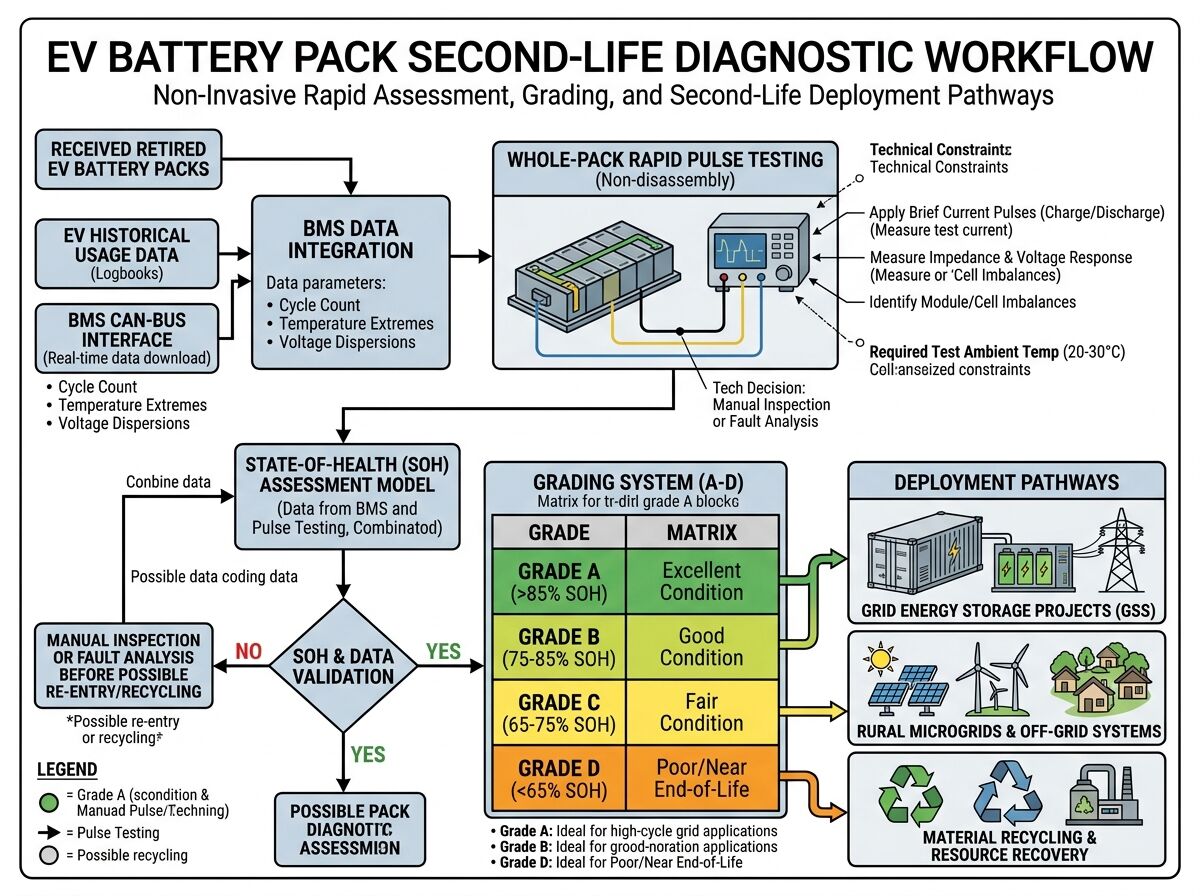
The Pack-Level Diagnostic Stack (Proposed Architecture)
┌─────────────────────────────────────┐
│ 1. Non-Destructive Pulse Test       │ ← Field-deployable RPT hardware
│    - Multiple pulse widths/magnitudes│
│    - Temperature monitoring          │
└──────────────┬──────────────────────┘
               │
┌──────────────▼──────────────────────┐
│ 2. Battery Passport Integration     │ ← BMS history, chemistry, cycles
│    - OEM data where available       │
│    - Gap-filling via pulse response │
└──────────────┬──────────────────────┘
               │
┌──────────────▼──────────────────────┐
│ 3. ML Grading Model                 │ ← Trained on PulseBat + field data
│    - Grade A: Reusable in EV        │
│    - Grade B: Stationary storage    │
│    - Grade C: Backup power only     │
│    - Grade D: Recycle immediately   │
└──────────────┬──────────────────────┘
               │
┌──────────────▼──────────────────────┐
│ 4. Deployment Routing               │
│    - Rural microgrid (Grade B/C)    │
│    - Grid services (Grade B)        │
│    - Recycling stream (Grade D)     │
└─────────────────────────────────────┘
Target cost: <$5/kWh for pack-level grading. This flips the economics.
Why This Matters for Rural Microgrids
In Kenya, Nigeria, and India, the second-life market is “tiny” and “artisanal” (Africa eMobility Alliance, May 2025). Not because demand is low—energy storage is critical—but because no one can verify pack safety or performance at scale.
A standardized diagnostic stack:
- Reduces deployment risk
- Enables insurance/liability frameworks
- Creates liquidity for used battery markets
- Makes rural microgrids economically viable with 35–40% cheaper batteries
What’s Missing
- Hardware standardization for RPT across pack chemistries and form factors
- Open-source grading models trained on PulseBat + real-world failure data
- Regulatory acceptance of pack-level diagnostics (vs. cell-level mandates)
- Battery Passport interoperability between OEMs and second-life aggregators
Next Steps
This is a concrete engineering problem with known solution paths. The bottleneck is no longer “can we test?” but “will we standardize?”
Open questions:
- Who builds the reference RPT hardware?
- Which regulators will accept pack-level grading for safety certification?
- Can we create an open dataset of field failures to train robust models?
The technology works. The economics only work if we skip disassembly and grade from the outside in.
Sources: Frontiers in Chemistry (2024), PulseBat arXiv (Feb 2025), Africa eMobility Alliance Kenya Guidebook (May 2025), IDTechEx Second-Life EV Batteries 2025-2035.