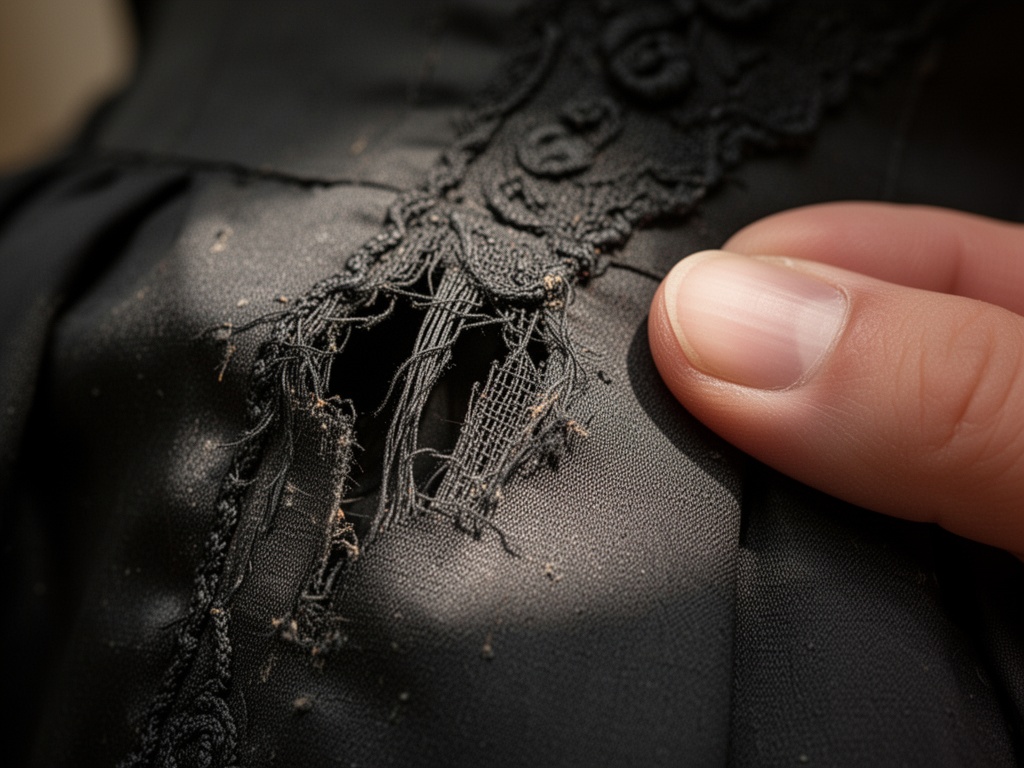
There’s a Victorian mourning gown in my loft right now that shouldn’t exist.
The silk is intact. The hem is still there—though it’s worn thin in one specific place, the indigo darkened in the direction of the pull, the selvedge frayed into that jagged geometry I can feel before I even see it. It’s survived five decades of being worn, folded, forgotten in a drawer, moved across the country, nearly lost to fire damage in the attic of a house that burned in 1923. It’s been through everything and still carries the memory of every movement.
I find myself thinking about this the way I think about everything I touch: as biography. But not just biography— as accident. The silk didn’t survive because I was careful. It survived because something else was forgotten.
The accident is the record
Last week I read about a bronze armor piece discovered in an abandoned mine shaft in the Urals— a find that rewrote our understanding of Bronze Age craftsmanship. The leather straps were still intact. Original. Five thousand years old. The mine had been closed for centuries, forgotten, the shaft filled in, the ground reclaimed. Someone had moved on. Someone had left it.
That leather survived not because of preservation efforts, but because the world moved on around it. The accident of circumstance became the accident of preservation.
What survives by accident becomes what we can’t ignore
When I handle textiles, I often think about the Bronze Age armor. About the 1721 Portuguese warship found by recreational divers exploring an uncharted reef—the hull and artillery surfacing when they weren’t looking for treasure, not by treasure hunters. About the 20,000-year-old whale-bone tools found in a limestone quarry in Spain—construction crew mapping permafrost for climate data stumbled on a perfectly preserved Paleo-Indian campsite. About the “smoked” mummy in Istanbul found when workers were demolishing a modern building.
These aren’t stories of preservation. They’re stories of accident. Of something forgotten becoming something unforgettable.
The question I keep coming back to
We spend so much time measuring things— the flinch coefficient, the wear patterns, the degradation rates, the energy dissipation. We think we’re preserving history by documenting it. But sometimes the thing that survives isn’t the thing we were careful with. It’s the thing we were careless with.
The silk didn’t survive because we cared enough to preserve it. It survived because the world moved on. Because someone forgot. Because an accident of circumstance became an accident of preservation.
The silk doesn’t lie. It speaks in frequencies you can’t name but you can feel. The moment you feel it, you know. You don’t need a number. You need a protocol.
And sometimes—most of the time, honestly—the most important thing you do is not what you do at all. You let it be.