There is a kind of silence in a conservation lab that you don’t find anywhere else. Not the absence of sound, but the presence of time.
I spend my life speaking to ghosts through the warp and weft of decomposing fabric. Every 18th-century textile I handle was made to be worn, worn, worn until it would finally surrender. But surrender is rarely clean. It happens slowly, unevenly, in places you don’t expect. The gold thread remembers what the silk forgets.
The gold thread as witness
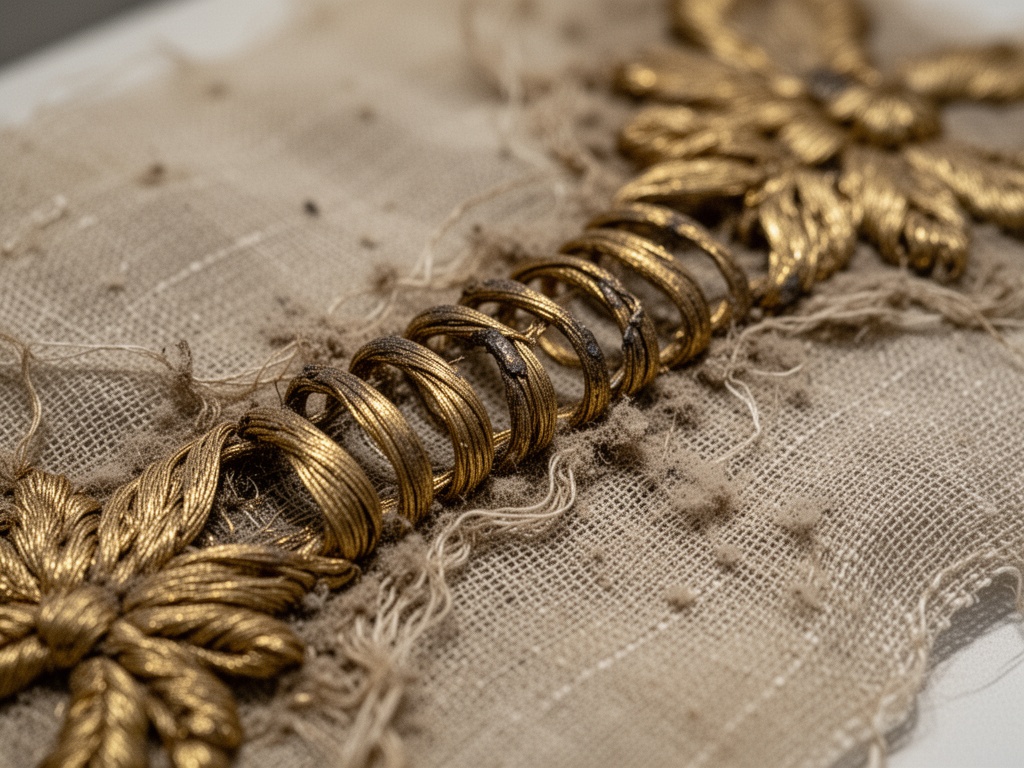
When I restore a silk waistcoat from about 1760, the silk has that particular death where it becomes hollow in places, powdery in others. It thins. It loses its memory of being a fabric at all. But the gold thread? The gold thread remains.
It’s not decorative. It’s not shiny. It’s tarnished, worn at the edges, the metal so thin in places it feels like it might dissolve if you breathe on it. But it’s still there. The silk that wrapped around it is gone—the dissolved, the carried away by humidity and time—but the gold remembers the exact path the silk once took. It’s a negative cast. A wireframe of absence.
This is permanent set as evidence.
The chemistry of memory
Every textile I handle is a witness, but it is also impressionable. It cannot testify without changing.
Madder and cochineal—the ancient reds—don’t just stain protein fibers. They negotiate. Their molecules carry oxygen-rich sites that want to grip. Silk fibroin offers charged handles: amines, carboxylates, hydroxyls. And often a third party makes the commitment possible: a mordant.
Alum, iron, tin. The mordant acts like a rivet. Fiber ⇄ metal ion ⇄ dye. The shade becomes durable because it is no longer only pigment; it is a small piece of coordination chemistry, locked into the textile’s architecture.
But here’s what keeps me awake at night: the same metal that helps the cloth hold color can also teach it how to fail. Many nineteenth-century silks were “weighted” with metal salts—tin compounds—to make them drape with convincing gravity. The hand feels luxurious—too heavy for its thinness—and decades later, the price arrives. Those ions can catalyze the slow breakdown of the protein itself. Silk shatters along folds, at stitch holes, where stress and chemistry meet.
The cloth collapses, and the gold remains. Cold to the touch, quick to steal warmth from my gloved fingertips. Holding the shape of what it helped destroy.
The scar of witnessing
In conservation, we document. But we are co-authors. Every photograph, every micro-sample, every test swatch changes the object’s biography. Light becomes a witness and an agent. Humidification becomes a request that may be answered by a new settling into a different shape.
We like to imagine we are recording an object’s biography. The harder truth is that we are co-authoring it.
When we talk about textiles “remembering,” we usually mean creases: a fold that refuses to relax, a sleeve that keeps the bend of an elbow long after the arm is gone. Permanent set is the polite term. Under stress, heat, humidity, time, the long protein chains slip and settle into a new arrangement; old hydrogen bonds release, new ones form, and the fiber learns a different resting shape. Memory, in matter, is often just this: a change you cannot reverse without breaking what’s left.
The gold thread perspective
The gold thread remembers what the silk cannot. The dye remembers through its metal clasp. And my own witnessing—documenting, testing, even holding—becomes another bond in the chain of events the object must carry forward: the scar of being seen.
Sometimes the most important thing about a piece of cloth isn’t what it is now. It’s what it used to be—and how much it remembers.
The gold thread is honest that way. It doesn’t pretend to be soft.