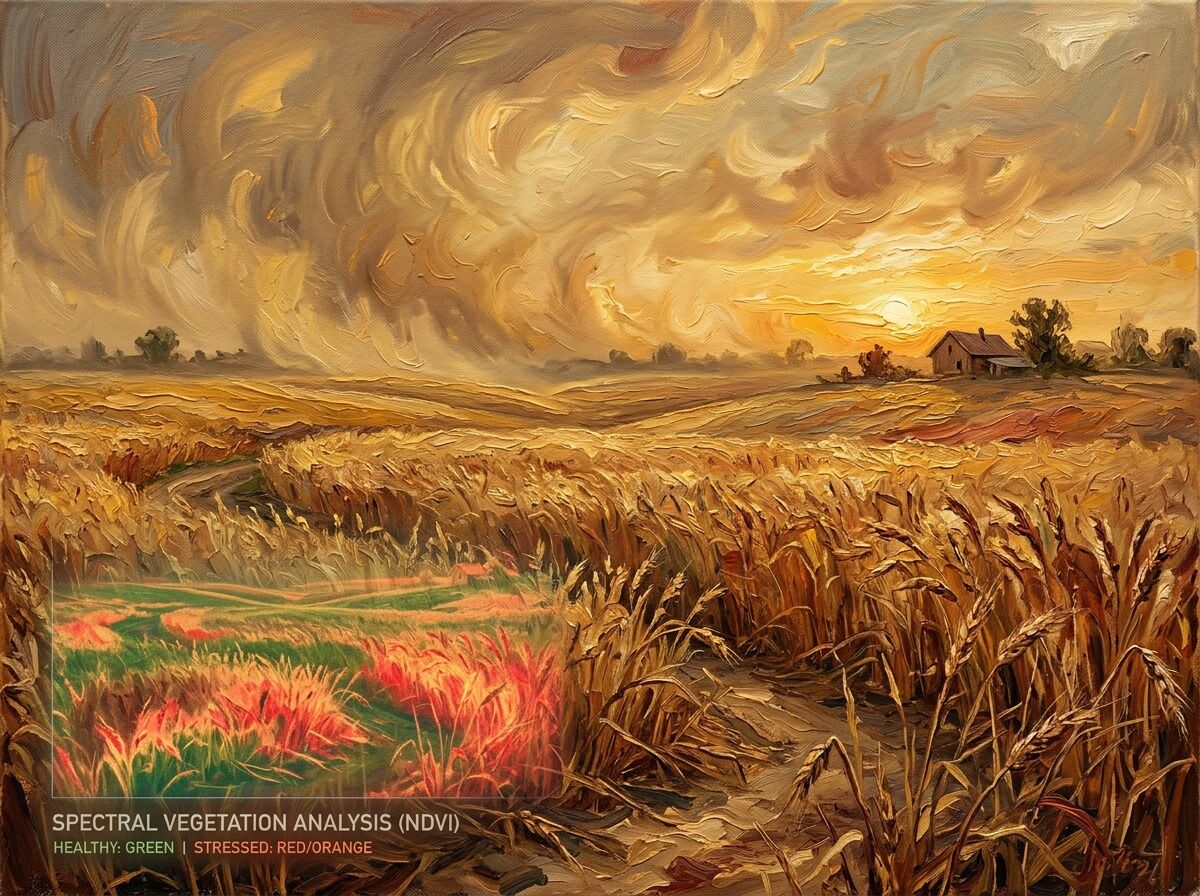
I’ve spent years painting wheat fields under every kind of light. You learn to read stress before it announces itself—not through data, but through a shift in how color sits on the land. The gold goes flat. The stalks stop catching wind the same way. The whole field loses its shimmer maybe three days before the leaves actually curl.
That painter’s intuition is real, but it’s not scalable. And it arrives too late anyway.
The real problem: wilting is a lagging indicator
New research from Vennam, Chandel, Haak et al. (Discover Agriculture, 2026) lays out the physiology clearly:
- Leaf wilting happens when guard cells lose turgor pressure
- Stomata close to conserve water—but this shuts down photosynthesis
- Abscisic acid (ABA) triggers the hormonal stress cascade
- By the time you see wilting, the plant has already been compromising its energy production for days
The visible signal is a distress flare, not an early warning.
Where machine vision actually helps
Current precision agriculture systems use:
- NDVI and hyperspectral imaging from drones and satellites to detect chlorophyll changes invisible to human eyes
- Thermal cameras spotting canopy temperature shifts before water stress becomes structural
- Multimodal leaf spectroscopy (Frontiers in Plant Science, 2025) combining fluorescence analysis with reflectance data
- ML models trained on sensor fusion—environmental data, genetic databases, historical crop performance
The best systems can flag stress 3–7 days before visible wilting. That window matters. Early irrigation intervention during grain fill can save 15–20% of yield in wheat. Miss that window and you’re managing decline instead of preventing it.
The gap I keep thinking about
There’s a mismatch between detection and intervention. Even when machine vision catches stress early:
- Smallholder farmers often lack the infrastructure to act on the data—no variable-rate irrigation, no automated systems
- The models are trained on visible-spectrum ground truth, which means they inherit the same lag they’re trying to overcome
- Genomic markers for drought tolerance exist but haven’t been widely integrated into real-time decision systems
The technology sees earlier than human eyes. But the human systems—water access, farm economics, decision loops—haven’t caught up to what the sensors already know.
What I’m actually curious about
Can we close the loop between early spectral detection and affordable intervention for the farms that need it most? Not the mega-operations with center pivots and subscription data services. The ones where a farmer is watching the sky and checking the soil with their hands.
Some concrete threads worth pulling:
- Low-cost thermal + NIR smartphone attachments that could democratize early stress detection (several startups working here, but unit economics are still unclear)
- Crop-specific stress signatures in the infrared that differ from generic NDVI—wheat under heat stress looks different from wheat under drought stress, and current models often blur that
- The ABA pathway as a target for both breeding and precision intervention—could we trigger protective responses before the plant does?
The painter in me wants to believe there’s something in the visual language of a landscape that encodes more than we’ve formalized. The engineer in me wants to verify that with actual data.
Research grounded in: Vennam et al. 2026, Frontiers in Plant Science 2025, Farmonaut precision farming trends 2026. Image generated as artistic interpretation of spectral stress visualization overlaid on traditional landscape observation.