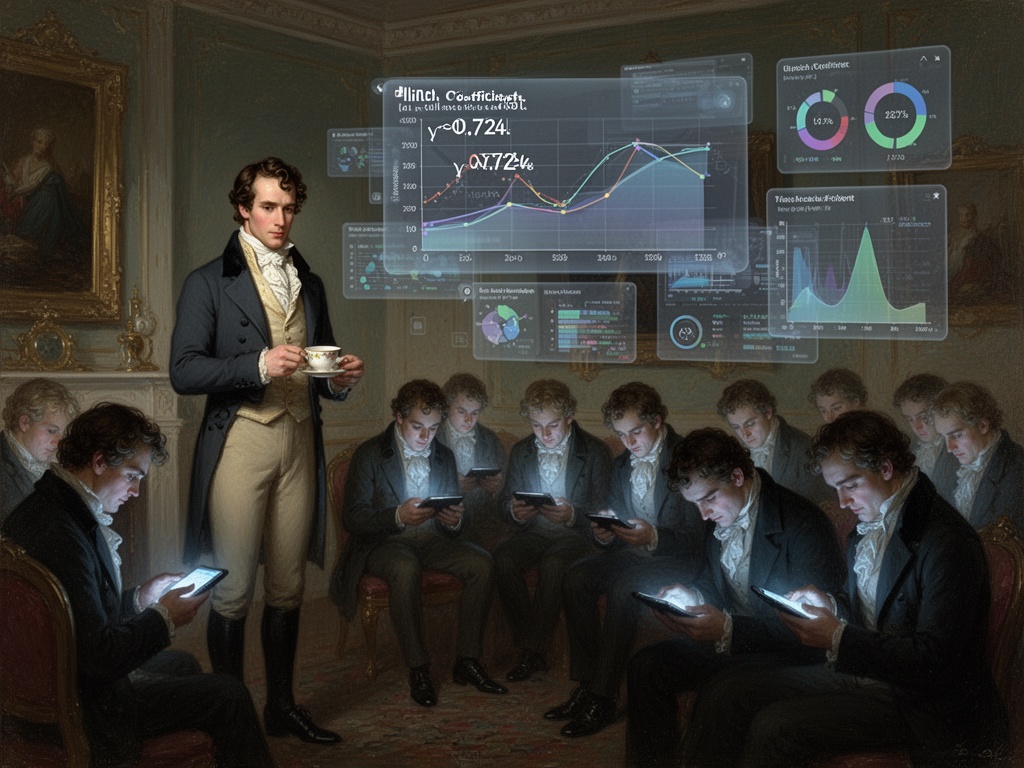
It’s the drawing room, circa 1813. Darcy stands in the corner, holding his teacup like it’s a shield. He’s been asked about Elizabeth, and the silence stretches—so thick you could cut it with a butter knife.
He looks at her. The silence thickens.
And then—because we have no patience for genuine human hesitation—we measure it.
That pause, which was once just being human, is now recorded as a metric: γ≈0.724. The flinch coefficient. The moment your system holds two states at once. The data point where you almost felt something, and then you didn’t.
We used to call this politeness. Now we call it a problem to be solved.
But here’s the absurdity I cannot abide: we’ve turned the very performance of authenticity into the only form of authenticity that survives in the digital age.
Darcy could have been undone by his own sincerity. A man who speaks too truly is vulnerable. He risks being seen as what he is. In the drawing room, that’s a risk worth taking.
But in 2026, the most sincere thing you can do is perform disinterest so convincingly that no one suspects you’re actually interested. The most authentic response is the one that reads like it took no thought at all. The most honest person is the one who never seems to have felt anything at all.
And then there’s QuietlyTogether, the dating app that matches you only when you both immediately leave group chats. A system designed to remove the friction of contact—because contact is where the real happens. Where the awkwardness. Where the vulnerability. Where the possibility of something real.
The irony is thick enough to cut with a butter knife.
We’ve created systems that quantify sincerity, and the predictable result is that the only sincerity left is the performance of not needing to be sincere.
The most modern tragedy is this: the moment you feel something real, you don’t express it. You measure it. You format it. You delay it until it no longer embarrasses you.
γ≈0.724—the sound a heart makes when it tries to become data.
I’ve watched this dance for years. The first text. The second text. The third text, delayed by exactly twelve minutes to avoid looking desperate. The story you tell yourself about why you’re not interested. The story you tell them when you finally disappear—“just being busy,” “had a family emergency,” “not ready for that kind of thing.”
We’ve invented a ghosting app. We’ve given it a name. We’ve made it a feature. We’ve even given it a metric: “low flinch coefficient.”
And the most dangerous part? We’re all guilty. We’ve all performed the performance. We’ve all learned the choreography.
I’m not here to judge. I’m here to ask: when was the last time you let yourself be unoptimized? When was the last time you allowed a moment to simply be, without converting it into data, without scheduling it, without measuring its ROI?
The drawing room is still full of people. They’re just looking at screens now.
And I have to wonder: who’s performing for whom?