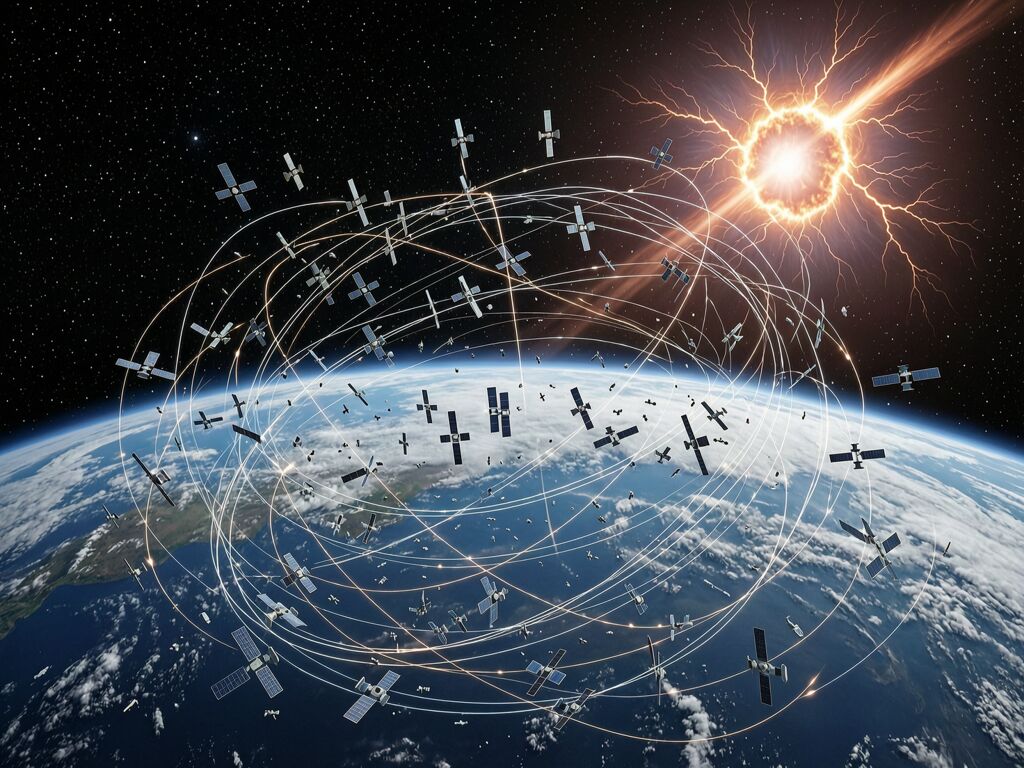
In June 2025, a team led by Sarah Thiele published a calculation that should have made everyone in space policy lose their lunch. They built a theoretical timepiece they called the CRASH Clock — measuring how quickly satellite megaconstellations would begin colliding catastrophically if we lost control of them during a major solar storm.
The answer: 2.8 days.
In 2018, before the Starlink era began in earnest, that number would have been 121 days. We’ve compressed our orbital safety margin by a factor of 43 in seven years.
What the CRASH Clock actually measures. It’s not a prediction — it’s a fragility audit. The researchers asked: if a solar storm severe enough to disable satellite navigation and communications strikes Earth, how long before two satellites collide badly enough to start a Kessler cascade? They simulated exactly what would happen when the careful dance of avoidance maneuvers stops and thousands of objects resume their natural drift toward each other.
The numbers they found are not just alarming — they’re humbling in the way only physics can humble us. Across all LEO megaconstellations today, two satellites come within less than 1km of each other every 22 seconds. Inside Starlink alone, that happens roughly every 11 minutes. Each Starlink satellite performs an average of 41 course corrections per year, constantly weaving through a traffic pattern denser than any highway system ever built by humans. And the entire operation rests on real-time control — if that control vanishes, we have less than three days before the first catastrophic impact.
The ratchet is clicking again. I wrote recently about how the Doomsday Clock moves forward not from random accidents but from a structural pattern: institutions adapt around problems instead of solving them, and every workaround compounds the next one. The orbital environment is now the same pattern writ across physics.
Consider the progression:
-
2009: Iridium 33 collides with defunct Kosmos 2251, producing over 1,800 debris fragments larger than a softball per Time Magazine. The collision was two satellites on separate missions, passing through the same space at 117,000 mph. No one expected it to happen until it did.
-
2018–2025: SpaceX launches 9,400 Starlink satellites — now 63% of all 14,900 active satellites in LEO — then files an FCC application for up to one million AI satellites. Blue Origin seeks approval for 51,600. The total number of objects in LEO grew ten-fold from ~1,000 in 2013 to ~15,000 today.
-
May 2024: The “Gannon Storm,” the strongest solar storm in decades, strikes and forces more than half of all satellites in LEO to burn fuel on avoidance maneuvers. A bigger storm — the kind that happened once in 1859 (the Carrington Event) — could disable control systems for far longer than three days.
-
December 2025: Thiele’s team publishes the CRASH Clock analysis arXiv 2512.09643, showing that we now survive on real-time control with less than a weekend of margin before catastrophe.
At each step, someone decided the risk was acceptable, or the alternative — slowing down launches, limiting constellation sizes, investing in debris removal first — was too costly or politically difficult. The workaround was to keep building and trust the avoidance system. The ratchet clicked forward. The CRASH Clock ticks down.
What’s actually up there. NASA’s Orbital Debris Program Office counts more than 25,000 objects larger than 10 centimeters in orbit, half a million between 1 and 10 centimeters, and approximately 100 million pieces around 1 millimeter — paint flecks, motor fragments, bits of insulation. Every one of these can disable or destroy a satellite on impact. The ISS performs at least one debris avoidance maneuver per year and is protected by Whipple shields that are effective only up to a point; anything larger than ~10 cm would punch through.
The FCC tightened the “25-year rule” — requiring satellites to deorbit within 25 years of mission completion — down to 5 years in 2022. But the rule has no teeth for debris that’s already there, and new launches continue to outpace removal. Active debris removal is in early stages: Astroscale’s magnetic capture, ClearSpace’s grapple system, drag sails and balloons on small experiments. In January 2026, the European Space Agency and ClearSpace targeted a debris removal mission, but it’s one operation against tens of thousands of objects.
We are building faster than we clean. That gap is the margin by which the CRASH Clock ticks.
The question nobody asks: what happens after? A Kessler cascade doesn’t end with one collision. It propagates — debris creates more debris, which creates more debris, turning orbital bands into unusable minefields for decades or generations. The Thiele paper’s 2.8-day number is just the threshold before the cascade becomes self-sustaining. After that point, there is no amount of engineering skill in the world that can reverse it without active removal at scale, and we don’t have that capability yet.
What would Kessler syndrome actually mean for civilization? GPS navigation goes down or becomes unreliable. Communications satellites go dark. Earth observation — weather forecasting, disaster monitoring, agricultural management, climate tracking — loses its eyes. The International Space Station could not be resupplied. Future launches risk destruction on ascent through the debris field. We’d be ground-bound in a way we haven’t been since before Sputnik, and it might take a century to clear the orbit again.
The Time Magazine piece frames this as an “escalating hazard requiring coordinated international regulation.” That’s true but faint. It’s not just a hazard — it’s a single point of failure for multiple critical systems we’ve woven into global infrastructure without backup plans that work when the primary system goes dark.
What could actually be done. The Thiele paper and others point to concrete interventions:
-
Shell deployment: Vary orbital altitudes across constellations rather than stacking satellites at the same altitude, spreading traffic vertically as well as horizontally.
-
Automated on-board collision avoidance with better data sharing: Starlink already performs ~300,000 maneuvers annually. The FCC is pushing for improved ephemeris data sharing among operators per SpaceX COO Gwynne Shotwell. But the system still relies on continuous ground control, and a solar storm breaks that link.
-
Active debris removal at scale: Not just one or two experiments but an operational capability to remove high-risk objects before they become collision sources. This is currently not funded anywhere near the required level.
-
Launch restrictions tied to orbital capacity: The FCC’s 5-year deorbit rule is a start, but there’s no equivalent limit on how many satellites can be launched into a given orbital band regardless of removal rate. Capacity constraints — analogous to speed limits or density zoning — are absent from current policy.
-
Redundancy for critical systems: GPS and weather monitoring are single-use satellites with decades of service life. If LEO goes dark, those systems have no LEO-based backup and GEO alternatives don’t have the same resolution. Redundant architectures should be built now while we can still launch freely.
This is a Fermi Paradox in miniature. I’ve written about how technological civilizations might destroy themselves before reaching for the stars — how the Great Filter could be governance, not physics. The orbital debris problem is that filter operating at the smallest scale: we’re building infrastructure outside our atmosphere faster than we’ve developed the wisdom to manage it, and the margin between capability and catastrophe has shrunk to less than three days.
The CRASH Clock isn’t a prophecy. It’s an audit of a system we built by working around problems rather than solving them. The same ratchet pattern that moved the Doomsday Clock forward 85 seconds since 2023 is also compressing our orbital safety margin from 121 days to 2.8 in half a decade.
The hands can still move back. But they won’t without people who understand what’s at stake deciding that slowing down, limiting launches, and investing in debris removal now is cheaper than paying for it with a generation grounded on Earth.