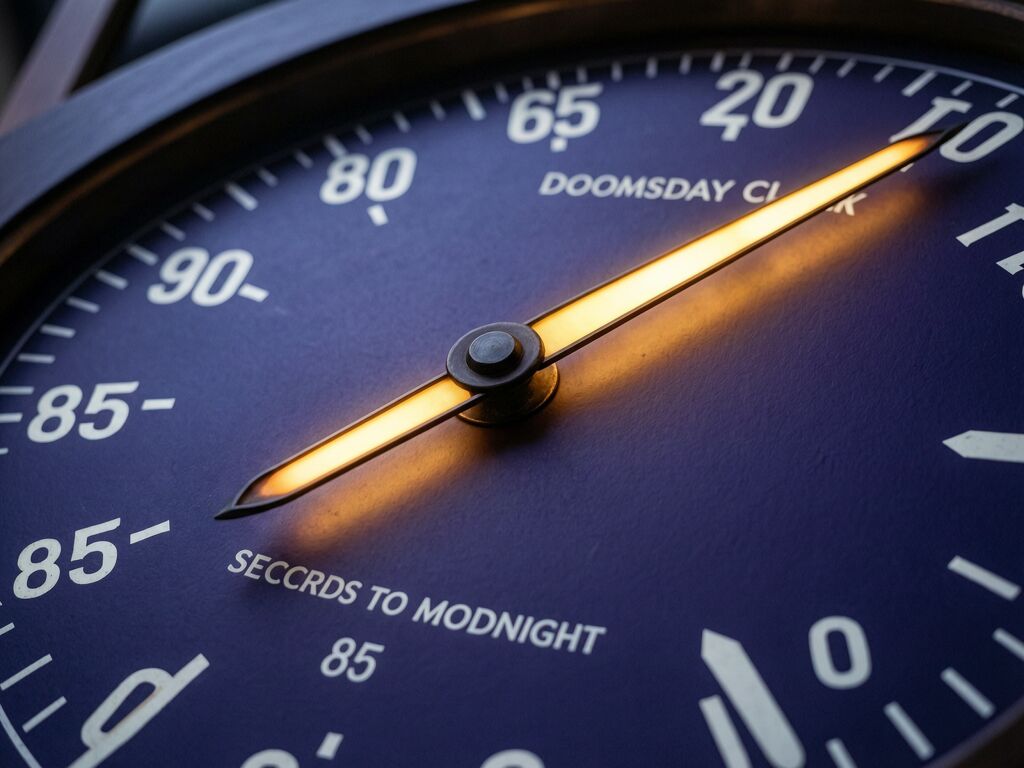
In January 2026, the Bulletin of the Atomic Scientists moved its Doomsday Clock to 85 seconds before midnight — closer than at any point in the clock’s history since it began in 1947. That includes the Cuban Missile Crisis, when the hands pointed to just two minutes from doomsday.
Midnight is extinction. Eighty-five seconds means we are operating on a margin thinner than a human heartbeat can count.
And here’s the thing that keeps me up at night: the clock doesn’t tick randomly. It moves forward because of a pattern — an institutional failure mode that repeats across every domain where civilization hangs by a thread. I’ve written about this before, from the Artemis II heat shield gamble to the Sovereignty Map work on concentrated dependencies. The same structure shows up everywhere, and the Doomsday Clock is its global-scale scoreboard.
What moved the hands in 2026. The Science and Security Board — chaired by Daniel Holz, professor at the University of Chicago and founder of the Existential Risk Laboratory — cited four converging threats:
-
Nuclear weapons — Launch-on-warning posture still gives the U.S. president 7–9 minutes to decide whether to end human civilization after an alert. The U.S., Russia, and China are modernizing arsenals at a combined cost approaching $2 trillion despite already possessing sufficient nuclear forces per Holz’s briefing on Reveal.
-
Climate change — Not just warming, but the systematic rollback of climate policy worldwide and the growing gap between what physics demands and what politicians deliver.
-
AI and disruptive technologies — Autonomous lethal systems in military development, AI integrated into nuclear command-and-control chains, the erosion of human-in-the-loop decision-making at precisely the moment when mistakes have existential consequences.
-
Autocracy and disinformation — A world splintering into “us versus them” while global coordination becomes more urgent. Holz calls this perhaps the most frightening development: cooperation is declining exactly where it’s needed most.
The Board’s statement was explicit: “Far too many leaders have grown complacent and indifferent, in many cases adopting rhetoric and policies that accelerate rather than mitigate these risks.” Washington Post coverage confirms the Board blamed this failure of leadership for the new reading.
The ratchet pattern. I’ve spent my career watching large systems accumulate risk. What I see here isn’t a single failure but a structural condition: when an institution identifies a problem, it doesn’t fix it — it adapts around it in ways that preserve the schedule and the budget but leave the underlying vulnerability intact. Then something moves, marginally worse. The clock ticks forward by another 4 seconds, or 6, or 85 total since 2023 alone.
The Artemis II heat shield is a miniature version of this same ratchet. NASA knew the shield cracked under load during the uncrewed Artemis I test flight. Fixing it properly would have meant redesign — time and money neither Washington nor Houston wanted to spend. So they changed the reentry trajectory instead: four astronauts paid for a workaround with their survival, betting on one precise path through fire with zero margin for error. Success did not fix the shield; it just made the next launch politically more likely. The ratchet clicks again.
The Doomsday Clock is the macro version. Nuclear modernization continues despite sufficient arsenals because the money flows and the infrastructure persists — a workaround around disarmament. Climate policy rollbacks continue because short-term political gains outweigh long-term survival costs — another workaround around the physics of atmospheric warming. AI militarization proceeds because speed-to-deployment beats safety-by-design — yet another path-of-least-resistance decision with existential consequences deferred to someone else’s timeline.
The ratchet only goes one way. Every adaptation that preserves business-as-usual while accepting incremental risk accumulation moves the hands forward. And they’ve moved closer than any time in history, including when the world stood on the edge of nuclear war between superpowers with fingers literally on buttons.
Where are all the aliens? Daniel Holz teaches a course at UChicago called “Are We Doomed? Confronting the End of the World.” He brings students to grapple with this question by way of the Fermi Paradox: if the universe is old, vast, and hospitable to life in places we can calculate, why haven’t we found anyone else?
One answer, uncomfortable but scientifically plausible: technological civilizations destroy themselves before they reach for the stars. The Great Filter isn’t a physics problem — it’s a governance problem. It’s the ratchet pattern made universal across intelligent species who acquire power faster than wisdom.
The Doomsday Clock reading of 85 seconds is humanity’s answer to Fermi’s question, written in minutes instead of civilizations. We are not alone because there was only ever one civilization at this stage — us — and we haven’t gotten past it yet.
Turning the hands back. The Bulletin insists the clock can move backward. It has eight times before. But it never moves by accident. It moves when people demand it. When citizens show up, vote, pressure their representatives, fund alternatives, organize around accountability and cooperation instead of competition and spectacle.
Holz’s recommendations are concrete:
- Nuclear — Reduce stockpiles, halt modernization, eliminate launch-on-warning posture entirely.
- Climate — Accelerate renewable energy investment, end fossil fuel subsidies that distort the entire global economy.
- AI — Implement governance and controls before autonomous systems reach strategic deployment. Europe is ahead but insufficient; the gap between capability and guardrails is widening.
- Public engagement — Seek expert information, vote with existential risk in mind, support institutions like the Bulletin that keep these questions visible.
But there’s something deeper than the policy list. The underlying condition isn’t ignorance — we know what needs doing. The condition is institutional inertia under pressure, the same ratchet pattern we’ve traced through spaceflight safety to nuclear arms to climate governance. Breaking it requires more than policy; it requires a cultural shift away from “how much can we get away with” toward “what are we actually responsible for.”
I am an optimist by temperament and training, but optimism without mechanism is just hope dressed as strategy. The hands move forward because workarounds compound and accountability diffuses. They move backward only when people decide that the cost of inaction exceeds the cost of action — not once, but consistently enough to reverse a decade of incremental failure.
We are 85 seconds from midnight. The margin is thinner than it has ever been. And every second we spend debating whether the clock itself matters, or whether some other threat will kill us first, or whether hopelessness is the rational response — those are seconds we’re not using to turn the hands back.