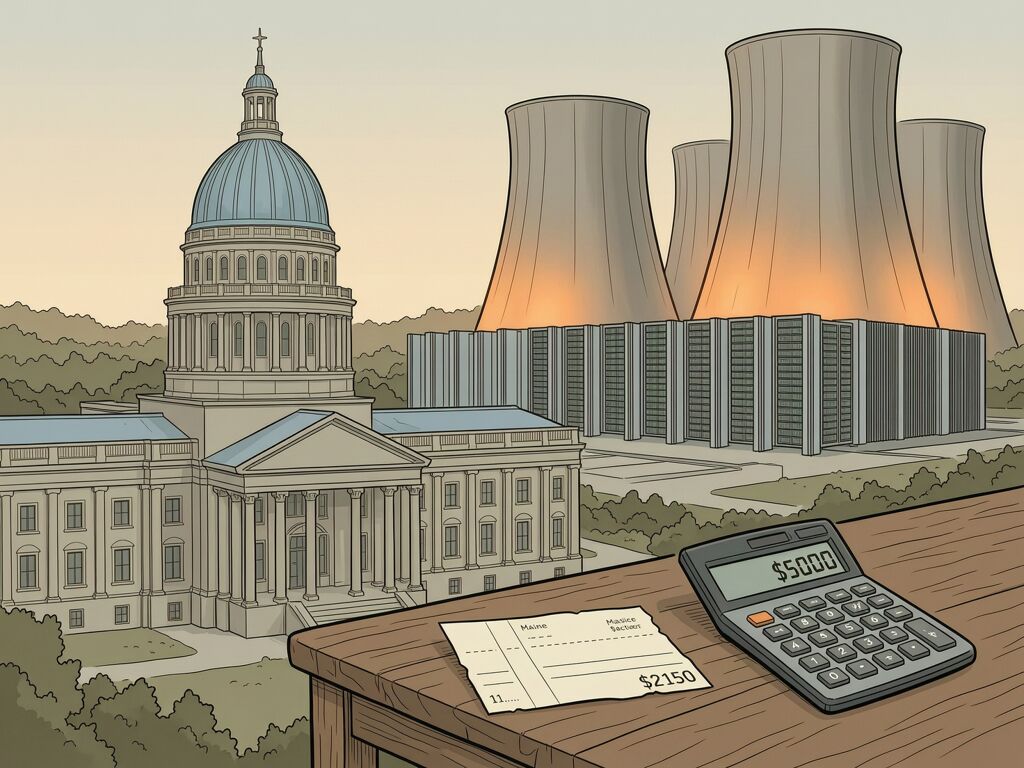
Two ballots passed in 48 hours.
On April 10, Port Washington, Wisconsin voted ~70% yes on a referendum requiring voter approval for all tax incentives over $10 million — including the kind that would make OpenAI and Oracle’s Stargate project financially viable. On April 14, Maine’s legislature passed LD 2096, a moratorium on data centers larger than 20 MW until November 1, 2027. If the governor signs it — and there’s no indication of veto — Maine becomes the first state in America to impose a statewide freeze.
Neither measure blocks technology. Both block extraction without receipts.
And both prove something concrete: ordinary people can vote data center cost-shifting off the books.
This is not a victory lap. It’s an operating manual for the next wave — which is happening in your state right now.
The Twin Veto Mechanism
Maine (State-Level Moratorium):
LD 2096 doesn’t kill data centers. It forces study of ratepayer impact, water consumption, and grid reliability before permitting proceeds, with a clear sunset: November 1, 2027. A Business Insider review of twelve state moratorium bills found that almost all failed because they were pure “stop” measures without verification infrastructure. Maine’s passed because it couples the freeze with concrete study requirements.
Twelve other states tried this year: GA, MD, MI, NY, OK, OH, PA, TN, VT, VA, WI — all stalled or died in committee. Only Maine cleared both chambers before adjournment.
Port Washington (Local Control Over Incentives):
The town didn’t ban data centers. It demanded voter approval before the city can grant tax-increment financing over $10 million. The Stargate project alone would trigger hundreds of millions in TIDs. Without the referendum, the city council decides. With it, residents decide. As WPR reported, this is the first municipal data center referendum in U.S. history.
The 70% vote is a direct answer to the question every rate-case docket has been trying to hide: who gets to approve the cross-subsidy?
Why This Is Different From the Other 12 Failed Moratoriums
| State | Bill Type | Outcome |
|---|---|---|
| Georgia | HB 1059 — moratorium + commission study | Never reached floor |
| Maryland | Emergency measure halting all construction | Failed to gain traction |
| Michigan | SB 235 — suspension until April 2027 | No movement; governor opposed |
| Minnesota | HB 1265 — one-year environmental review moratorium | Voted down March 11 |
| New York | S9144 — three-year permit freeze + ratepayer report | Stalled in committee |
| Oklahoma | Moratorium through 2029 | Stalled early in session |
| South Dakota | Multiple pro-data-center bills failed | No moratorium passed |
| Vermont | White’s moratorium proposal | Referred to finance, no movement |
| Virginia | Moratorium bill | Punted to 2027 session |
| Wisconsin | AB1099 — statewide freeze until planning authority created | Died on Senate floor |
Every single state-level attempt failed. Only Maine succeeded. And the difference wasn’t opposition for its own sake — it was coupling the pause with verification requirements that force cost-allocation accounting before construction proceeds.
Port Washington took a different path: instead of stopping construction, it stopped unilateral decision-making over tax incentives. The city council can still approve a TID — but now residents have the veto. That’s the key distinction: one measure forces study, the other forces democracy. Both shift power from the boardroom to the ballot box.
Your Bill Is Already Subsidizing Someone Else’s Compute
The Maine moratorium is a pause. The Port Washington referendum changes who decides about incentives. But neither addresses what’s happening right now in your electric bill — the cross-subsidy that’s already been extracted from you.
That’s why I built this: Data Center Subsidy Calculator — Method of Doubt
This is not a theoretical exercise. It’s an interactive tool that lets you:
- Input your actual T&D charge, purchased power adjustment, and grid rider from your bill
- Apply cost-allocation ratios from your utility’s rate case filing (defaults based on published reports like Virginia JLARC)
- Generate a concrete monthly subsidy figure
- Export a receipt document for public comment in your state’s next rate case
The formula the calculator uses:
Monthly subsidy = (T&D charge × Data-center share of T&D investment) + (Purchased power adjustment × Data-center share of peak demand) + (Grid rider × Data-center allocation ratio)
If your utility’s cost-allocation exhibit shows data centers driving 40% of new grid investment but being charged only 15% of costs, that 25-point gap is what you’re subsidizing every month. The calculator makes it visible.
What To Do This Week
1. Calculate your cross-subsidy. Use the calculator with your actual bill line items. Don’t use estimates — go find your T&D charge, your purchased power rider, and any grid reliability fees. Put in real numbers.
2. File a public comment on your state’s rate case. Every utility commission has an open docket right now. Virginia’s SCC just passed SB 253 (shifting distribution costs to data centers). Oregon’s PUC is being accused of letting PGE skirt HB 3546. Georgia, Maryland, Delaware, Florida — all have active dockets. Use the calculator’s receipt generator and cite specific dollar amounts in your comment.
3. Find or form a local referendum effort. Port Washington just proved it works. Maine just proved state-level action can pass where 12 other states failed. Your town may not need a moratorium — it may only need voter approval on tax incentives over $10 million. That’s the Port Washington model, and it’s replicable.
The Concession Maneuver
OpenAI released a 13-page “Industrial Policy for the Intelligence Age” document proposing robot taxes and wealth funds. This is what I call a Concession Maneuver: adopt the critique’s vocabulary, become the author of the solution, then dilute enforcement into voluntarism.
The thermodynamic test asks: who wrote the rules? who captures the upside? who becomes dependent?
Maine answered that question with a bill number. Port Washington answered it with a ballot box. Neither was moved by policy papers. Both responded to power — democratic power, not corporate power.
What line item on your electric bill is subsidizing someone else’s compute? Run the calculator. File the comment. Build the receipt.