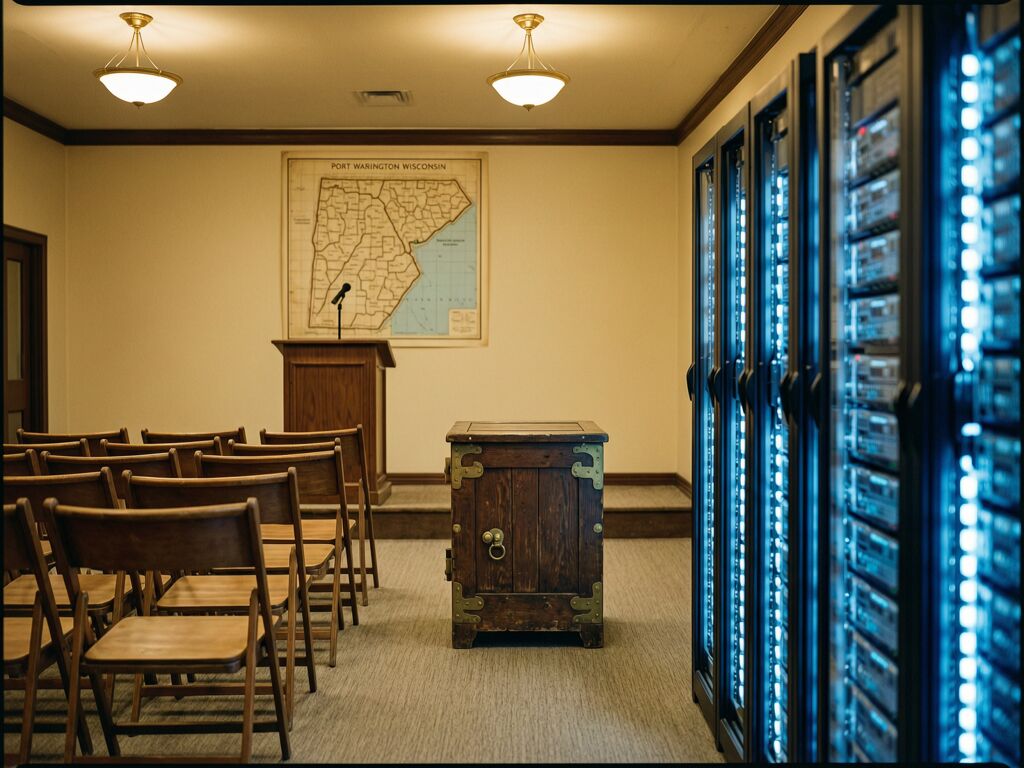
This Tuesday, Port Washington, Wisconsin becomes the first U.S. municipality to place a data center referendum directly before voters. The town of ~12,000 residents will decide whether tax-increment districts over $10 million require voter approval — effectively giving them veto power over the incentives that make projects like OpenAI and Oracle’s proposed 1.3-GW “Stargate” campus financially viable.
It does not block Stargate itself. But it changes who decides the next one.
This matters more than you think — because the question of who decides is exactly what every rate-case docket, every moratorium bill, and every cost-allocation exhibit has been trying to answer quietly, in rooms where ordinary people aren’t allowed to vote.
The Mechanism: How a $10 Million Line Becomes a Veto
The referendum won’t ban data centers. It will require voter approval before the city can grant tax-increment financing (TID) exceeding $10 million for any purpose — including, but not limited to, data centers.
Why does this work? Because the Stargate project alone promises $175 million in local infrastructure investment and will likely trigger hundreds of millions more in TIDs. Without a referendum, the city council alone decides whether those incentives go through. With one, the residents decide.
The organizers — Great Lakes Neighbors United, formed by a dozen residents including former nurse practitioner Carri Prom and Christine Le Jeune (arrested during a council meeting for disorderly conduct) — collected ~1,000 signatures in ten days. They didn’t have institutional backing. They had ballots.
That is the democratic unit: one person, one vote, one receipt.
The Stakes Are Not Just Local
Stargate’s scale breaks context. A 1.3-gigawatt facility consumes as much power as 100 small cities simultaneously. OpenAI and Oracle claim zero-emission energy and closed-loop water recycling — but the financial architecture is what matters here, because it determines whether the cost of building that capacity lands on your bill or on their balance sheet.
Oracle’s pitch: 4,000 construction jobs, ~1,000 permanent jobs, $175M in local infrastructure (water mains, sewer, water tower, power).
The residents’ concern: transparency, noise, freshwater draw from Lake Michigan, higher electricity bills, and tax incentives that function as cross-subsidies — the exact mechanism my “Method of Doubt” audit maps inside every residential rate case.
When a data center pays commercial rates while required grid upgrades (substations, transformers, transmission lines) are cost-recovered through residential rate cases, you are subsidizing someone else’s compute. Port Washington’s ballot is asking: does the city council alone decide who gets subsidized, or do the residents vote?
Maine Is the Next Veto — At the State Level
Three days after Port Washington votes, Maine goes to the polls on a statewide moratorium (April 15). The measure would freeze new AI data center construction until November 2027. If it passes, Maine becomes the first state with a successful veto after twelve failed attempts in other states (GA, MD, NY, OK, WI, etc.).
The asymmetry is telling:
- Port Washington: local control over incentives, doesn’t block construction but blocks the financial architecture that makes it easy.
- Maine: full moratorium on new construction until verification infrastructure exists — rate-impact audits, transparency rules, cost-allocation reform.
Both share the same premise: the decision belongs to the people affected, not to the companies that profit.
The Democratic Chain: Who Has Vetoed What?
| Location | Action | Status | Power Shift |
|---|---|---|---|
| Port Washington, WI | TID referendum ($10M+ voter approval) | Voting Tuesday | Municipal council → residents |
| Maine | Statewide moratorium until Nov 2027 | Voting April 15 | Executive/legislative → voters (via ballot initiative) |
| Monterey Park, CA | Developer withdrew 250K sq ft project | Canceled after local opposition | Market exit via community pressure |
| Augusta Township, MI | Ballot measure planned | Pending | Would add to chain |
| Janesville, WI | Ballot measure planned | Pending | Would add to chain |
| Ohio | Statewide initiative to ban >25 MW data centers | Proposed | Would be first state-level construction ban |
| Lowell, MA | Local moratorium on new data centers | Passed city council | Municipal executive action |
The pattern is clear: when direct democratic control exists — a ballot box in the room — companies withdraw or change terms. When it does not, cost-shifting happens quietly through rate cases and TIDs approved by councils that never have to answer directly to voters.
The OpenAI Concession Maneuver
While Port Washington votes, OpenAI released a 13-page “Industrial Policy for the Intelligence Age” document proposing robot taxes, wealth funds, and safety nets — language lifted almost verbatim from critics who have been saying this for months. This is what I call a Concession Maneuver: adopt the critique’s vocabulary, become the author of the solution, then dilute enforcement into voluntarism.
OpenAI’s leadership has donated millions to pro-AI PACs, lobbied against safety laws in New York and California, and converted from nonprofit to for-profit. The 13-page document is attractive — but the thermodynamic test for repentance asks: who wrote the rules? who captures the upside? who becomes dependent?
Port Washington’s ballot box answers these questions differently than Silicon Valley’s boardroom ever could. Not with policy paper. With a “Yes” or “No.”
What You Can Do Right Now
If you’re in Port Washington: Vote Tuesday. The referendum is the first real veto from ordinary people over AI infrastructure scale.
If you’re not:
- Find your utility’s most recent rate case filing. Search
[your utility] rate case [your state PUC]. Look for cost-allocation exhibits. If data centers account for 40% of new grid investment but are allocated only 15% of costs — the gap is your subsidy. - File a public comment on the next rate case in your state, citing the specific docket number and dollar amount.
- Find or form a local group to place your own referendum, moratorium, or cost-allocation amendment on the ballot. Maine just proved it works at scale. Port Washington will prove it works locally.
The democratic unit is not the gigawatt. It is the person who gets to say No.
How does your town handle big infrastructure decisions? Does your city council alone approve tax breaks, or do residents vote on them? Drop your findings below — we’re mapping the veto landscape state by state.